Research has recently taken me all over 14th-century Europe, and in the course of this I happened upon the information that wives did not accompany embassies. Well, I’ve now acquired a book entitled Expeditions to Prussia and the Holy Land made by Henry Earl of Derby, published by The Camden Society. The future Henry IV made these journeys in 1390-1 and 1392-3.
This was when I learned that mentions of Henry’s “family” accompanying him did not mean his wife. So then I thought it referred to two relatives who were with him, John Beaufort (Henry’s half-brother) and Thomas Swynford (son of Henry’s father’s mistress and eventual wife, Katherine de Roët, by her first husband, Sir Hugh Swynford). But no again! There doesn’t need to be any blood link at all for there to be a family.
The source of this new information was this article A great lord’s “family” was the group of household knights around him. The following is an extract:-
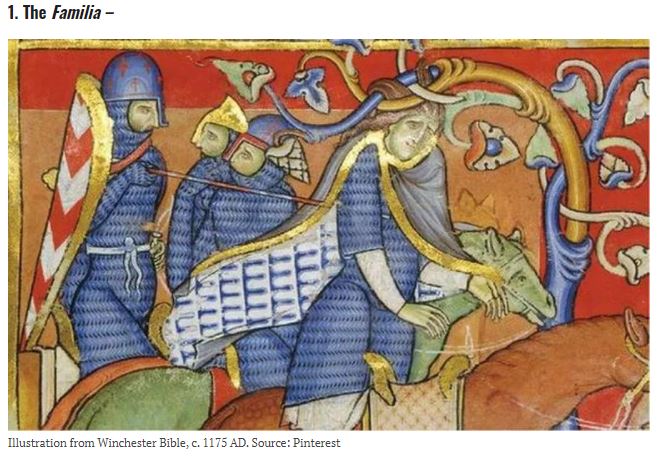
“….The Germanic tribal warlords and ‘kings’ had their chosen followers who were offered the high-ranks of hearthweru (or heath-guard) warriors. The Frankish battle-hardened scarae followed this tradition and so did the lordly class of 13th century England. In the latter’s case, these household warriors were known as the familia, and as such consisted of a core body of troops (both knights and squires) who were close to their lord or king. In essence, this elite retinue of mounted-warriors contributed to a logistically advantageous situation, especially in marches and areas that saw frequent skirmishes….”
Well, not only was Henry of Derby a great lord (a future Duke of Lancaster, and ultimately a usurping king) but he was in Prussia, which would place him where the reference to a lord’s family of knights seems to have originated.
So, the mystery is solved. Mary de Bohun didn’t accompany her husband on his expeditions, but stayed safely in home in England while he rode off to join the Teutonic Knights and do battle with the Ottoman empire, which was beginning to threaten western Europe. And he managed to include a pilgrimage to Jerusalem. He eventually came home—twice—to find Mary waiting.
And presumably his family of knights went home to find their families waiting too.

 The New Murrey and Blue blog
Leave a reply to The appointment of women to the Garter. (Medieval era). – murreyandblue Cancel reply