The Hertfordshire village of King’s Langley is “jam-packed with royal history”. Indeed it is, although the connection to Henry VIII (the article has a LARGE picture of him!) isn’t the point for those of us who think the Tudors had no business being on the throne.

“….The earliest known royal residence in Kings Langley was a hunting lodge which existed during the reign of Henry III (1216-1272). It was used to hunt deer, as at the time, a huge forest stretched from London to Berkhamsted….”

From being a mere hunting lodge it became a royal residence, and was finally regarded as the next best thing to a palace.

Many medieval royals had a soft spot for King’s Langley, and you can read of some of them at this site

And to read much more about “royal” King’s Langley, go here

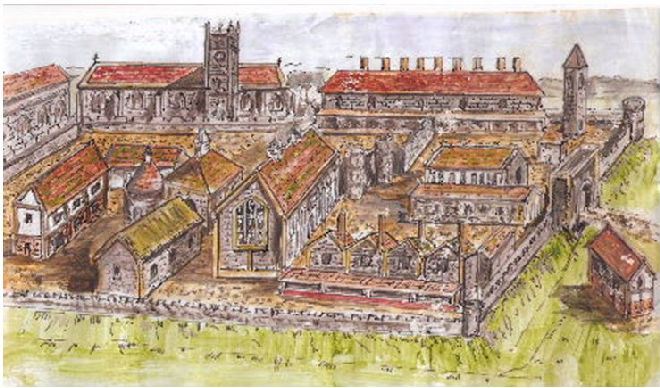
reconstruction of King’s Langley royal residence

Subscribe to my newsletter

  1. […] am unable to explain why King Richard ‘commanded’ his aunt to be buried at King’s Langley. She died in 1392, and he cannot yet have decided to have his new Westminster tomb built. It may be […]

    Like

  2. […] sort? He was an awful man, and nothing to brag about. Ask his wives, to three of whom he gifted King’s Langley. Short tenure, I […]

    Like

  3. […] King’s Langley was once home to a massive Plantagenet palace, built out of the remnants of a hunting lodge of Henry III for Edward I’s Queen, Eleanor of Castile. She furnished it lavishly, with carpets and baths. There were shields decorating the hall and a painted picture of four knights going to a tournament, while the expansive gardens were planted with vines. After her death, the palace was held by Edward Prince of Wales (later Edward II) who spent a fair bit of time there, as did some of his sisters. Edward founded a Dominican friary in memory of his mother in the northern parkland near the palace. He also built a huge cellar under the castle known as ‘Le Cave’ which was so large it was rumoured he stabled horses there. It was in this friary that Edward had his favourite, and possibly his lover, Piers Gaveston, buried two years after Gaveston’s murder. He had the remains wrapped in cloth of gold at an enormous cost, and held a huge feast with many notables invited–although some chose not to attend. […]

    Like

Leave a reply to A VISIT TO KING’S LANGLEY – murreyandblue Cancel reply