Helen Carr

Fourteenth-century England may not be everyone’s cup of tea, especially when the fifteenth century is more important for Ricardians, but the reign of Richard II is very much my interest. So I look forward to this new Helen Carr work.  Bring it on!

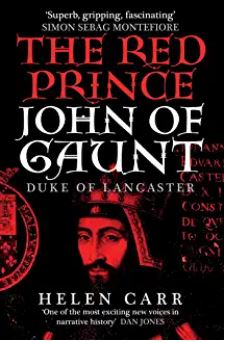
I’ve ordered Helen Carr’s biography of John of Gaunt, and hope to enjoy it, although as I’ve stated before Gaunt himself has never been a favourite of mine. But he is fascinating, and is up there in the top few when it comes to those figures who’ve had a huge effect upon our medieval history. If The Red Prince, John of Gaunt changes my opinion, I’ll be sure to tell you.

Subscribe to my newsletter

  1. Yes, I share your ambivalent attitude to J of G – I “blame” him for Margaret Beaufort because of him marrying Katherine Swynford. (Though come to that, if he hadn’t, RIII would never have been born!) And he’s been “rescued” in my eyes ironically, by Shakespeare, by that marvellous deathbed “Sceptred Isle” speech: “This precious stone set in the silver sea….This blessed plot, this earth, this realm, this England”.

    Liked by 2 people

    1. It has bothered me no end WHY Gaunt would have had his four adult bastards by Swynford legitimized when he had a healthy male heir who in turn had FOUR healthy MALE grandsons – how much more biological insurance for posterity did Gaunt want or expect from his heir?! Not to mention that the daughter, Joan, was already married with two children and had Gaunt had no difficulty finding a suitable husband for his bastard daughter!
      Had he left things as they were I DO think Ralph Neville, soon to be rewarded for supporting Henry of Bolingbroke overthrow his cousin, the king (ahem) becoming the first earl of Westmoreland, would still have married even a bastard daughter of Gaunt, and history be served, a dozen plus new Nevilles ensue (including Cecily). Royal bastards are just different, presumably. It has to be something else that triggered both Richard II to allow this legitimization – as well as whatever it cost Gaunt to pay off the Pope.
      The best I can come up with is Richard simply wanted to irk his cousin Bolingbroke by straddling him with half-siblings who would now compete with his own sons for the crown (which he most certainly had his eye on for a very long time, sorry but I see an obvious intention in Bolingbroke’s manner and attitude for a very long time, in the US we call it ‘itching for a fight’)
      And, for Gaunt the reason may have been he was desperatiely covering his bases, suspecting the worst of his nephew once he was gone, perhaps he saw Richard attainting Bolingbroke and believing he could disbar Henry’s whole line from the throne? I cannot imagine Richard would have done that, or could have, but things get iffy with royal claims, (ie. Henry of Richmond anyone?)
      If that was the case, could the Beauforts simply have been a fail safe plan that Gaunt ‘innocently’ thought would protect his heir? (Imagine THAT conversation with Bolingbroke!)
      I would not want to be the biographer of Gaunt, the copious contemporary material about him is severely negative, not slanderous decades and centuries after the fact. He may well have suffered from being in the shadow of his older brothers Edward and even Lionel but unlike many much younger sons of nobility and even kings, Gaunt was well set up with a fabulous heiress, a ready made fortune, and presumably happy marriage. Had Blanche lived at least as long as Queen Philippa, (if not his amazonian granddaughter Cecily duchess of York, who likely never would have been born!) then Gaunt’s story would have been different. What it would have meant for Richard II, without Beauforts to cudgel Bolingbroke over the head with, and without a pack of legalized Beauforts to cudgel England over the head with is the stuff of my too often conjectures. ,

      Liked by 1 person

      1. Nothing will ever convince me that Gaunt hadn’t always wanted the throne for his line—he certainly worked at getting Edward III to draw up that entail which excluded female lines from the succession. Thus he eliminated the Mortimers, because they descended through Lionel of Clarence’s daughter. I also believe Gaunt educated his awful son Bolingbroke.to follow in his footsteps. Bolingbroke always intended to make a move on the throne, and Richard II played into his hands with that second expedition to Ireland. What a time to choose! So I fear that the very names John of Gaunt and Henry of Bolingbroke start my teeth grinding! And I think Gaunt and Edward III were hypocrites of the highest order, because they both made claims on foreign thrones through women—Edward through his mother, Isabella of France, and Gaunt through his second wife, Constance of Castile. Bastards both. Figuratively speaking.

        Liked by 1 person

  2. The thing I dislike about Gaunt was his unmitigated greed. He was never satisfied. His son, Bolingbroke, had the same attitude. Yes, all nobles were greedy for more lands, but when you already have far more than anyone else it really is not a good look.

    Liked by 2 people

  3. BTW I have just received Kathryn Warmer’s book on Gaunt, which I was fortunate enough to win in a draw. It looks promising, but I will post on here when I have worked through it.

    Liked by 2 people

    1. I have this book on order! Can’t wait to read it.

      Like

  4. Viscountessw, We’re on the same page with Gaunt, a scheming, devious opportunist and with an eye popping income to live as if he were king. Both Gaunt and H4, at least from the long view, may have had some scholarly barbs thrown at them, but I think they’ve escaped the real accountability that they should have received (not unlike H7 thru Eliz I, I know, sacrilege) IF there is criticism it is always couched in trimming details, carefully provided context to ensure a reader’s empathy that is never provided elsewhere (I’ll just say it like that). It isn’t just Ian Mortimer who has written about E3 and H4 and perhaps allowed criticism in the form of ‘wow how rough is it to be king?!!!’ type examples, I keep hearing or reading that E3 is considered England’s “greatest king” (that alone to me is jaw dropping)
    H4 was hounded by rebellions, assassination attempts, persistent fear/paranoia of being overthrown (NOT unlike H7 and if not the assassination attempts it is only because H7 from the start had a police state up and running almost as soon as the dust settled at Bosworth, all of MB’s spies and agents, laughingly called her counselors, were a ready made unit in her son’s service, even the necromancer!) But this turbulence and ever present instability is just glossed over, even E4, if you really do a careful reading of Scofield you get the sense that Edward was never really ‘safe’ – partly from H6 still being alive, and then because in his second reign because of his own poor foreign policy decisions – read Scofield! (still my favorite source for Edward, she may have known NOTHING about Richard, and she didn’t beyond what Crowland wrote) but she knew how to assemble widespread available (usually official documents) resources into a cogent framework and her own often witty asides are refreshing, as is critical observations about Edward’s conduct – when no one else does so in the ‘scholarly’ community – oh if only there were a Scofield to do the same with Gaunt, H4, and of course, H7 and his fortunately brief dynasty of three infertile grandchildren!

    Liked by 1 person

  5. Those two wretched words, “if only”…. I’d sure change a few things in history if only I had the means….and that damned time machine! I’d need to be invisible, able to fly, and have an endless supply of wealth and influence. Oh, and I’d have to be a very talented witch. I’d whisper in sleeping ears, leave heaps of gold coins under the relevant pillows, and string trip wires in front of the necessary feet. I’d cast spells on various parliaments so they only did the right thing (heaven forfend!) Then I’d whistle up storms at sea. Oh, such fun! Bolingbroke would have sunk without trace in 1399, and so would Tudor in 1483. And I wouldn’t have let Buckingham survive to be executed, I’d have had him reach the swollen, raging Severn and promptly fall in. Yippee! There he goes! Margaret Beaufort would disappear mysteriously one dark, foggy Hallowe’en night before 1483, and the Stanleys would have been assassinated by their own men, who’d think they’d been cheated. Oh, those mysterious whispers in the night….

    I won’t go on, because it’s all too ridicuous. Heaven alone knows what our history would have been thanks to my invisible, anonymous mischief, but I’d have had a great time while it lasted.

    Liked by 1 person

  6. I’m too much of a revenge has to be now type, or perhaps I should say I want justice now. When lockdown descended on us over here (I’m in NJ) we went into full nobody left their house lockdown, seriously) and I thought, do it, you’ve thought about it, you’ve got all the research (or so I thought at the time) you could need, just do it. The project I began is to not rehabilitate Richard, he doesn’t need that from me or anyone else – but give a mightyy smackdown on these scholars and writers who are driving you nuts! Clarify just what the situation was in spring 1483 and eradicate in the process these entrenched myths and biases that have jammed up the works. I can’t read a darn thing without making corrections all over the margins, noting where the author is trimming, too busy excising pertinent even crucial data from the points raised and highlighting others so as t0 make some requisite number of targeted smears on Yorkists – or more likely on Richard – and always falling back on the irresponsible and intellectually lazy “child killer’ canard.
    The disservice that they do to the study of History, which is never settled, never any ONE thing, is incalculable, and a wretched insult to all of these people, from all sides, caught in a civil war, most of whom spent their entire lives IN a civil war. Not a couple months or years, but their entire lives, I’m in a country where 4 relatively short years of what we call The Civil War is still so wrought with anger, hatred, misunderstanding and pain, still mined by opportunists to make the most of the misery that cataclysmic event brought, and in a country today where likely 70% of the population has not one ancestor who lived in this country in the 1860’s yet ‘we’ are treated to its presence as if it happened yesterday SO imagine what life was like for Richard, and his peers, all of whom lived their entire lives on the edge of that axe blade of a civil war. It’s a perspective the comfy scholars in their tidy university departments (read ‘bubble’) have no appreciation for. It’s why I put aside (initially) their books and periodicals and concentrated on the world Richard and Edward and Louis Xi would have actually recognized, and that is where as a visual artist I realised to do this project I was woefully lacking in research – also why it’s probably NOT been done before!
    .
    The unhappy fact is “the Yorkist age was particularly sterile ground” for scholars and academics (JR Lander, writing in 1976) and even more so for anyone who needs to know just what Baynard’s castle looked like before H7 got his hands on it; what taverns/Inns/tenements/ street names were actually there in 1483, what was the fashionable footwear, headgear (even armor underwent a big change), what about the ships, the streets,paved? The Walbroke, which you just brought up a couple posts back, was possibly vaulted over, but possibly not in may places right around the area where the Cutlers and Skinners’ had their Halls, and pigs still roaming around, cleaning the streets? I found plenty for Richard II’s London – that is Chaucer’s London, and infinitely TOO MUCH for everything after 1500, it’s all that stuff for the middle, even H6 gets ignored,lumped into chapters for Chaucer’s England or the all purpose ‘Late medieval’ period (which makes me wonder what the Yorkists are, early Renaissance? nah, scholars and historians would never allow for that!)…so I went back to square one, to the books on gilds, wine and salt and fur merchants, shipwrights, maps maps maps, Messers Ekwall and Harben and all know each other better than I know my kids now, then I tackled the Burgundians, and lez francoys,

    And so it has been for the last 2 years, I’ve had to change, adjust, rethink my ‘position’ on virtually everything I’ve read in the traditional literature, I won’t use anything I haven’t looked at from10 different perspectives, good thing the drawing takes so long! haha

    I’m not doing this for rehabilitation for Richard, no, more like for the reputation of historians! Too many decided to what TOO many academics do, make it look good and do so very little with the staggering access to resources that they have been blessed with – if it alerts and influences a few people who still think Shakespeare was writing about the historical Richard that’s all good, the real Richard was infinitely more interesting, complex and burdened with the agonies of living in a civil war than any academician ever considered. And they never look at his world from any but the calcified perspective that was never accurate in the first place. What if Buckingham decided to just chill, let the money roll in for a few months, good grief, just be his normal layabout self for 8 more months… the so-called rebellion would have collapsed without him, without him even needing to life a fat finger, tho he would have enjoyed grabbing a few more attainted goodies, then in late April 1484 the heir dies. And with the Queen unlikely to have more children? WHO is the heir now? If Bucky had just sat back and stayed the bored nobleman of means, his wife was with child at the time, go ahead, enjoy the coming event, don’t sweat anything … within months he would have been not just cousin Richard’s best friend and supporter, but who else as his heir?

    Figuring out where and when Richard moved the two sons of Edward was not as difficult as historians make it sound AND I finally figured out WHY the plot to set fires as a distraction was such a staggeringly bad idea, one that required immediate and private execution …. but first, I had to find out about the Siege of London Tower for that, and coming fill circle, typical that it was by accident, a reference in a genealogical paragraph for Sir Thomas Browne … now why oh why isn’t that Siege the FIRST thing writers talk about with Richard and the plots of 1483?!

    Like

  7. […] back up this timing, in The Red Prince, her biography of Gaunt, Helen Carr states that Percy “….followed Gaunt across the Channel on 17 July 1373….” […]

    Like

  8. […] The Red Prince, Helen Carr has Holand faced with a fait accompli by the men. He certainly was not a ringleader of anything […]

    Like

Leave a reply to viscountessw Cancel reply