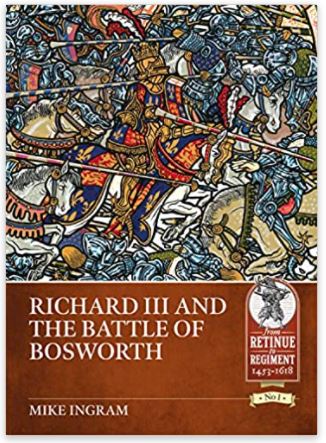
A review of Mike Ingram’s book on Richard III and the Battle of Bosworth….


I like to read a good review, and here is one  about Mike Ingram‘s book Richard III and the Battle of Bosworth. There is no point in reviewing the review, so I’ll just say that after reading this one you’ll know exactly what you’ll get if you purchase the book. No, it doesn’t contain “spoilers”, it just lays out the facts and lets you decide for yourself. I will now be purchasing the book for myself.

The book is available from Amazon.co.uk.

Since writing the above, I have learned that Mr Ingram has passed away. See comment below. This is very sad news. May he rest in peace, and may his work always be appreciated.


Subscribe to my newsletter

  1. Earlier this month (10 Dec 2021) I got an email from the Society that Mr Ingram had just passed, no details, just very sad all around. A devotee of Richard and the period itself his expertise on medieval military details was one I respected. Political commentary will always and should be an ongoing debate. Anne Sutton, as usual, said it best a few years ago when trying to untangle the vicious mess that was the Hungerford grant (and let’s not talk about the Countess Oxford!) when she wrote, “without curiosity about details, no real historical research is possible” – Mr Ingram always had scads of details that I myself not being inclined towards horsemanship, arms or artillery greatly appreciated. Very sorry to read of his passing, and do pick up his books ( he also has one of the Battle of Northampton, 1460) that might be considered a ‘specialist’ read, but then so is Bosworth, for anyone not intimately involved in Ricardian or WoTR studies.

    Liked by 3 people

  2. Thank you — I have just ordered this!

    Liked by 1 person

    1. I know my weaknesses and the military theatre is the big one. As we are missing so much of the primary documents for Richard the next tier out is the milieu in which he lived, and trust me massive amounts of that information survives! We may not know where he was at critical points in his short life (ex. when did he join and leave Warwick’s household; where was he late July thru early October 1469; where was he Oct thru Nov 1470, etc) but we can easily find who rented what shop on the Bridge (name a decade) and for how much and to whom or what ships brought in what goods to what port, quantities, name of ship captain and their career outline, we don’t know who Richard’s mistress(es) were but I can find the names of Black William Herbert earl of Pembroke’s (many) mistresses names, their children by him, (and those of his brother Sir Richard, AND his sons, one of whom had 17 named children, natural and legitimate!) we have Coroner rolls, Hustings, property leases, mountains of information about the Gilds and their apprentices, YOU name it, we can ferret out that material and of course, military matters.
      The Osprey line of guides is well known and yet I continue to find ones I didn’t know they publish, my latest is on the Medieval Cannon (1346-1494), right up Richard’s alley. Everytime I think I know ‘enough’ I find out something else that puts me back to square one, for example, just how many Burgundian troops did Richard have at Bosworth? That would mean handgunners, and artillery – a book I am looking to get hold of is Anne Curry and Glenn Foard’s 2013 quasi archaeological approach to Bosworth. Most recently I found The Burgundian Wars by Detlef Ollesch and Hagen Seehase, this was a awesome find, blew me away (97839963600142), yes, on the technical side but invaluable concerning Charles the Bold/Rash; wrote one of my rare Amazon reviews for that one! Along those lines was The Medieval Fighting Man: Costume and Equipment 800-1500 by Jens Hill and Jonas Freiberg (9781785000096), the daily reality of Richard as a military commander I think is too often overlooked due to the political squabbles that historians and writers engage in (possibly because they too know little about military tactics, strategy or operations).
      Richard was a soldier and engaged in war by necessity (to quote Prof. Patrick Parsons) not by choice or preference although I think his upbringing as a knight imbued with chivalry was meant to give it an honorable cast (something sorely missing in the Stanley brothers, and that is not me saying this, although I could! That comment too is from Prof. Parsons, from Univ. of Strathclyde).
      My latest obsession is the so-called Battle of Edgecote, July 1469, spurred by a book by Graham Evans, (2019, 9781794611078) – this virtually forgotten ambush then execution of the Herbert brothers devastated Edward IV’s entire strategy for the Borders and Wales (not to mention an incredibly politically astute and reliable ally in Pembroke) and it thrust a very young Richard (he just turned 17 that October of 1469) into holding the Borders and Wales for Edward until Pembroke’s heir reached majority (that in itself is another story but simplified the younger Herbert either was not inclined or had no such desire to follow in his father’s dominance by military means. As a consequence he lost favor with Edward in his last years and failed to adequately serve Richard III, or even his own territorial interests before or after Bosworth).
      I may want to concentrate on softer edges in the world Richard lived in the harsh truth is he spent his whole life in a civil war, and not just one fought amongst strangers, but family, extended and some very close to home.

      Liked by 3 people

  3. […] “rogue trader” reputation in several occupations, Thomas’ birth in the year of Bosworth, his wild youth and train of thought during his “apprenticeship”, showing the site of […]

    Liked by 1 person

  4. […] here. It includes some history of the Stanleys, showing how they reached the point they did at Bosworth. Boo-hiss to them, I say. But I do wish Jean Gidman well with her […]

    Like

  5. […] a knight of the body of Richard and according to old Cornish tradition he may have been present at Bosworth for Richard before making his escape after the battle to Cornwall (1).    Knighted by Edward on […]

    Like

  6. […] concerns the way Henry set about promoting (read ‘doctoring’) his image as soon as Bosworth was over and done with. Well, as over as it ever would be throughout his reign, because various […]

    Like

  7. […] achievement, despite his superior numbers. It could very well have proved to be his equivalent of Bosworth. However, it was a victory bought at the cost of many brave […]

    Like

  8. […] According to this article Heritage Britain there are apparently sixteen buildings/sites in Leicester that are at risk from disrepair or plain neglect. They include the church of St Mary de Castro: “….‘St Mary of the Castle’, this church once served Leicester Castle. King Henry VI was knighted there at the age of four, as was Richard, Duke of York, father to King Richard III. It is thought likely that Richard III would have worshipped at the church when visiting Leicester Castle, perhaps even before setting off to the Battle of Bosworth….” […]

    Like

  9. […] Yeomen of the Guard were created by Henry the Weasel after the battle of Bosworth. See […]

    Like

  10. […] Henry conquered Richard III (who was indeed the rightful King of England and was betrayed on the battlefield) and then stole the throne. Oh joy, now we have the House of Tudor. Come back Plantagenets, all is […]

    Like

  11. […] is amusing to perhaps imagine a medieval Battle of Bosworth on the ice, with perhaps a much-less-lucky (or turncoaty) Stanley’s head serving as a rather […]

    Like

  12. […] action starts on the night before Bosworth, with a bevy of ‘ghosts’ appearing to a troubled Richard as they do in […]

    Like

  13. […]  George duke of Clarence,  and the violent death of her youngest surviving son Richard III at Bosworth. But that is another […]

    Like

  14. […] In fact Richard was negotiating with the Portuguese for two royal marriages for himself and his eldest niece, Elizbeth of York, but fake news was put about that he intended to marry Elizabeth! How incestuous that would have been, and how unthinkable for a man like Richard. Yet he’s accused of seriously considering such a marriage. Even at the time he was forced to deny it in public. Deny what? An unpleasant rumour that had no basis whatsoever in fact. The Portuguese negotiations were still in progress when Richard was murdered at Bosworth. […]

    Like

  15. […] small nephews, betrayed, widowed, robbed of his only legitimate son and then brutally murdered at Bosworth heroically defending his throne. Yes, Richard III was definitely a tragic figure, and he claims our […]

    Like

  16. […] after the Buckingham rebellion but he did sit in judgement over two 1484 rebels. He fought at Bosworth and was reluctant to serve Henry “Tudor”, decining to serve in the latter’s first […]

    Like

  17. […] as a traitor by the new king. This certainly happened when Richard III was hacked to death at Bosworth and replaced by Henry VII, who promptly strove to date his reign from the day before the battle, so […]

    Like

  18. […] his 1502 biography of Henry VII, Bernard Andre (ca. 1450-1522) declines to describe the battle [of Bosworth], preferring to leave a blank page”. The reason Andre gives is that he wasn’t there, didn’t […]

    Like

  19. […] William Stanley crowning Henry Tudor with the fallen King Richard’s crown in the aftermath of the Battle of Bosworth.  Unknown […]

    Like

  20. […] isn’t a castle that comes easily to mind, even though a former occupant fought for Richard III at Bosworth. It’s in Nottinghamshire, dates to the 14th century, and was larger and more opulent than Haddon […]

    Like

  21. […] go on to  create  Thomas a Knight of the Garter.   However following the death of Richard at Bosworth in 1485 –  a battle at  which there is no indication Thomas was present  –   the accession […]

    Like

  22. […] rebellion and had to flee to a sanctuary. Pardoned, he nevertheless joined Henry Tudor at Bosworth and in time drew the rewards of victory, becoming firmly established in his sphere of […]

    Like

  23. […] return to this point later.   As an example the body of John Howard, Duke of Norfolk, slain at  Bosworth in 1485,  was laid to rest at Thetford Priory while the bodies of Richard Neville,  Earl of […]

    Like

  24. […] Richard’s death at Bosworth, Thornbury was given to Jasper Tudor.  Not that it was a castle then, because it was still a […]

    Like

  25. […] survived the Battle of Bosworth. The date of his death is not clear, but 5 April 1486 is claimed. Legend has it he was […]

    Like

  26. […] about twenty-five years without a head, but nobody noticed, even when he fathered three children.3) Bosworth is actually very close to York, not Leicester.4) His head was taken to York on the day of the […]

    Like

  27. […] Derwydd Manor is in the far southwest of Wales, so Henry Tudor was there not long after landing with his French force, which included some Lancastrian traitors. The above article states “….It is thought that Sir Rhys and Derwydd Mansion provided accommodation for Henry Tudor, as well as 5,000 Welsh soldiers added to Henry’s growing army, as he travelled to Bosworth….” […]

    Like

  28. […] and the first two describe Richard’s reign and the “Tudor” invasions leading to Bosworth, after which Buc’s great-grandfather was beheaded. There are many Latin quotations and much […]

    Like

  29. […] Hitchens, again like Grant, comes down in favour of Richard and his “just and largely happy reign”. Oh, if only Richard had been on the throne infinitely longer than fate dictated. If only the Weasel had been crushed at Bosworth. […]

    Like

  30. […] usurper, didn’t hang around long for his coronation either. Richard III was murdered at Bosworth on 22 August 1485, and Henry was crowned and anointed, his scrawny….er, bony backside plonked […]

    Like

  31. […] it was ten years after Bosworth, when the Yorkist pretender Perkin Warbeck was causing Henry many sleepless nights, that the first […]

    Like

  32. […] He had to speak to Elizabeth, whose House he had dashed aside finally at Bosworth. Well, not finally, for there had been that business at Stoke Field, and now there […]

    Like

  33. […] invaded with a foreign army and confronted Richard at Bosworth Field. Well, Henry’s army confronted Richard while Henry himself was careful to keep back behind […]

    Like

  34. […] met his fate on the battlefield at Redemore (Bosworth) on Monday 22nd August 1485, and Henry Tudor took the throne. Elizabeth Woodville may have been […]

    Like

  35. […] spring (2025) will see the launching of another attraction set around the Battle of Bosworth and the fate of our favourite king, Richard III. It is to be called […]

    Like

  36. […] and a Territorial Army officer, covering battlefields from centuries of conflicts. Series 2 covered Bosworth quite well, although it described “Tudor” as a “Lancastrian claimant” ready […]

    Like

  37. […] that John de Vere, 13th Earl of Oxford (who was born today, 8 September 1442), had been pivotal at Bosworth and had been rewarded handsomely by the grateful Henry VII. Gifts were lavished upon the earl who […]

    Like

Leave a reply to A cowardly man who feared being without personal guards…. – murreyandblue Cancel reply