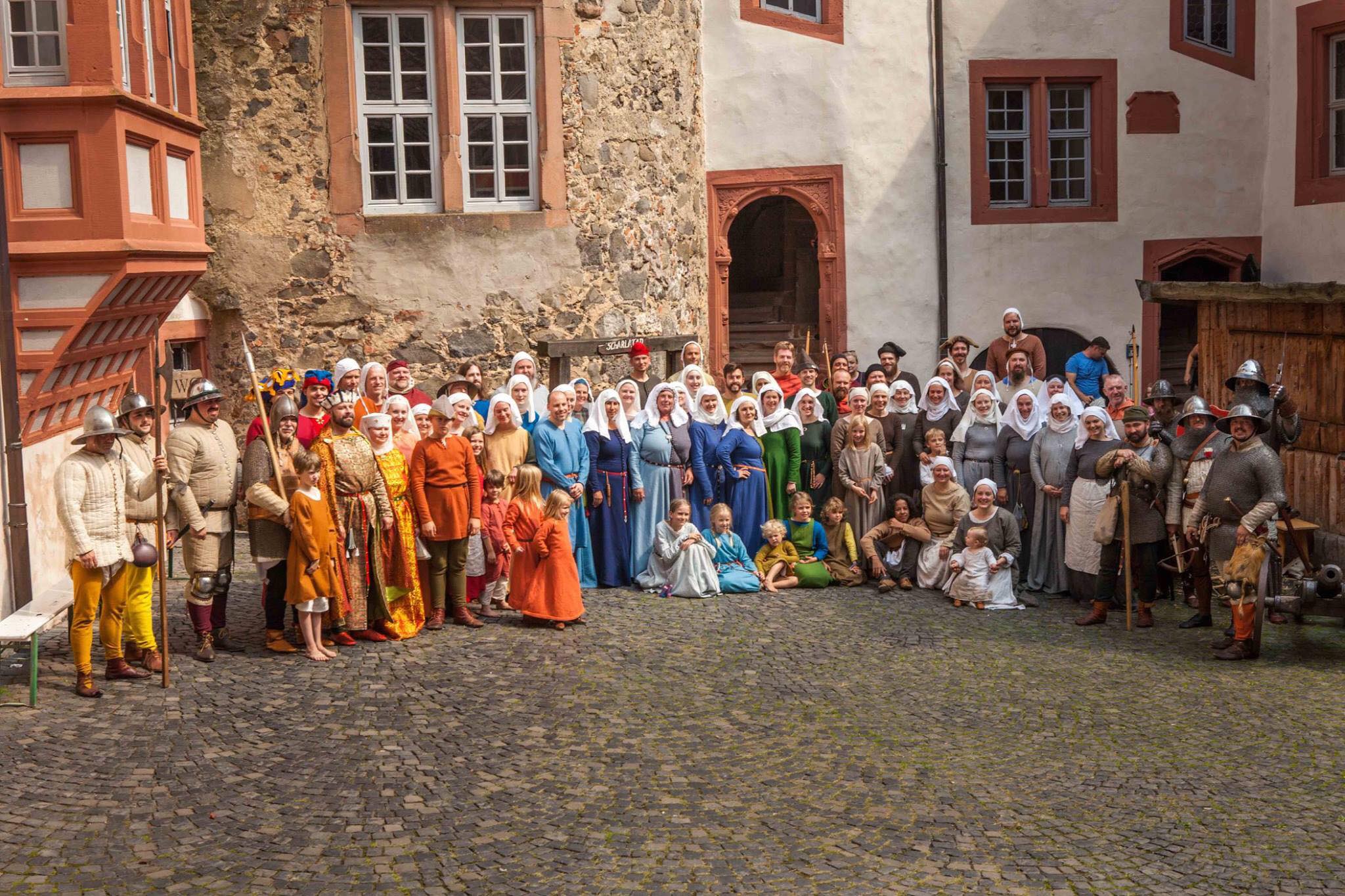
While going through some of my old medieval research, I came upon a list that has given me pause to reconsider some of my descriptions of materials used for clothing. The list was in a paper read on 6th April 1911: XXII—A Wardrobe Account of 16-17 Richard II, 1393-4, by W. Paley-Baildon, Esquire., F.S.A.
“….MATERIALS.
Both in material and colour Richard’s tailors had a large variety to choose from:-
Cloth of gold was red, white, blue and black.
Velvet was white, green, blue, black and red.
Silk was green and white.
Satin was white only.
Cloth was black, scarlet, white, green, violet, sanguine, and blue.
Tartarin was black, green and white.
Cloth of damask was black and green.
Taffeta was green only.
Buckram was black only.
Frieze was sanguine and green.
Ray, a striped material, is generally described by reference to its ground, which was sanguine, green, russet, powdered.
Fustian was white only.
Other materials were Brabant cloth, Kendal cloth, brown russet, blanket, blanket cloth, ‘soupedevyn’, ‘red faldyng’, ‘black streit’, black kersey, linen cloth of ‘reynes’ and ‘westfall’.
The prices vary in a most remarkable way, showing a large range of qualities. The price of cloth of gold is not given; perhaps it was not sold by the yard. Red velvet cost 13s 4d the yard, and the best scarlet cloth 12s; sanguine cloth 10s 6d, white velvet 8s, white satin 6s 9d. Linen and Brabant cloth were sold by the ell; silk was sold by the ounce, and thread by the pound. The lady who sold silk is called the ‘silk-wife’, corresponding to the more familiar ale-wife and fish-wife,
The furs, used largely for trimming, were ermine, minever, bys, budget, gray, cristy gray and calabre. Bys was the most expensive, costing 18s; the ‘furrure’, cristy-grays were 8s 4d each, budgets 4s each, lamb skins 1s 10d, ermines and minevers 14d each; while backs of fine gray were only 2½d each…..”
That’s the end of the extract, and now it’s viscountessw “talking” again. I confess to being somewhat puzzled. For instance, was satin really only white? And silk only green or white? Yes, I know that these were Richard II‘s personal/livery colours, but the list seems to suggest they were the only colours available in certain materials.
As an author, have I been wildly incorrect by mentioning anyone wearing, say, blue satin? Oh, and it seems that sanguine doesn’t mean the colour of blood, as might be thought. No, it refers to the veins in which the blood flows. So look at the inside of your wrist—those silvery blue veins must be sanguine. So I’m informed, anyway. And there’s no mention at all of pink…yet what else could you call the robe of the blue-hatted gentleman (with the white shoulder collar) immediately left of centre in the illustration below? By the way, I’d love to know what the man in black is whispering to him. Call me nosy.
These questions mean I cannot be absolutely certain how to read the above list, but it’s highly interesting all the same, and presumably reliable for Richard’s court if none other. I certainly look anew at illustrations like the one below, from Les Très Riches Heures du Duc de Berry.

To learn a little about how various colours were achieved, go to this website from which the top illustration has been taken.


 The New Murrey and Blue blog
Leave a reply to catchlight Cancel reply