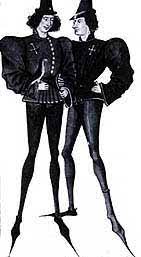
15th C fashion could be quite dramatic…and sometimes, to our modern eyes, a bit ridiculous. Nothing more so than the infamous Poulaine shoes, with their excessively long pointed toes that looked as if they were dangerous to walk in (the nearest we had to them in modern times were the Winklepicker shoes worn by Teddy Boys in the 50’s) Even the medieval clergy loved them, although they were not supposed to wear them. The length of Poulaines grew so outrageously long amongst fashionable young men that Edward IV finally was forced to put a ban on the length of the toe, limiting it to a mere two inches. I guess one could not have servants and lords tripping all over each other’s extended toes at table or in the council chamber!
Recently at Cambridge, archaeologists have examined the feet of some medieval male skeletons and noticed something vastly different in the feet of those prior to the 13th. Only a few of these skeletons had…bunions.
However, as shoes became progressively longer-toed, leading to the excesses of the 15thc, so too did damage to the foot become more common and apparent. This was most visible in the remains of older men. 27% of the skeletons excavated in Cambridge from the 14/15th centuries had a bunion, over 4 times as many as in the 1100-1200’s.
Bunions are formed by some bones moving out of place in your foot. This makes your big toe lean towards your smaller toes and causes a bump to stick out at an angle. It can be quite painful. Tight, narrow ill-fitting shoes are a big cause…but bunions can also appear through heredity, foot shape and arthritis.
It seems that the sufferers found in the medieval graves in Cambridge had also been more prone to falling over and injuring themselves–a number were found with healed fractures.
Ah, what we do for fashion!
Medieval Bunions in Cambridge:
https://www.bbc.co.uk/news/uk-england-cambridgeshire-57427365
Medieval Winklepickers
https://www.ancient-origins.net/news-history-archaeology/winklepickers-0015435:
Genuine Medieval Poulaine


 The New Murrey and Blue blog
Leave a comment