This year is the 550th anniversary of the Battle of Tewkesbury, and—justifiably—Gloucester wants a piece of the celebratory action. After all, Gloucester did contribute a lot to the outcome, by ensuring Margaret and her forces were obliged to take a stand in a place they wouldn’t have chosen. The queen wanted to pass through the city and cross the dangerous Severn by the bridge to the Welsh side, but Gloucester had closed its gates, forcing Margaret to continue northward on the English side of the river, because Edward IV’s army was bearing down on them at a rate of knots. For the same reason, with Edward at their heels, they got no further than Tewkesbury before a confrontation was their only option.

But today I’m writing about Gloucester’s role. I’ve said before that on Alney Island there is a commemorative woodland at the nature park
Alney Island is to the west of the city where the Severn divides for a while and then unites again, forming the island. The woodland is named Richard’s Wood, and is in honour of King Richard III, who granted the city its charter. (When you get to the link to the video below, don’t listen to Mr. Andrew Armstrong, City Archaeologist for Gloucester City Council, who believes Richard’s only reason for this was to grovel for favour because he was so wretchedly unpopular for stealing the throne, killing his nephews and so on. Such nonsense.)
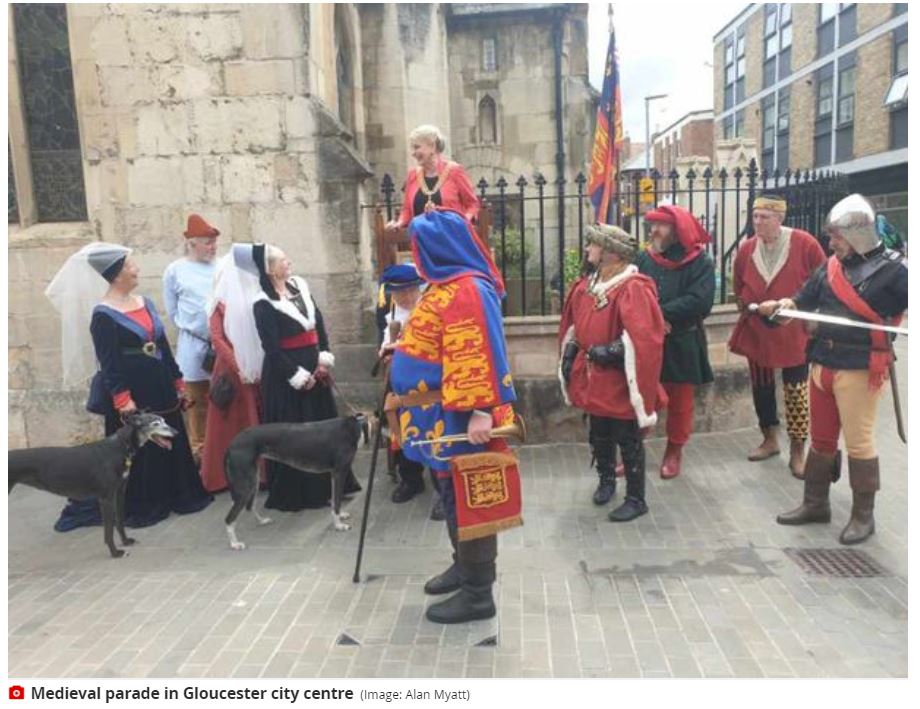
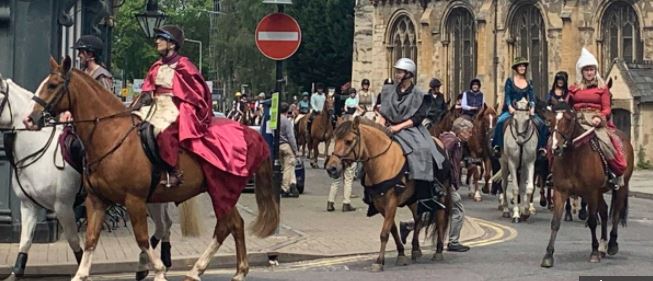
Gloucester’s part in events of 1471 was also celebrated by a mounted procession through the city centre, with everyone in medieval costume. You can see it here Unfortunately it wasn’t advertised, so there weren’t many people to watch it pass by, social distancing or not. By the illustrations above, it was clearly well worth observing!

Now we come to Mr Armstrong, whose video places him firmly on the Lancastrian side. He finds it “understandable” that Henry VI went after the Duke of York, who was doing what Lords Protector are supposed to do. He speaks of “poor 13-year-old Edward of Westminster” being executed after Tewkesbury. Then he states that Clarence was drowned in that old Butt of Malmsey. Oh dear. After that he pronounces Richard to have been an evil usurper who was responsible for the deaths of his dear little nephews and had no right whatsoever to the throne, blah-diddy-blah-diddy-blah. Oh, and Henry Tudor WAS the Lancastrian heir. Um, really?
I won’t insult you by drawing further attention to the numerous bloopers in the narration, but if you can ignore all that, it’s interesting about Gloucester itself, the city walls, defence and so on.
I rather fancy Mr Armstrong’s pips squeaked loudly when he related that Gloucester closed its gates (willingly enough) against Margaret of Anjou, whose forces then lost the ensuing battle.
So Gloucester did indeed contribute handsomely to the victory at Tewkesbury, whether or not the City Archaeologist for Gloucester City Council likes it. 😊


 The New Murrey and Blue blog
Leave a reply to Anne Ayres Cancel reply