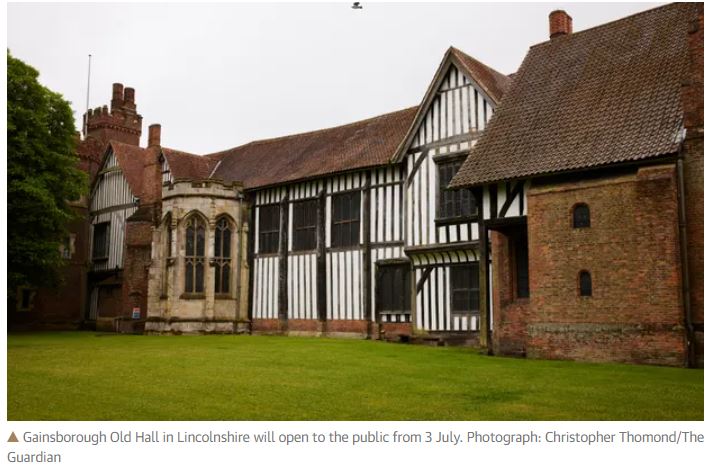
Well, if Richard III was entertained there, Gainsborough Old Hall can’t have always been Tudor! This article even says as much in a heading: “….Lincolnshire house, built in 1460, has been a theatre, preaching house, pub and masonic temple….” Excuse me, but 1460 was Plantagenet, not Tudor. Maybe it’s a Guardian error. (Perish the thought.)

The article then goes on to say:

….The hall was built in 1460 for Sir Thomas Burgh, a political climber and survivor who wanted a spectacular family home that would reflect his status.

“….All that he created is more or less still there, a Tudor relic almost hiding in plain sight in the middle of the Lincolnshire market town….”

So, a Tudor relic from 1460. Check your dates, Guardian.

The fact is that anything half-timbered is labelled Tudor, when in fact such buildings and styles had been around for a long time before HVII’s family left the homestead in Anglesey to mix with the nobs and become a plague upon England. Henry VII must have at least one fan, I suppose, but I’ll bet that fan likes to refer to him as Renaissance. Oh no. Henry was medieval, pure and simple. Well, maybe not pure…. And the Renaissance is welcome to Henry VIII, et al.

Why can’t Tudorists accept that most things accorded to the Tudors actually began under the Plantagenets. Night didn’t suddenly descend at Bosworth on 22nd August 1485, and a glorious new dawn commence, with a dazzling shaft of sunlight beaming down frm the heavens to illuminate cherubic Henry Tudor. Richard III was fast becoming a Renaissance monarch when he was sliced down that awful day at Bosworth, murdered by Tudor’s henchmen in an act of treachery that left even Henry Tudor himself jittery ever afterward. If they could do it once, well, they could do it again. Serves him right.

Anyway, I digress from beautiful Gainsborough Old Hall, which has returned to the English Heritage fold and will reopen on Saturday, 3rd July. This magnificent 15th-century house is well worth a visit.


Subscribe to my newsletter

  1. Thank You so much for a very interesting read, funny though, I was just reading about Catherine Parr and a man named Burgh was also mentioned. I honestly didn’t even know that this beautiful and very important historical building existed. I only hope that the statue and history hating brigade don’t get anywhere near it. You know what they’re like, anything built before the year 2000 and it’s racist, the most used word ever invented, since the creation of the written word.

    Liked by 1 person

  2. You’re absolutely correct, as a newspaper article or whatever, then, they should get it right. As for myself, I’m allowed a few mistakes, I’m getting on in years and at a push, an amateur historian. Medieval history can’t be beaten, it’s just all so interesting, fascinating.

    Liked by 1 person

  3. I agree! As for being allowed to make a few mistakes…I’m no spring chicken either and have to grin and bear it if I make a mistake. Not that it happens, of course. 🙄

    Liked by 1 person

  4. […] Sir Thomas Burgh was the builder  of Gainsborough Hall, as seen today,  after inheriting the original building in 1455 on the death of his mother Elizabeth Percy,  when he was 24 years old.  The building and enhancement, which took place over the course of  20 years, was enabled by  Thomas becoming a very wealthy man ‘through the force of his personality,  sage advice (he was counsellor to three monarchs),  administrative and business acumen and skill in serving four kings in turn – Lancastrian, Yorkist and Tudor to become the leading magnet in the country (1)   Thomas clearly was one of those adept and charming characters who can both run with the hounds and play with the foxes being awarded lands by Henry VI but later to become and remain one of Edward IV’s favourites. He was appointed Constable of Lincoln and Bolingbroke castles in 1461 – both traditionally Lancastrian prizes –  made an esquire of the king’s body on 2 April 1461 four days after the battle of Towton,  which meant of course he would wait personally on the king in his private chambers,  knighted by February 1463, and was  Master of the Kings Horse by February 1464.    He consolidated the authority of the new dynasty in and around Lincolnshire as Hastings and Herbert where doing in the Midlands and Wales and was similarly rewarded as they were with lands and offices (2). But in those turbulent  times trouble was never far away, and Thomas’ rise and rise had caused resentment, jealousy and anger – then as now one man’s gain could well be another man’s loss.    In late 1469 trouble was brewing in Lincolnshire and this instability was exploited by members of the Welles family led by Richard, Lord Welles,  his son Robert and his brothers-in-law,   Sir Thomas de la Launde  and Sir Thomas Dymmock,  who to settle a private feud went full tonto when they attacked and sacked the Hall.   The Warkworth Chronicle reported ‘the Lorde Willowby,  the Lorde Welles his son,  Thomas Delalond  knyght, and Sere Thomas Dymmoke knyght,  the Kynges  Champyon,  droff oute of Lyncolneschyre  Sere Thomas à Burghe,  a knyght  of the Kynges howse and pullede downe his place and toke all his goodes and cataylle that thei myght find’ (3).  Warkworth may have over egged the pudding slightly with the remark ‘pullede downe his place’ -as pointed out by Nicholas Bennett  – as much of the surviving structure of the Hall predates 1469.  However Emery points out that while it’s possible parts of the Hall were unaffected by the attack  the west range was indeed so damaged that it had to be rebuilt in 1479 (4). Certainly the attack and sacking  must have been extremely violent and a horrendous experience for the inhabitants resulting in Thomas and his family fleeing to Yorkshire. This  volatile situation escalated eventually culminating in  an enraged and galvanised Edward IV marching on Lincolnshire to quell what had now become a full blown rebellion at the Battle of Empingham  – also known as Losecoat Field – near Stamford on the 12th March 1470.  I have only touched lightly here upon the rather confusing toing and froing that took place in the weeks which led to Empingham but for those who would like to delve deeper I can recommend reading The Road to Losecoat Field: The Story of the First Lincolnshire Rebellion by Nicolas Bennett. After the rebellion – which later became known as the First Lincolnshire Rising –  had been crushed and Lord Welles executed, Thomas’ wealth was enhanced by the reversion of the lands forfeited by the executed lord.   Thomas’ powers would be  eclipsed for a while with the readeption of Henry VI until Edward’s triumphant return to the throne in 1471.  When Edward died rather suddenly in 1483 and Richard III became king Thomas was able to seamlessly and successfully transfer himself to the new king’s household retaining all his old offices.  On October 10th 1483 Richard III would spend the night at the Hall on his way to London from York.  That night Richard dictated a letter to a John Crackenthorppe, Receyvor,  instructing him to pay Humphrey Metcalfe, a servant, ‘for thexpenses of oure housholde at oure Castelle of Carlile the somme of fyve hundreth markes’ signing off with Yevene etc at Gaynesburghe the xth day of Octobre the furst yere of oure Reigne (5).  Richard would go on to  create  Thomas a Knight of the Garter.   However following the death of Richard at Bosworth in 1485 –  a battle at  which there is no indication Thomas was present  –   the accession of Henry Tudor brought about the loss of his gains from Richard as well as several of his Lincolnshire offices.  Nevertheless he did manage to maintain his position of royal councillor – no doubt Henry recognised his skills and wisdom – and in 1487 he received a personal summons to parliament.  Rosemary Horrox wrote there is no evidence he took his seat in the Lords and in his will he described himself simply as ‘Thomas Burgh knight‘ (6).  […]

    Like

Leave a reply to artwork368 Cancel reply