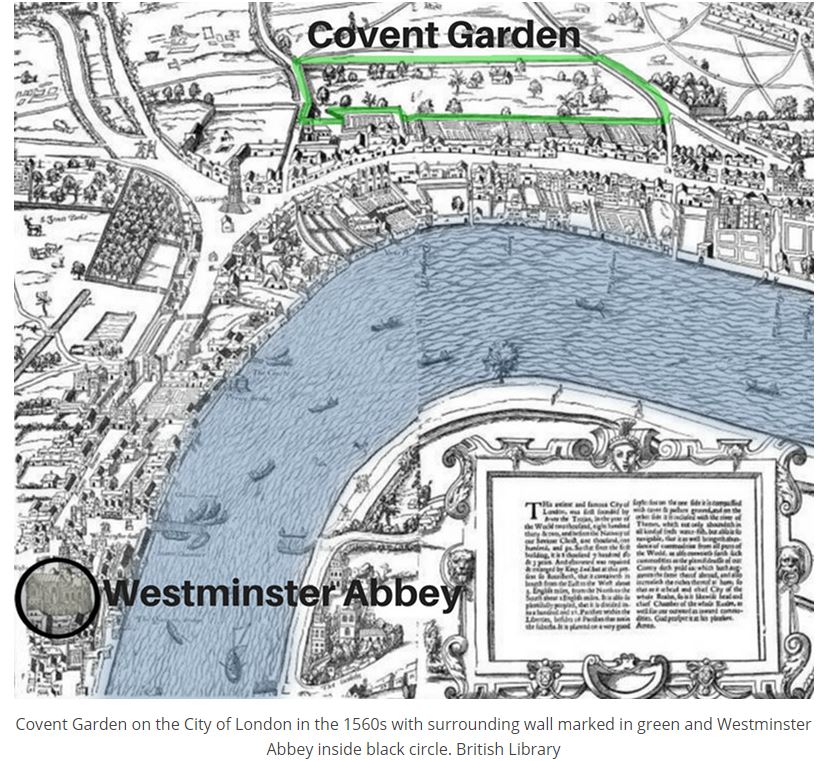
If you go to this site, you’ll find the following:
“Covent Garden” is essentially a corruption of “Convent Garden” using the French couvent derivation as opposed to the Latin conventus….
“….Couvent means a religious building such as a nunnery or monastery….
“….By the 13th century, most of the present Covent Garden area was land belonging to Westminster Abbey which included a walled vegetable garden tended by the monks….“
Then, at this other site, you’ll read that:
“….Henry VIII….swapped property with the Abbey – to the Abbey’s disadvantage. In return for the lands of the Priory of Hurley, which he dissolved in l536 and which was already a daughter-house of Westminster, the king received Covent (Convent) Garden (the monks’ vegetable garden), Hyde Park and a good deal of property in Westminster….”
So, if Westminster Abbey itself confirms this about the name, who am I to query it? And it’s actually so obvious that the present name came about this way that I can hardly believe I didn’t realise it from the outset. But I’m still learning something new every day, and this is clearly my ration for today.
To be absolutely certain about Covent/Convent, go to this page.
Later: And lo! What should now happen but that I resort to Anglo-Norman Letters and Petitions, by the Anglo-Norman Text Society on an entirely unrelated search? There, by pure chance, I came upon a letter (No. 18) from Richard II to the Abbot and Chapter of Sherborne in Dorset, which ends: De par le Roy a les abbé et covent de Shireburne. Not Westminster, I know, but still the covent spelling meaning convent. The modern French is, of course, couvent, as explained above.


Leave a comment