
I confess that I had never before seen a drawing, painting, engraving, whatever that depicted the Old Palace of Sheen as it was before Henry VII went to work on demolishing it and turning it into Richmond Palace. Sorry, but the present Richmond is a red-brick monstrosity in my opinion. I’m not saying the original Sheen was exactly beautiful, but it would have been easier on my eyes, that’s for sure.
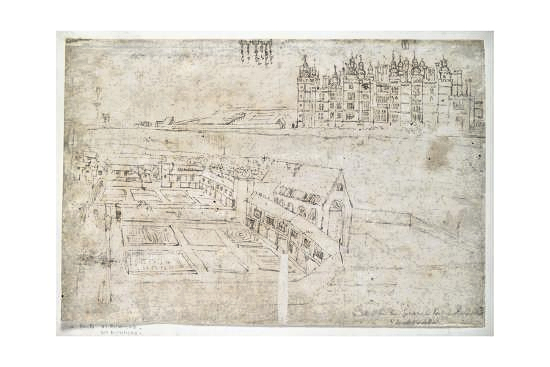
Anyway, I digress. I had just taken delivery of a biography of the 14th-century architect Henry Yevele (by John H Harvey) and took a dip through it, as most of us probably do before actually reading a new non-fiction book. On this occasion I came upon the above illustration, which I had never seen before, and which, according to its caption is of the Old Palace before being demolished in 1562.
So this is the second version of the palace. The first was destroyed by Richard II in 1394, when his much-loved queen, Anne of Bohemia, died there suddenly at the age of only twenty-seven. The next was built by Henry V, as see in this link https://www.geni.com/pro…/Shene-Manor-Surrey-England/26486, where I found the following:-
“….Henry V began the building of a new Palace in 1414, but this was not finally completed until the 1440’s in the reign of Henry VI. This second palace was extensively damaged by fire in December 1497 when Henry VII and his court had come to Shene for the Christmas season….
“….Henry VII, patron of the Renaissance arts, resolved to rebuild the Palace and in 1501 changed its name from Shene to Richmond after his earldom in Yorkshire. Occupying in its heyday an area of about 20 acres, the Palace extended from the Green to the river, and from approximately the line of the present Old Palace Lane to Water Lane. It assumed the appearance accurately recorded by Wyngaerde in 1561-2….”
So, presumably, the remains of Richard II’s palace hadn’t been repaired or rebuilt between his reign and that of Henry V? And from the latter’s completion in the 1440s it only survived until the fire in December 1497 that very nearly singed Henry VII for good and all! Pity, because England suffered another decade or so of the old misery . . . sorry, ‘the patron of the Renaissance arts’. (Argh! No one else had any idea of developments in art, of course! 😠)
Anyway, it seems that the above illustration is one of only two verified depictions of the second palace, which is the one Richard III would have known. How do I know this? Because in the list of illustrations in the Yevele book there is an explanation of the drawing, as follows:
“ . . . . Figure 25 is a sketch by Antony van den Wyngaerde in Bodleian MS Sutherland 171, f.11. It is dated 1562, while another view apparently made at nearly the same time shows the site of the ruined hall cleared.* This sketch, and a smaller copy in Wyngaerde’s finished view of Richmond Palace from the waterside (Sutherland 171 f.12) are the only authorities for any part of the pre-Tudor Palace of Shene, destroyed by fire in 1498 [23 December 1497] . . . .”
The van den Wyngarde sketch at the top of this article seems identical to the ‘….smaller copy in Wyngaerde’s finished view of Richmond Palace from the waterside….’ mentioned in the Figure 25 paragraph above.
It certainly appears the only view we’ll ever have of the hall where Plantagenet kings once banqueted. But that said….

Is it a coincidence that the “terrace” of windows on the right of the 1805 illustration immediately above this paragraph could well be in place of the terrace of windows in the earlier 1562 illustration at the top of this article? Was the older building merely tidied up and improved? I don’t know, but in the original drawing the walled approach (on the far left) to the palace passes beneath a gateway, then turns sharply right to pass beneath what looks like a main gatehouse access to the great hall. Might the crenellated buildings immediately against the end of the terrace in the 1805 picture be where the original main entrance was?
It’s interesting to speculate.
* I haven’t been able to find this second drawing (without the hall) anywhere, and if it weren’t for the first one being included in the Yevele book, I still wouldn’t know about that either. Both are elusive, although the first one can be found under the title of Richmond Palace, and is described as an early Tudor garden. If anyone does have the second drawing, after the hall was demolished, I’d be very interested to see it.


 The New Murrey and Blue blog
Leave a reply to Hard time to be a woman? – murreyandblue Cancel reply