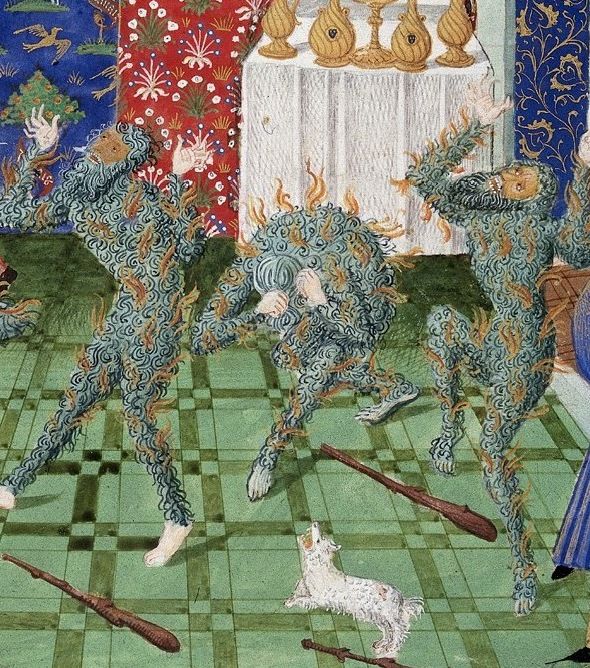
On January 28, 1393, Charles VI decided to partake in the Bal des Sauvages, the Ball of the Wild Men, a masquerade ball in which the ruler joined with gusto, joining a party of five other nobles to perform a frenzied dance dressed as a ‘woodwose’–a Wild Man of the forest. Unfortunately, the Ball ended up in disaster and tragedy, when the dancers’ costumes were ignited by a torch, and hence the ball is now known as the Bal des Ardents–the Ball of the Burning Men.
The costumes of the dancers, sewn on, were made of linen soaked with resin, and tufted with flax to give the ‘wild men’ the necessary hirsute and troll-like appearance. To complete the outfits, they wore masks, hiding their identity–most of the revellers did not even realise the king was one of the party. There were some safety measures taken by the celebrants; no torches were kindled within the hall and no one was permitted to bring a torch inside.
However, the King’s brother Louis, Duke of Orleans, and a friend, arriving late and both very drunk, ignored the rules and marched into the hall carrying torches. Some say Louis held a torch over a dancer’s head to try and identify him and a falling spark caught on the man’s leg; another account says he actually flung the torch at the dancers. They were standing so close together (some accounts say some were chained ) that they were immediately engulfed in a ball of flame.
The Queen of France, Isabeau, knowing the king was in the troupe fainted when she saw the flames leap up and heard agonised screams. However, by sheer luck, it seems like Charles was not chained with the rest and was standing slightly apart from the others, near his aunt Joan, the Duchess of Berry. The quick-thinking young duchess flung her huge skirts over the King to keep his costume from being set alight by flying sparks.
Of the six men who caught alight, only two survived– the king and Sieur de Nantouillet ,who threw himself bodily into a huge vat of wine, which extinguished the flames. The king’s brother Louis was blamed for the accident and was later accused of many evils, including sorcery, but the people of France also believed the ball showed up the king’s own weaknesses–Charles was known to suffer mental illness, perhaps inherited from his mother, Joanna of Bourbon. One time he attacked his own companions before falling into a catatonic state, another time he could not remember he was king and did not recognise his wife,. He thought he was Saint George and believed he was made of glass, ordering metal rods sewn into his garments to keep him from shattering.
Poor Charles was, of course, the father of the Catherine of Valois, who married Henry V of England–a union that produced Henry VI, who inherited his grandfather’s mental illness and was prone to falling into a catatonic state. Charles was also the grandfather of Catherine’s children with Owen Tudor, founder of the Tudor dynasty (unless Owen was not the father of the eldest, Edmund as has been hypothesised). In any case, it does not appear Charles’ unfortunate medical condition was passed to any of Catherine’s subsequent children after Henry.
https://www.ancient-origins.net/history-important-events/ball-burning-men-0013313: THE FULL STORY OF THE BALL OF THE BURNING MEN.


 The New Murrey and Blue blog
Leave a reply to The de Courcy Matter, Part II: The French side of the story…. – murreyandblue Cancel reply