Ela of Salisbury has been called a ‘towering female figure of the 13th’ century by historian Linda Elizabeth Mitchell. However, outside of some quarters in Wiltshire, she is not terribly well known. What is even less commented on than her accomplishments is her genealogy. She is a foremother to Richard III and Edward IV in two lines, through her sons William and Stephen, and also is an ancestor of the Neville family.
Ela was born in Amesbury, Wiltshire in 1187, the only child of her parents, William, Earl of Salisbury, and Eleonore de Vitre. She became Countess of Salisbury in her own right at 9 when her father died. She then seems to have mysteriously been spirited away to France, perhaps by uncles not wishing for King Richard I, whose ward she was set to be, to marry her off to one of his favourites, hence losing the Salisbury inheritance. However, a romantic tale says that Ela was located by Sir William Talbot disguised as a wandering minstrel, who brought her to the King. She was then promptly married off to his illegitimate half-brother, William Longespee–Longsword–whose mother was Ida, Countess of Norfolk. William became Earl of Salisbury in the right of his wife.
Ela and William eventually began married life when she was in her teens and he about ten years older. They seemed to have had a harmonious life and had at least eight children. King John was now on the throne, and William was one of his increasingly few supporters.
However, toward the end of John’s reign, even he went over to the French, supporting Prince Louis above his brother. Some say this was because John had tried to have his wicked way with Ela while William was languishing in a dungeon in France, a captive of the ‘Fighting Bishop’ Phillip of Dreux after the disastrous Battle of Bouvines.
However, when John died in 1216, William abandoned Louis’ cause and threw his support behind his young nephew, King Henry III. In the years that followed, William and Ela were involved in the building of new Salisbury Cathedral, each laying a founding block. The cathedral and town were moved from Old Sarum to a less windy spot down on the lands known as Merryfields near the river. The Earl and Countess continued to live in the great royal fortress that stood amidst the huge Iron Age ramparts of Old Sarum.
William went to war in Poitou one last time but quickly set off for home after becoming ill. Unfortunately he was shipwrecked off Jersey and believed dead by all except his loyal wife Ela. The nephew of Hubert De Burgh the Justiciar came to Sarum, trying to convince her to marry him–she angrily sent him away, telling him not only was she convinced William was alive, she was so far above him in status that his whole suit was ridiculous.
William eventually returned and he was furious when he heard about Hubert de Burgh and his nephew. He complained to the King, who said he must work it out with de Burgh. William seemed to have reconciled with the Justiciar, even dining at his house…but days later, William fell sick and died. Many believe Hubert had poisoned him. The Earl was the first person buried in Salisbury Cathedral, in a very fine tomb with effigy which exists to this day, minus its bright original colours. When the tomb was opened, a rat was found inside William’s skull in a remarkable state of preservation. It was tested and found to contain high amounts of arsenic. So maybe William WAS poisoned–or perhaps he had been taking an arsenic-based medicine for whatever had ailed him in France.
Ela went on to become Sheriff of Wiltshire, one of only two female medieval Sheriffs. When King Henry wanted Sarum Castle back, she bought it off him instead. After giving up the Sheriffship, with all her children in good marriages or serving in the Church, she decided to found two monastic houses in a single day–Hinton Charterhouse and Lacock Abbey. A short whole later, she became a nun at Lacock, and then its Abbess. She died in 1261 in her 70’s.
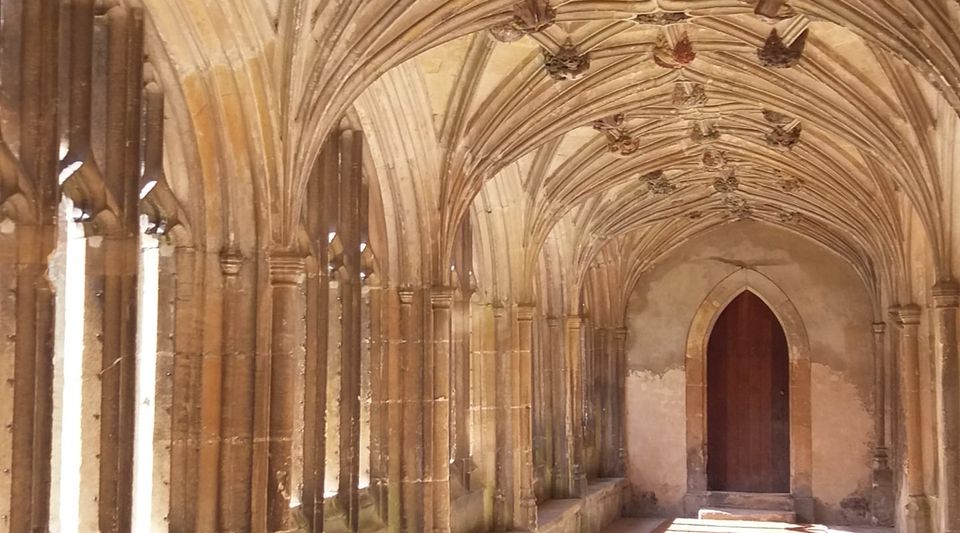
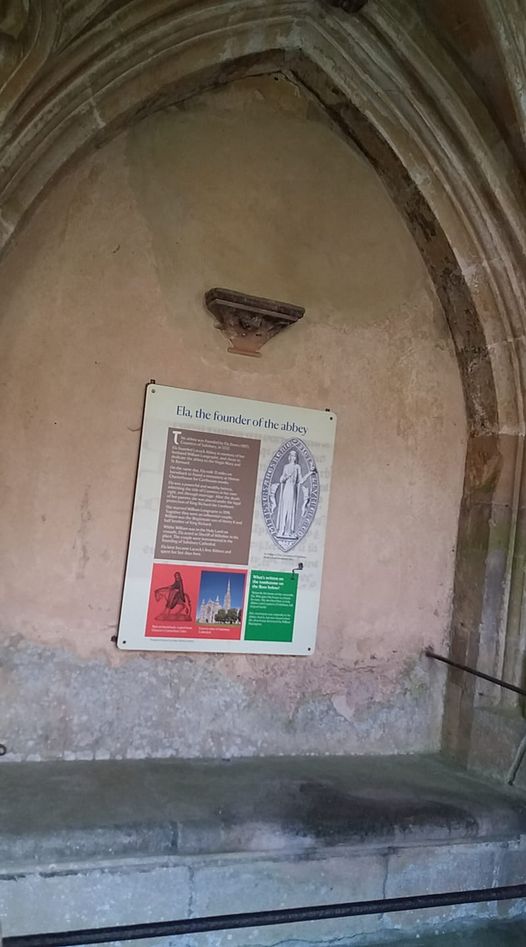
The Abbey of Lacock was dismantled during the Reformation, and a great house built over the ruins, but the beautiful cloisters endure as do several well preserved chambers leading off them. They are frequently used in TV and film today. Ela’s tomb managed to survive, being brought from the completely destroyed church and placed in the cloister. On it the words are still visible– “Below lie buried the bones of the venerable Ela, who gave this sacred house as a home for the nuns. She also had lived here as holy abbess and Countess of Salisbury, full of good works”.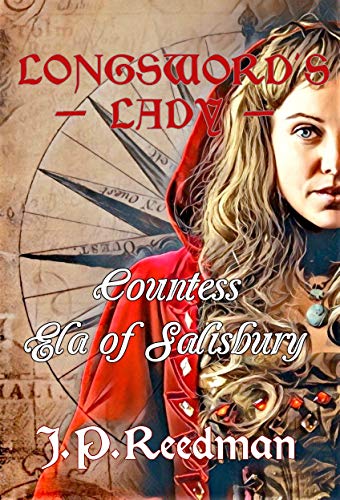
Ela’s life has now been fictionalised for the 800th Anniversary of the founding of Salisbury Cathedral in 2020, in the new novel LONGSWORD’S LADY by J.P. Reedman: http://mybook.to/elasalisbury
here is the genealogy of Ela, showing the important lines of descent through her children .
 The New Murrey and Blue blog
Leave a comment