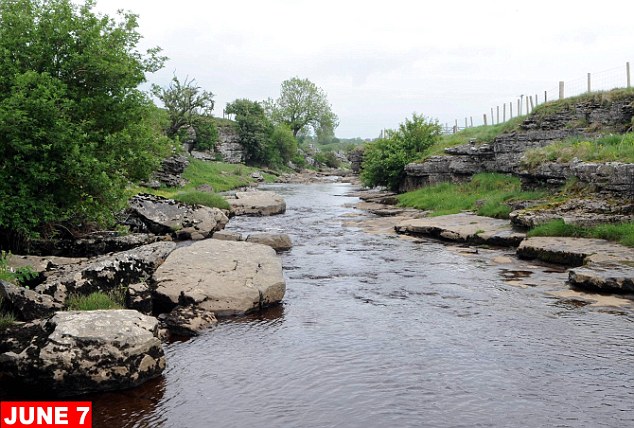
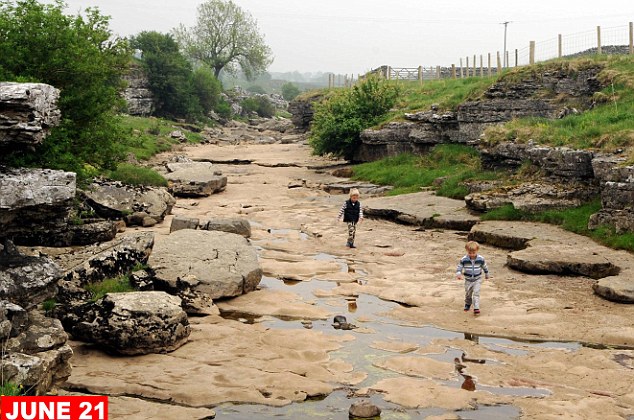
Both River Greta illustrations taken from this Mail article
Well, here we are in 2021, which I hope it will prove an infinitely better experience than 2020. In the year 1399, some folk in Bedfordshire witnessed a “portent” that must have made them wonder what on earth that new year had in store for them. And I don’t mean the laurel trees that are mentioned first in the following extract.
The pictures above are obviously not medieval Bedfordshire, but are of the River Greta in modern County Durham, which dried up in a matter of two weeks in 2010. The illustrations are included here just to show the swift change from flowing to drying up. If the 1399 incident happened suddenly, then it certainly wasn’t a gradual drying up to which the local populace would become accustomed as it proceeded. It was sudden and dramatic enough to warrant being recorded in the chronicle.
According to the St Albans Annales (and repeated in Chronicles by Chris Given-Wilson, from which I have copied the text) – “…The year of grace 1399, and the twenty-second year of King Richard’s reign:- in this year the laurel trees throughout almost the whole of England suddenly withered, and then shortly afterwards many of them revived again; which seemed to presage (praesignantes fortisan) the fact that, although some of the lords had been humiliated and imprisoned, and others had been sent into exile, they would soon be restored to their former dignity. Also, another portent was seen on the Feast of the Circumcision [1st January] near Bedford, where what had undoubtedly been a very deep and fast-flowing stretch of water which ran between the villages of Swelston and Harlow suddenly stopped flowing from the higher of the two places, while what remained of the water ran down to the other, lower place, as a result of which the riverbed, which no one had ever seen before, remained dry for three miles. This was thought to signify a sundering of the people and the realm, and the desertion of King Richard, as indeed happened that year…”
I won’t try to solve the mystery of the laurel trees, except to imagine it was some cousin of Dutch Elm Disease that struck and then receded, but the business of the disappearing Bedfordshire stream is another matter. To begin with, I haven’t a clue which stream or between which actual villages it flowed. I’ve tried to find Swelston and Harlow but cannot. Not even one of them. Perhaps they have different names now? Perhaps they’re deserted? Although if the latter, they are still usually to be found on OS Maps.
As you can see, the above photographs were taken in the summer, whereas the event in 1399 was in the heart of winter. Yes, droughts happen in winter too, and according to my research it’s possible the summer of 1398 had been part of a series of very hot, dry summers, but the winter of 1398/99 was very cold. That’s not to define whether it was wet or dry, of course. All the story from Annales says is that this Bedfordshire stream/river ran dry “suddenly”.
I know that some streams and rivers do dry up, disappear, and then reappear, generally according to the weather, i.e. lack of rain to supply them, but on the whole these streams are known for doing this. Whatever happened to this particular “very deep and fast-flowing stretch of water” was so totally out of the ordinary that it was recorded for us to read of it now.
So, what do you think, ladies and gentlemen? Is it possible to identify these villages and the lost stream that ran between them. Did it ever flow again? Or did it dry up forever? The Annales fail to say. And what, with our modern advantages and knowledge, do we think could have happened?
Anyway, I’ll end this with another warm greeting for the New Year. Fingers crossed that it goes some way to banish the awfulness of 2020!


 The New Murrey and Blue blog
Leave a comment