Recently it has come to my attention that Salisbury Museum holds a carved wooden box which, according to local legend, was fashioned out of the original headman’s block on which  Henry Stafford was executed on November 2, 1483. The carving of the box into its present shape took place in Victorian times.

Why anyone would think that a headman’s  block would convert to a nice ornament  I am not certain–but hey, the Victorians are known for their love of the Gothic and ghoulish.

Of course, chances are that the box is just part of the local legend and not The Block at all. It was supposedly found in the courtyard of the old Blue Boar inn, near a headless skeleton, sometime in the early 19th c. . Now the chances of the skeleton being Harry Stafford is rather remote, despite the story that he was imprisoned in the Blue Boar before his execution for treason. He may well have spent a miserable night there before being taken to the scaffold the next morning, but the most trustworthy accounts say  the execution took place in the Market Place, not in the inn’s courtyard. The Market Place would attract  the crowds and as the west  was brimming with Buckingham’s rebels, Richard would be keen to show them a traitor’s fate. And, as was usual, people needed to see that this great rebel was truly dead, otherwise rebellion could still be fomented in his name.

A  fragmentary skeleton from the Blue Boar’s courtyard did in fact exist,  but as disgraced as Harry Stafford was,  it is beyond unlikely that he would be buried under tiles near an inn’s scullery. Traitor though he was, he was of royal blood and Richard’s cousin. Salisbury being a place of very ancient occupation, the remains from the Blue Boar could have been from any period from the prehistoric onwards, or even those of a more recent murder victim.

There was no mention of any  ‘block’ at the time the skeleton was found, so this tale of the  headman’s block being found seems to have been a slightly later addition to the Buckingham legend. How one would tell exactly what it was meant to be after being buried for centuries is also debatable. I am sure it was not still running blood, ahem.

A radio carbon date could, of course, rule the carved box in or out–just like it could rule in or out those debatable Bones in the Urn.
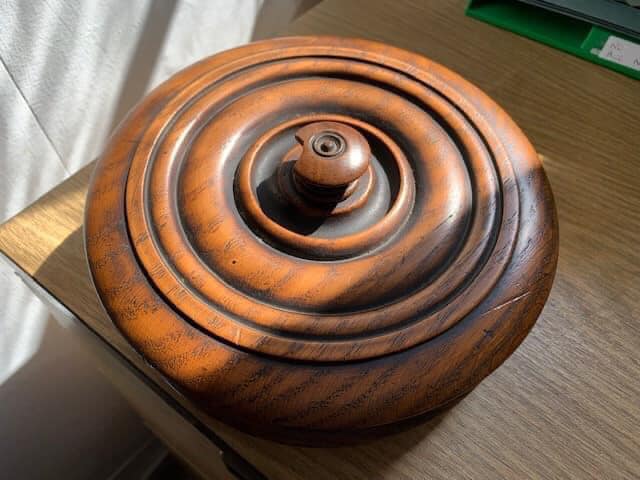
block


Subscribe to my newsletter

  1. […] his cousin’s rather spectacular fall from grace and subsequent execution that year, Edward seems to have laid low for a bit, having been granted permission to enter his […]

    Like

  2. […] I was forgetting, it was Richard’s nasty, vindictive fault that the Judas earl ended up on a Salisbury scaffold. That Buckingham betrayed the true king is somehow brushed […]

    Like

  3. […] Woodville (Earl Rivers), together with Sir Richard Grey and others, met the Dukes of Gloucester and Buckingham as the Great North Road and Watling Street […]

    Like

  4. […] about Grey Friars in Salisbury is that one solitary chronicle mentioned it as the burial place of Henry Stafford, Duke of Buckingham, after his execution in the Market Square on November 2, 1483. (His ghost is said to haunt […]

    Like

  5. […]  Elizabeth, Lady Latimer daughter and co-heir of Richard Beauchamp,  Earl  of Warwick and  the Duke of Buckingham as well as acting as a legal advisor to the Archbishop of Canterbury.  Catesby was clearly on a […]

    Like

  6. […] who was also the 1st Duke of Buckingham. After his demise, it passed to none other than Henry Stafford, Duke of Buckingham, Richard III’s untrustworthy ‘friend’ who was executed for rebellion on November […]

    Like

  7. […] been a rumour than Richard III stayed in Salisbury Cathedral Close when he arrived in the town for the execution of Henry Stafford, Duke of Buckingham. Traditionally, it is said he stayed at King’s House, […]

    Like

  8. […] King’s Chamber, on October 19th 1483, that a furious Richard sent for the Great Seal to sign Henry Stafford, Duke of Buckingham‘s death warrant, writing in his own hand that Buckingham was the ‘most untrue creature […]

    Like

  9. […] whose activities will be traced in this article fall into four main strands: the Woodville family; the Duke of Buckingham; Henry Tudor; and his mother Margaret Beaufort. All four came to be woven together by the month of […]

    Like

  10. […] of Salisbury‘s claims to fame is that it was the place of execution of Henry Stafford, Duke of Buckingham, infamous rebel and possible killer of one or both ‘princes in the Tower‘ (that’s […]

    Like

  11. […] regime. Unlike his Bolton cousins, he didn’t gain property in the South-West after the Buckingham rebellion but he did sit in judgement over two 1484 rebels. He fought at Bosworth and was reluctant […]

    Like

Leave a comment