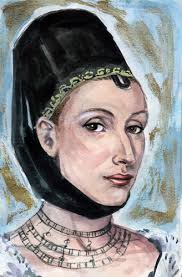
One of the main reasons we now have an amazing King in the list of British monarchs is without doubt the precontract between Lady Eleanor Talbot and King Edward IV.
The turning point in the election of Richard, Duke of Gloucester, as king of England was the discovery of a precontract between the former king and the representative of the noble and powerful family of the Shrewsburys.
Everything started in the early summer of 1460 when Eleanor and Edward met for the first time. She was 24, he was just 18. Edward fell in love with her and she was captivated by the charming new King. It seems that he had promised to marry her after bedding her and the wedding took place in secret, possibly in the spring of 1461 in the presence of Canon Robert Stillington who, on 1st November of the same year, was awarded by Edward an annual salary of £365 (around £235,000 today!). That was a regular contract of marriage so why do we refer to it as a precontract? The answer is that the term precontract has to be accepted with all the implications it had in medieval times: that is neither more nor less than an actual marriage. Precontract does not mean a “betrothal” but it is a legal term to indicate a marriage contract and it becomes a precontract only when a second marriage is arranged for one member of the couple while still married to the previous spouse. So the term precontract does not mean a contract arranged before a marriage but a contract arranged before a subsequent marriage. It is important to clarify this key point to fully understand the reason Richard, Duke of Gloucester, could become King Richard III.
If we consider the succession of events in the life of Edward IV, it is easier to understand why his brother, Richard, was the true and legitimate heir to the throne of England.
Edward IV married Eleanor Talbot with a regular contract of marriage. The nature of this marriage was a secret one, so the sources we have cannot be contemporary but date to about twenty years later. When Edward married Elizabeth Woodville (possibly on 1st May 1464), Eleanor was still alive even though retired as a tertiary of the Carmelite Priory in Norwich. This implies that the second marriage of Edward was adulterous. It also means that the second contract was invalid and Edward was a bigamist. This invalidity could not be changed by the death of the first wife before any children of the second marriage had been born, so there is no justification for Edward’s behaviour and it is undeniable that the consequence of the precontract was the immediate bastardisation of all the issue of the marriage between him and Elizabeth Woodville. The validity of a marriage depended on the existence of a contract, not on the birth of children so it didn’t matter that Edward and Elizabeth had ten children, both boys and girls. The fact that Edward V and Richard of York were born after the death of Eleanor Talbot (she died on 30th June 1468) is not relevant because they were offsprings of an invalid marriage, ergo the king’s bastard sons.
The precontract was known to the Council thanks to the witnessing of Robert Stillington, Bishop of Bath and Wells. He claimed he had celebrated the wedding of Edward and Eleanor and this declaration could be a factor in his arrest in 1478 as, apparently, the bishop had previously revealed the secret marriage to George, Duke of Clarence, who afterwards claimed to be the true heir to the throne. On 8th June 1483, Stillington unveiled the precontract’s existence to the Council during a meeting at which Richard, Duke of Gloucester, was not present. The possible reason for his absence could be that Stillington had already informed Richard about the precontract.
Many wonder if there was written proof of the precontract’s existence but so far nothing has been found and it is very unlikely anything will come to light. The first reason for this is that it is possible every proof in favour of Richard’s legitimacy to the crown was destroyed by the Tudors to strengthen their very weak claim to the English throne, and second because no proof of evidence was normally produced to invalidate a marriage. The authority of a bishop’s word was enough both for the Council and Church to accept the precontract as a fact. A false declaration for a man of God in medieval times was a warrant of eternal damnation in Hell. From then on, the Council started to consider Richard of Gloucester as the successor to his brother and the approval of the three Estates of Parliament to declare Richard king is proof of this. Edward V signed his last official document on 9th June 1483.
For centuries, historians have investigated the person of Robert Stillington and his role in the events of that crucial year, looking for a possible proof of bribery from Gloucester and Stillington’s corruption. This has been in vain. Nothing that could prove either or both has been found and Richard III never rewarded Stillington for his key role in his accession to the throne. Stillington was eventually handed over to Henry VII and died in prison after having being involved in the plot to place Lambert Simnel on the throne.
Other additional elements that could indicate the existence of the precontract were the fact that Edward IV declared public his marriage with Elizabeth Woodville only in September 1464, a couple of months after the death of Joan, Eleanor’s sister-in-law (possibly a witness of the first marriage?). Other elements are the sources. Over the centuries, historians have tried to give their personal opinions on the matter and many convey that the precontract was indeed a fact.
The Crowland Chronicle and the Titulus Regius state that Eleanor Talbot was indeed Edward’s wife and the Crowland writer uses the word matrimonium referring to the two of them. No source refers to Eleanor as Edward’s mistress.


 The New Murrey and Blue blog
Leave a reply to Elizabeth’s Letter – murreyandblue Cancel reply