Did Richard II hide his treasure down a Cheshire well….?

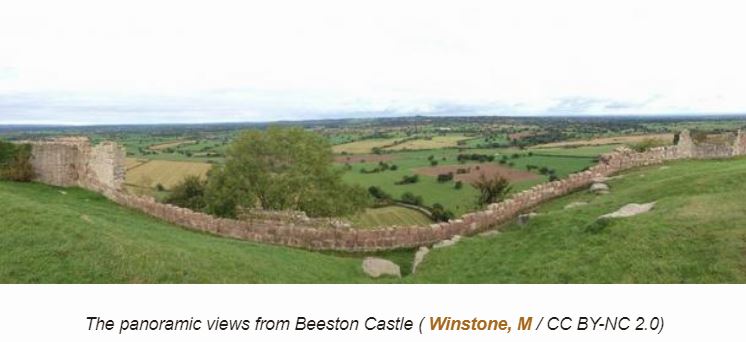
“….To provide the castle’s inhabitants with fresh water, wells were dug into the rock. One at 370 feet (113 m) deep, is one of the deepest castle wells in England. According to legend, it was the hiding place of Richard II’s treasure which he stashed before leaving England in 1399 to quell the rebellion in Ireland. The treasure has never been found….”

Richard II leaves for Ireland, 1399 – from Froissart’s Chronicles

And where is this deep well? Beeston Castle in Cheshire, which county was, of course, one of Richard II’s main source of support. We’ve all heard of his famous Cheshire Archers, who were both loathed and feared,

To see the article which has prompted me now, go to Ancient Origins. The link also contains a fascinating 3D reconstruction of the castle at its height, literally. Recommended. Even more recommended is this page which has many illustrations.

But don’t all descend upon Beeston in search of hidden gold!

To read much more about Richard II’s treasure and Chester, go here.

Subscribe to my newsletter

  1. RII had a treasury at Holte Castle in Denbighshire. The last treasure located there was that collected by Sir William Stanley and confiscated by Henry VII.

    Like

  2. I know that well that well!

    Beeston Castle was a favourite Sunday jaunt of ours with the kids (they really liked it, honest). The castle is on top of a very high hill and has great views, and the well, of course, goes all the way down to the bottom.

    Good views too on approaching by car. The hill with the castle ruins on is one of three tall hills that march in a line. Always reminded me of the Weather Hills in Lord of the Rings, although we never encountered any ringwraiths on the top.

    Are you saying there may have been the next best thing to dragon gold down that well, and we never even brought a bucket?

    Like

    1. ‘Twould seem so, maryeflowre, but it’s never too late….! 😄

      Like

  3. Richard II had an absolute stack of cash down the road at Holt. It would be surprising if there was money at Beeston too. The Holt money was not hidden.

    Beeston Castle is in a very lovely area and there are one or two rather good pubs nearby. One day, who knows, we may all be able to go back to enjoy them!

    Liked by 1 person

  4. […] The other episodes revealed “Ava”, a mysterious young woman who was buried in Caithness, now adjacent to the A9, and Norton Priory, a monastery near an industrial estate in Runcorn. The museum on this site holds hundreds of skeletons, including: 1) A well-preserved male, who died aged 50-60 in 1150-1250. He died by a vertical sword wound whilst not wearing armour, which was evidently not an execution, to be buried near the nave. He, another Paget’s disease sufferer with thicker bones and some hearing loss, is likely to be a knight and a member of the Dutton family, who were in the Earl of Chester’s retinue and were major benefactors to Norton. Sir Geoffrey Dutton, with John de Lacy and Ranulph Earl of Chester, went on the Fifth Crusade, principally to Egypt, in 1220. Documents from seven years later show that he returned, donating land from great Budworth to the Priory, as well as a fragment of the “True Cross”. 2) Yet another wealthy Paget’s sufferer from that era, buried in the east part, who is possibly Canon William Dutton. 3) Another layman who died in the following century, in his forties. He had a fractured clavicle and a rotator cuff injury that may have resulted from jousting. This took place at nearby sites such as Beeston Castle. […]

    Like

  5. […] can say, because there are hardly any useful images of her. But, her son by the Black Prince was Richard II, who certainly was blond, although that may only have been because of his father, who was from a […]

    Like

  6. […] bloodline right to be king, but the fact was that he’d invaded England fully intending to topple Richard II. Which he did. And Richard died mysteriously at Pontefract. Of natural causes? Oh, of course. […]

    Like

  7. […] it’s always satisfying to come upon a site that is well worth recommending. The history of Chester has been dealt with thoroughly at this website. So if you want to know about that city (and its […]

    Like

  8. […] is an article about the histories of some Wetherspoons pubs in Cheshire. One of them, the Friar Penketh in Barbauld Street, Warrington, is said to stand on the site of a […]

    Like

  9. […] I won’t argue with anything regarding Robin Hood, about whom legends and “facts” are legion, but in this instance I was searching for information about Guichard d’Angle, who was Earl of Huntingdon for only a few years in the latter quarter of the 14th century. A Scottish ruler of Huntingdonshire? With a name like Guichard d’Angle I doubt it very much in this case. You can read more about Guichard here . He was tutor to the boy Richard of Bordeaux, who, of course, became Richard II. […]

    Like

  10. […] century earlier the sometimes uncouth Richard Fitzalan, Earl of Arundel was eventually flattened by Richard II, who couldn’t abide him any more) Arundel was deficient in tact, but even he wasn’t uncivilised […]

    Like

  11. […] when I look at the illustrations in, say, Froissart’s Chronicles, I have to admit that quite often the horses of fully armoured knights also look smaller than […]

    Like

  12. […] it comes to other medieval monarchs I think the Westminster Abbey likeness of Richard II is probably spot-on. As are the exceedingly unflattering likenesses of Henry […]

    Like

  13. […] a visit in the island in 1394 by an Englishman called Sir William de Lisle, a chamber knight to Richard II. Froissart relates the story, but doesn’t include any details. I want to get Sir William from […]

    Like

  14. […] II appears in connection with Beeston Castle in Cheshire:- “….[It] seems to balance precariously on a rocky crag above the Cheshire […]

    Like

  15. […] of Wales, the Black Prince, died before his father, Edward III, he left a small boy, the eventual Richard II, as the new heir to the throne. Children were always at risk of dying suddenly in the medieval […]

    Like

Leave a reply to An excellent site dealing with the history of Chester…. – murreyandblue Cancel reply