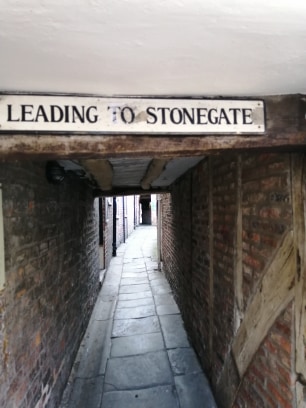
 There is a Building in York where you can go back in time to 1483. It is situated in the City centre, no 2, Coffee Yard. You may access it from there, or from a small alley in Stonegate. This Building is now known as Barley Hall.
The story of this mansion is fascinating, and it dates back to 1360, when it was built as the hospice, of Priory Nostell House. This Priory had seen better times, as in the second half of the 15th century, it suffered some financial difficulties, so it was decided to rent it.
The price was quite high, 53 shillings and four pence, the equivalent of £2000 today. (that is, three months wages of a skilled tradesman) At that time only very wealthy people could afford rent such as this.
 In 1464, the house was rented to one William Snawsell, an Alderman of York, who was a goldsmith, master of the Mint, also a sheriff and even the Mayor in 1468. He became the most famous tenant of Barley Hall, henceforth, the building was known as the Alderman’s House.
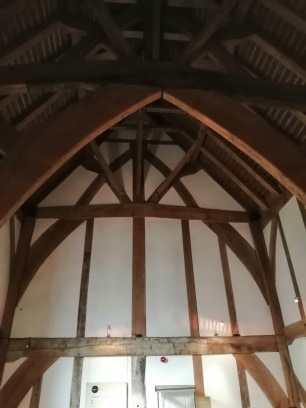
The property had been refurbished around 1430 when it is thought, that the Great Hall was enlarged, as, there is evidence that builders cut through into the adjacent range of the building, to create the arched canopy above the high table. In this hall all the occupants had their meals with the family sitting at the high table, slightly above the rest of the people in there, as an indication of their higher status.
It seems that in 1480 the house consisted of eleven rooms, with eighteen members of the household including servants. There is no evidence that the house was refurbished during the time that Snawsell rented it. He left the house in 1492, due to poor health and retired to Bilton.
 Since then the Alderman’s House was altered greatly. After his departure, the house was leased out again, this time, to a William Carter, a York wine merchant. It was split into separate smaller dwellings, and the biggest surviving part is the great hall, and the 14th century wing.
As the centuries passed, the building changed shape, colour and also materials, so that at some point its medieval features were difficult to be seen. During the Dissolution of the monasteries it was confiscated by the crown, and in the following centuries, it was subdivided into many smaller properties, and also extended.
The darkest period for Barley Hall was in the Victorian Age, when the building was used as a plumber’s workshop. But the house still had to wait for another century, behind a wall, before being rediscovered and refurbished.
 In 1984, the building was under threat of demolition and also that year it was nearly turned into flats. Luckily, at the last minute, its fate changed. The Trust acquired it in 1987, when it was realised that it had Medieval origins. The refurbishment lasted 6 years before Barley Hall became what it is today.
All the timbers were dismantled, examined and reconstructed close to its original status, using the same tools and materials from the Medieval period. It was even possible to date the construction from the age of the trees used for the timber frame. Upon analysing the trees’ rings it was asserted, that they were felled in May of 1360, and in 1361 it was discovered that another house was built close to Barley Hall, so it was definitely built around then.
In early Nineties, the York Archelogical Trust excavated the site, trying to understand how the house would have looked in 1483. The structure was meticulously rebuilt, and the interior furnished with objects based on actual fourteenth century designs. Barley Hall is today a pristine L-shaped half-timbered house with a cobbled yard and it is organised in three wings, one of which contain the Great Hall, a masterpiece with an exposed section of the original medieval floor, with brick tiles arranged to form a geometric pattern.
In the Hall, you can admire a massive tapestry, that covers the wall or most of it. It consists of red and green vertical stripes with the white rose of York intersected within the green stripes. This is the result of long and patient work by people who painstakingly weaved the tapestry, using the original medieval method.
 Other chambers, include a Pantry where a pantler worked, having responsibility for food, and a Buttery occupied by a butler responsible for beverages. The Parlour was used by Snawsell for his business meetings. In this room you can admire a chest that is a replica of one left to Snawsell by his aunt.
It was possible to access the kitchen, from the Great Hall, and some smaller rooms could have been used by servants as their bedrooms.
People who contributed to the rebirth of Barley Hall did an incredible job. This is a unique Building, and it is not exaggerating to say that nothing else like this exists in York, and very few in the whole country. Barley Hall was named after the Trust’s founding chairman the late, Professor Maurice Barley, and opened to the public for the first time in 1993. In 2010, it celebrated its 650th anniversary, with a number of workshops and events, with people wearing medieval clothing.

 The New Murrey and Blue blog
Leave a comment