Thomas More’s detailed and heart-wrenching account of the murders of Edward IV’s sons is well known, and is usually either accepted or dismissed in toto so it would probably be useful to pause at this point to remind ourselves exactly what it was that Thomas More claimed had happened to the boys and why opinions as to the veracity of his story are so divided.
Richard, said More, set off on his progress leaving the boys in the Tower with four keepers (one being an habitual murderer named Miles Forest) and just one of their old servants (William Slaughter). The King’s intention was to kill the boys at some point in order to secure his position, and when he reached Gloucester (say, 31 July or 1 August) he finally made up his mind to get on with the business. He sent one John Grene ‘whom he specially trusted’ to carry a letter and a verbal credence to Sir Robert Brackenbury, the Constable of the Tower, instructing him to put the boys to death; but, contrary to the royal plan, Brackenbury replied that he would rather die. Grene returned with the bad news, finding the King at Warwick (this would have been the second week of August). That night, Richard complained to a ‘secret page’ of his that no one could be trusted, to which the page replied that there was an overlooked attendant lying in the antechamber who, he was sure, would do anything in return for recognition. At this Richard got up, roused Tyrell from his pallet and instructed him to organise the boys’ deaths. The next day, Richard sent Tyrell off with a letter commanding Brackenbury to hand him the keys of the Tower for one night.
Having decided he would need two murderers, Tyrell enlisted his own horsekeeper John Dighton as the first, trusting that the homicidal Miles Forest would have no objection to being the second. At the Tower, Brackenbury obligingly handed Tyrell his keys, and that night Tyrell dismissed all the boys’ attendants except for Forest. At about midnight Dighton and Forest crept into the Princes’ chamber, smothered them with their own bedding then laid out the bodies for Sir James’ inspection.
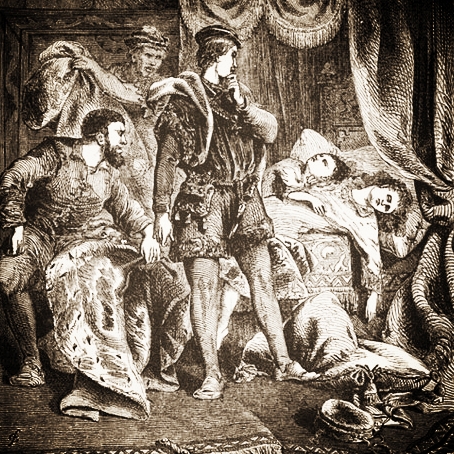
Satisfied that they were dead, Tyrell commanded Dighton and Forest to bury them at the foot of the stairs (presumably those leading down from their bedchamber in the White Tower, though this is not specified), ‘meetly deep in the ground under a great heap of stones’.
When all this had been done, Sir James galloped back to Richard with the good tidings. Richard thanked him profusely but was unhappy with the ‘vile’ burial arrangements. Thus (it was said) Sir Robert Brackenbury had a priest of his disinter the bodies and rebury them somewhere more fitting; but, since Richard, Brackenbury and the priest were all dead by the time More wrote, there was no longer any way of discovering where this was. More supports his story, picked up (so he claims) from ‘them that much knew and little cause had to lie’, with the assertion that Tyrell and Dighton had confessed to the crime when they were questioned in the Tower prior to Tyrell’s trial and execution in 1502 (but note that More did not claim this confession to have been written down, still less to have seen a transcript of it).
The flaws in this account are many. First, though we are told that Richard ‘before had intended’ to kill his nephews, he had clearly not thought to sound out Brackenbury about it before leaving London. And, when Brackenbury rejects his orders, does Richard have him removed from post, or quietly despatched on account of his dangerous knowledge? No, he simply asks him to hand over the keys to Tyrell for the night (actually, it is not clear from More’s tale why Tyrell needed the Tower keys). This time Brackenbury meekly does as he is told although he evidently knows what is afoot as he later has one of his priests move the remains. More puzzling still, the real-life Sir Robert continued in post as Constable of the Tower throughout Richard’s reign and died fighting for him at Bosworth.
As for Sir James himself, More’s picture of a frustrated servant overlooked for promotion simply does not fit the facts although there have been recent attempts to rehabilitate it. Tyrell was one of Richard’s most prominent knights and the rewards he enjoyed after this period were by no means out of keeping with his previous career. Miles Forest existed, but the real-life job of this alleged serial-killing hard man had been looking after Richard’s wardrobe up at Barnard Castle, and he does not appear to have ever been in any trouble with the law. More’s depiction of him seems no more than a device to explain how Tyrell had felt able to count on his co-operation without having had an opportunity to sound him out about the murders in advance.
The burial of the bodies, even ‘meetly deep’ as described by More, would have been a challenging task for two men during the course of a short August night. If the murderers had crept into the Princes’ room at about midnight, then work on the gravedigging is unlikely to have been started before 12.30 am, giving them a window of little more than four hours to complete their task before the keys would be needed for the reopening of the Tower at sunrise. And if we try, as is generally done, to reconcile More’s description of the Princes’ burial with the discovery of the 1674 remains, the problems merely multiply. The 1674 remains were not found ‘meetly’ deep at the foot of an internal staircase, but 10 ft down under the foundations of an external staircase that was being removed. The two descriptions do not match, and the 1674 burial could never have been effected and made good in the space of four hours. Another possibility is that the remains were found in 1674 where Brackenbury’s priest had removed them, but such an interment place would have been no less ‘vile’ than the original burial place, and a solitary priest would scarcely have been able to dig the bodies up and rebury them in such a location with total discretion.

Against these objections, however, must be set the fact that Polydore Vergil, writing at a roughly similar time, also pinned the blame for the boys’ deaths on the late Sir James Tyrell and, like More, has Richard write from Gloucester to the Constable of the Tower ordering him to find a suitable means of despatching the princes. But according to Vergil the Constable merely prevaricated and Richard went on waiting for him to act, finally losing patience during his stay in York (31 August to 20 September) and despatching a woeful Sir James to do the deed. Vergil’s chronology is not precise but he seems to be placing Tyrell’s departure from York after Prince Edward’s investiture (8 September), which is just as well because Sir James had a special role in the investiture procession as Master of the Henchman. Nor does Vergil mention any confession; indeed, he flatly states the manner of the boys’ death to be unknown and attributes the rumour of the murders to Richard himself. The nature of the story, however, is such that – if there is any truth in it at all – it is most likely to have emanated from individuals working at the Tower.
The only details in the accounts of More and Vergil that might have been witnessed by third parties are Richard’s despatch of a messenger (possibly John Grene) to Brackenbury from the city of Gloucester, the later despatch of Sir James Tyrell to the Tower, and the absence of any sightings of the Princes by Tower staff after the night of Tyrell’s visit; these are also the only details upon which More and Vergil are agreed. After Bosworth there was only one acceptable explanation for the disappearance of Edward IV’s sons, which was that they had died during Richard III’s reign, preferably on his orders, and so any theories built around the boys’ disappearance had to fit into that framework.
It is interesting, and probably relevant, that two separate sources describe a failed attempt by supporters of Edward V to rescue the boys from the Tower after Richard left the capital; the ringleaders were identified and arrested, and are probably those who had ‘taken upon themselves the fact of an enterprise’ about whom Richard wrote to his Lord Chancellor from Minster Lovell on 29 July. This foiled attack on the Tower might have suggested to Richard that the boys would have to be killed, had he been so inclined, but it is equally – if not more – likely, given his rivals’ youth and innocence, that Richard’s response would have been to have them discreetly removed to secret locations far from the city, where they would no longer be the focus of discontent.
For this plan to work well, it would have been reasonable for Brackenbury to have been given some advance warning so that bags could be packed for the boys’ journey, and so that one or two of their attendants could be enlisted to accompany them; the delivery of such a warning could have been the real purpose of Grene’s mission to Brackenbury. On this reading of events, Tyrell’s mission would not have been dependent upon Brackenbury having rejected the orders from Grene, and Miles Forest may have come under suspicion simply because he too disappeared from the Tower that night, having been brought along to attend upon the boys during the journey. The hours of darkness would have been the best time to smuggle the boys out of the Tower, and if there was any concern that they might not wish to co-operate then they could have been sufficiently sedated to enable Tyrell and his men to carry them both out without waking them. The Tower keys would have been needed in order to get the little party out of the fortress under cover of darkness, and Sir Robert Brackenbury would have had no reason to interfere with such a mission.
This scenario is merely offered as a suggestion as to the sort of reality that might possibly underlie More’s implausible murder tale. I would be the first to admit that there is no evidence that this is what occurred, but it would see off the inconsistencies in More’s story remarkably well. I make no suggestion as to where the boys might have been taken next, how they might have travelled, or what might have become of them in the longer term: those are separate questions.
SOURCES
Sir Thomas More: ‘The History of King Richard III’ and Selections from the English and Latin Poems, ed. Richard S. Sylvester, Yale, 1976
The History of King Richard the Third, ed. Richard Bear, website of the American Branch of the Richard III Society
Polydore Vergil, ‘Anglica Historia’ (1555 Version), ed. Dana F. Sutton, Philological Museum website of the University of Birmingham
https://www.hrp.org.uk/tower-of-london/history-and-stories/the-ceremony-of-the-keys/#gs.7frn87
Histoire des Règnes de Charles VII et Louis XI par Thomas Basin, Evéque de Lisieux, ed. J. Quicherat, vol 3, Paris, 1857, p. 137
Signet Warrants for the Great Seal and Signet Letters to the Chancellor, transcribed R. C. & P. B. Hairsine for the Richard III Society, 1979
‘Observations of the Wardrobe Account for the Year 1483’, Rev. Dr. J. Milles, Dean of Exeter, Archaeologia, Vol. 1, 1770, p.375
Helen Maurer, ‘Bones in the Tower: A Discussion of Time, Place and Circumstance, Part 2’, The Ricardian, No. 112, March 1991
John Stow, Annales of England, 1600 edition, p. 767


 The New Murrey and Blue blog
Leave a reply to SIR JAMES TYRELL – CHILD KILLER OR PROVIDER OF A SAFE HOUSE ? | murreyandblue Cancel reply