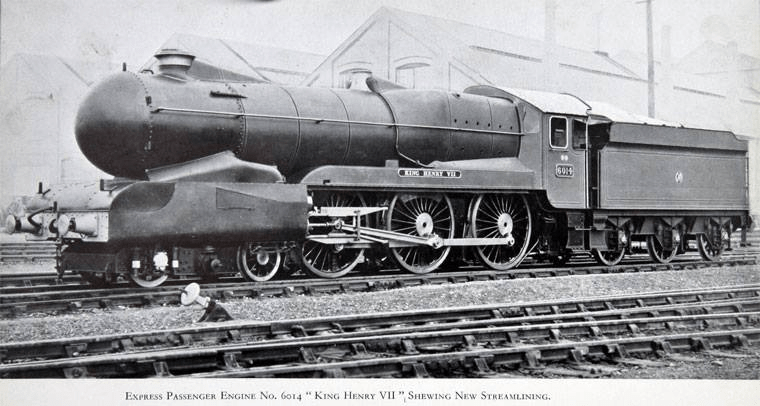
King Henry VII – an ugly abomination

In the late 1930s it became fashionable for railways to “streamline” steam locomotives. The Great Western Railway could not be bothered to do a proper job, but as a gesture towards the trend modified one of their existing locomotives to the incredibly ugly condition seen above.


The engine chosen? King Henry VII.

Clearly someone high up at Swindon Works was a closet Ricardian with a sense of humour.


Subscribe to my newsletter

  1. Or a sense of revenge? Love it, Ricardians lurking everywhere, ready to pounce.

    Like

  2. […] believe he was), whatever could someone in the late 15th c have been trying to tell us about Henry VII in this amusing manuscript doodle? Especially as it came from  the Archbishop’s Register of […]

    Like

  3. […] dear, how very Henry VII. I’ve just read in this link that because the leek was the emblem of the Welsh, on one St […]

    Like

  4. […] on the text. Wyatt was a politician and courtier who became a great friend and supporter of Kings Henry VII and Henry VIII, and what really caught my eye was this:-“ . . . He [Wyatt] had been at Eton with […]

    Like

  5. […] third friend has drawn my attention to the words of Prince Arthur, eldest son of Henry VII, on the morning after his marriage to Catherine of Aragon. Apparently he remarked that “It is a […]

    Like

  6. […] a shame though, because Powis Castle today is extraordinarily beautiful. I lament that Tudor‘s invasion with his foreign army didn’t take him into a particularly gluey and […]

    Like

  7. […] much. Rather late in the day, the ultra-cautious character of Elizabeth’s Tudor grandfather, Henry VII, came to the […]

    Like

  8. […] the rightful king. Well, unless you were someone like Henry Bolingbroke (Henry IV) or Henry Tudor (Henry VII) who thought it was still OK to kill the king. Clearly the fact of coronations and holy oil […]

    Like

  9. […] seems that in 1497, when the abbey precincts were protected by a wall, Henry (of Despicable Memory) decided to pay York a visit and stay at the abbey. So that he could have […]

    Like

  10. […] Ralph may have been present at 1482 negotiations for the Scottish marriage in the reign of Edward IV, and may have observed when his cousin stood proxy for Cecily at the betrothal ceremony. Ralph was to be a member of Richard III’s household, and as Masham and Upsall are both in Yorkshire, maybe he was in Richard’s household when he, Richard, was Duke of Gloucester and in charge of that northern part of Edward IV’s realm. In The Register of Bishop Fox of Durham Ralph is described as providum et discretum virum – a prudent and discreet man. He must have been to eventually survive a man as vengeful and suspicious as the Tudor usurper Henry VII! […]

    Like

  11. […] dear little nephews and had no right whatsoever to the throne, blah-diddy-blah-diddy-blah. Oh, and Henry Tudor WAS the Lancastrian heir. Um, […]

    Like

  12. […] there’s Henry VII and his Tudor rose. Don’t get me started on that pseudo-Welshman. He used Welsh symbols to raise […]

    Like

  13. […] Henry VII “knew” that Edward IV‘s sons were dead by the time of his accession, why did he […]

    Like

  14. […] at the Battle of Tewkesbury in1471. Did Edward father anyone? Another thing, I suppose, is that Henry Tudor claimed to be the heir of the House of Lancaster, and he certainly fathered children through […]

    Like

  15. […] no matter how loudly Tudorites shout that Tudor = Renaissance, Henry VII didn’t wake up the morning after Bosworth, sit up in bed and cry “Eureka!” Er, maybe he’d […]

    Like

  16. […] England in early 1506 when his ships were caught in a terrible storm. He fell into the clutches of Henry VII, who was only too delighted to receive him and force him to agree to treaties. See here. […]

    Like

  17. […] III of the house of York (white rose) was killed by Henry Tudor, Duke of Lancaster soon to be King Henry VII (red rose). Richard’s body was not found on the battlefield, a fact that upset the Yorkists for […]

    Like

  18. […] in far more danger from the Tudors and Beauforts than they’d ever been from Richard, because Henry Tudor had made them legitimate again and couldn’t afford for them to reappear to out-claim […]

    Like

  19. […] III. Maybe with the king having the security of an heir, neither this earlier Henry — nor the Henry Tudor of the future — would have rallied the support he actually […]

    Like

  20. […] During the Wars of the Roses, Dunwich favoured the Yorkist cause and hence was penalised by Henry VII, further adding to the town’s decline. Some say you can still hear the bells of the vanished […]

    Like

  21. […] monastery, no doubt aided by the fact that even Henry VIII could hardly destroy the burial place of his parents.    However the Augustinian Merton Priory along with  many others did not.  It was razed to the […]

    Like

  22. […] loomed throughout Richard’s too-short reign, and the eventual invasion and usurpation of Henry Tudor had Woodville backing. One of their number, Elizabeth of York, became Tudor’s queen. Elizabeth is […]

    Like

  23. […] of the season. This year the occasion was more lavish than usual because tomorrow, All Hallows, King Henry VII’s younger son, three-year-old Prince Henry, was to be created Duke of York. There would follow […]

    Like

  24. […] supporters of Richard III, we find it only too easy to dislike Henry VII. Not only did the churl defeat and kill Richard (not even through his own martial endeavours but […]

    Like

  25. […] of Bletsoe, Duchess of Somerset. This means she was a half-blood relation of Margaret Beaufort, Henry VII and their descendants. Other ancestors included the Scropes of Bolton and Ralph Neville, Earl of […]

    Like

  26. […] locomotive ‘Fair Rosamund’ was the only one of its class to carry a name. It was, of course, named […]

    Like

  27. […] Catesby, directly descended from Sir William Catesby, sought to kill James VI/I, a descendant of Henry VII, by gunpowder 120 years after Henry had Sir William hanged after Bosworth.This second case, of […]

    Like

  28. […] He joined the Buckingham rebellion and had to flee to a sanctuary. Pardoned, he nevertheless joined Henry Tudor at Bosworth and in time drew the rewards of victory, becoming firmly established in his sphere of […]

    Like

  29. […] that the burial of Lincoln would have taken place on the battlefield without the authority of Henry VII.    These were the days when to conform to the strong Christian beliefs of the times strenuous […]

    Like

  30. […] was quick to pass statutes to justify the claims of obvious usurpers such as Henry IV and Henry VII. Indeed, Chief Justice Thirning was at pains to tell Henry IV that a claim by conquest was […]

    Like

  31. […] (sic), being by the east coast, had nothing to do with Tudors, real or imagined, until after Henry VII‘s accession, so it definitely wasn’t a “stronghold” of theirs during the […]

    Like

  32. […] claiming to be Edward or his younger brother….” Oh dear. Wrong king, I fear. It was Henry VII whose reign was thus dogged…and who’s to say they were imposters? They could well have been […]

    Like

  33. […] as well it didn’t collapse over dear William One. It ought to have had the decency to fall in on the first Henry Tudor instead…if he ever went […]

    Like

  34. […] a surplus). The blue boar was the emblem of the Earl of Oxford, who’d fought for the Weasel, um, King Henry VII, so anything to do with him would get the thumbs up. The white boar could simply be painted blue, […]

    Like

Leave a comment