 It seems that some of the denialists are becoming even more sensitive than before and dislike being called Cairo dwellers. One Michael Hicks acolyte went to the point of giving Matthew Lewis well-researched biography of Richard III a one-star review. Sadly for “Alex Brondarbit”, the introduction to his own latest book (below) by the Professor has also appeared. Although the length and phraseology differs, few will believe that Hicks didn’t “inspire” the secondary effort.
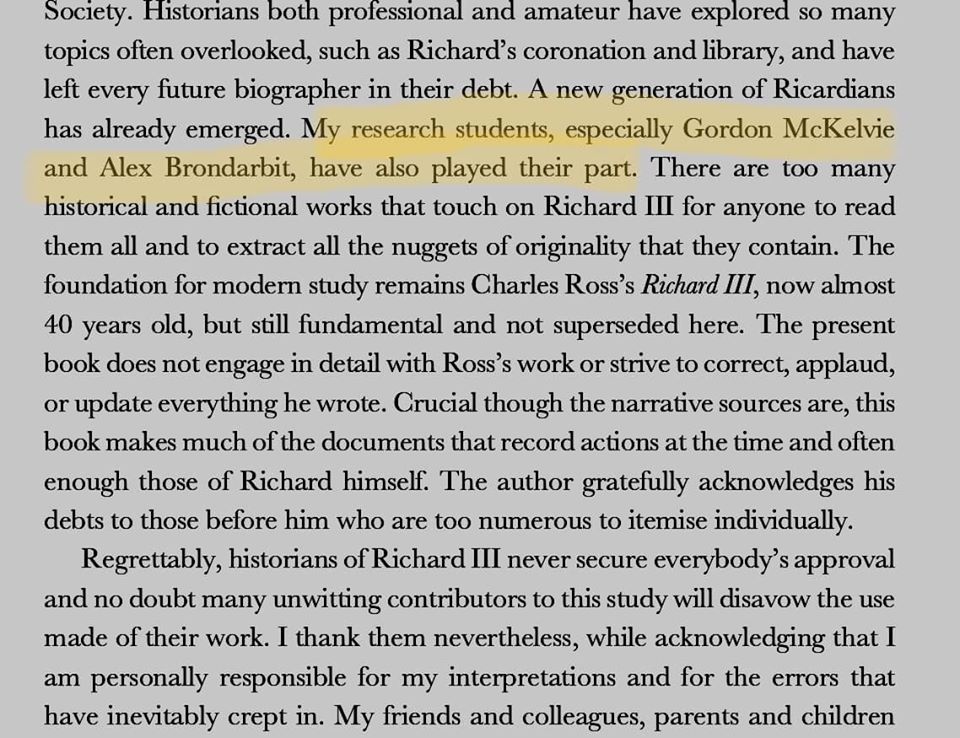 In his review, Hicks cites his own mentor, Charles Ross, describing his work as the definitive biography – and herein lies the problem. Ross wrote nearly forty years ago, reciting all of the old discredited sources, ending by stating that Richard’s body was dumped in the Soar after the Reformation. Hicks has written at least a dozen books about Richard III in that time, still based on Ross’ research, but the history and the science have moved on.
In fact, we at Murrey and Blue have drawn attention to this stasis on several occasions, pointing to:
Barrie Williams‘ painstaking research in the Portuguese archives that proved Richard’s remarriage plans soon after Anne Neville’s death, thereby contradicting the hoary old myth about Richard and Elizabeth of York,
Marie Barnfield‘s proof that “affinity does not beget affinity” and that Richard and Anne had all the dispensations they required,
The conclusive identification of Richard’s remains, which were still under the former Greyfriars and nowhere near the river Soar, through research initiated by John Ashdown-Hill and others,
Ashdown-Hill’s work on the pre-contract, restoring Lady Eleanor to her rightful place in history as Edward IV’s legal wife.
The evidence adduced by Wroe, Carson, Fields and Lewis, inter alia, suggesting that either or both “Princes” survived beyond 1485 together with Ashdown-Hill’s discovery of their mtDNA.
 As one who has read both Kendall and Ross on several occasions, it is surely the case that the former captures Richard III’s essence far better, notwithstanding the fact that it was the earlier book. We have a whole series of posts based on the book Kendall could have written today and we can be confident that he would take account of this new learning were he still alive. Ross both wrote and died more recently but I doubt that he would have changed a word, just as Hicks’ mind is unchanged in that interval, even as the evidence points in a different direction. He evidently has a lesser opinion of amateurs, as many of the above are, but it is they who have made the great discoveries since 1980. It is the amateurs who have conducted original research here and not relied on the flaws inherent in Mancini, Vergil and More.
As the Arabs, including those in Cairo, say: The dog barks, but the caravan moves on.


 The New Murrey and Blue blog
Leave a reply to Melisende Cancel reply