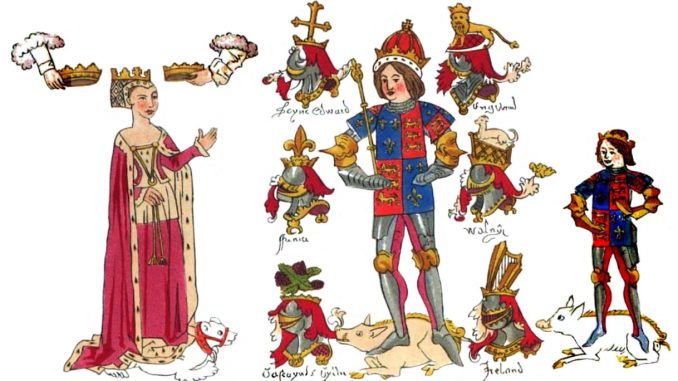
When we buy a non-fiction book (in our case usually something to do with Richard III and the medieval period) we anticipate its arrival with some relish. This is how I felt when, after reading many praises for Peter Ackroyd’s History of England, I decided to buy Volume I online.
It arrived this morning, and I leafed eagerly through the pages, to get a feel of it before reading it properly…but when I came to Illustration 49 (of 51) it was an image of Richard III from the Rous Roll – just him, taken from the image above. Then I read the caption: “Richard III standing on a white boar; the white boar was his personal badge or ‘livery badge’. It may derive from the Latin name of York, Eboracum, since he was known as Richard of York.”
Um…oh no he wasn’t, Mr Ackroyd. His father was Richard of York, and so was his nephew, Richard of Shrewsbury, who was created Duke of York and became one of the boys in the Tower. Richard was always Richard of Gloucester, and then Richard III.
As you can imagine, my heart sank and my hackles began to rise as I sensed that I’d purchased a real turkey. I have indeed, because Peter Ackroyd goes on to relate in full the version of events according to the Sainted More, strawberries, withered arm and all. The murder of the boys in the Tower is taken for granted, but the possibility of Henry VII being responsible is “essentially a fancy”. Oh, right. Why, may I ask? Because his tricky, grasping, dishonest hands were suddenly lily-white? No, according to Ackroyd: “There can be little doubt that the two boys were murdered on the express or implicit order of Richard III.” Clearly this author has inside information that has been hidden from everyone else.
And there’s more: “There had been usurpers before, wading through gore, but Richard III was the first usurper who had not taken the precaution of winning a military victory; he claimed the crown through the clandestine killing of two boys rather than through might on the battlefield.” Really? Methinks Mr Ackroyd is too accustomed to composing eyecatching blurbs!
And Richard “set up a ‘council in the north’ to consolidate his power in that region. Excuse me? Richard was consolidating his own power? Um, where was Edward IV while all this was going on? Or was Richard now ‘king of the north’, and a law unto himself?
And Richard contemplated marrying Elizabeth of York…at least, he would have done if he’d been able to get away with it. No mention at all of the important Portuguese negotiation for both his own marriage and that of his niece. Indeed no, the only reason Richard didn’t rush her to the marriage bed was because he would not have been “able to marry the girl whose brothers he had destroyed”.
Polydore Vergil “states that Richard III was now ’vexed, wrested and tormented in mind with fear almost perpetually’.” In fact, Ackroyd is prepared to judge Richard solely on the traditional stories, which were (sorry to repeat it again) the work of the victor at Bosworth, in whose interest it was to blacken Richard’s name and memory as much as he possibly could. Henry VII was surely the best spreader of fake news in history!
Oh, and Richard was “buried without ceremony in a stone coffin. The coffin was later used as a horse trough and the bones scattered”. Really? No wonder Ackroyd thinks Henry VII was the best thing for England, they share a liking for telling stories!
The copyright for this abominable work of fiction is 2011. Oh, dear, a year later and Richard himself was able to refute claims of hideous deformity and being chucked in the Soar (Ackroyd missed that one, by the way.)
There are many other points in this book with which anyone of common sense will disagree. Those who have really studied Richard III, will know that he has indeed been cruelly maligned by history. He did not do all those things of which he was accused…and if he had Hastings executed without delay, you can bet your bottom dollar it was for a damned good reason. Richard didn’t execute people left, right and centre…there are quite a few he should have topped, but he was lenient! Which makes him a black-hearted, villainous monster, of course.
Anyway, I regret being swayed into buying this book. It is nothing but traditionalist garbage! I hardly dare turn its pages to my other favourite king, Richard II. No doubt Henry Bolingbroke gets the laurels and is patted on the head for having that other Richard murdered. Ah, but that’s different. It was OK to kill Richard II. So, in 1399 there was a Richard usurped by a Lancastrian Henry, and then another such thieving Lancastrian Henry happened along in 1485. Neither of the Richards (both married to Annes, by the way) usurped anything, but they both get the blame for everything.


 The New Murrey and Blue blog
Leave a reply to Dianne Cancel reply