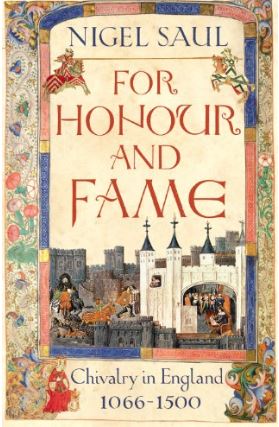
For Honour and Fame - Nigel Saul

Having just acquired Nigel Saul’s For Honour and Fame, about chivalry in England from 1066 to 1500, one of my first actions was (as always!) to go to the pages that refer to Richard III. Well, it’s second nature to any Ricardian, I think.

So, on page 279, I read:

“. . .A generation later there was to be another, still greater, heiress who was to play a role in the preservation of specifically chivalric memory. This was Anne Neville, daughter of Richard Beauchamp, earl of Warwick, and sister and heiress of his son Henry, duke of Warwick, who died young. Anne’s self- appointed task in the last years of her life was to cherish and protect the memory of her late father, one of the Lancastrian monarchy’s greatest captains. . .”

Um. . .eh? For a moment the penny didn’t drop, and I couldn’t fit Anne Neville with such a claim. Then I realized it was one of those banes of all writers, a monumental blooper. It was not Anne Neville who was meant, but her mother, Anne Beauchamp.

Phew!

So, the mix-up of Lady Annes is an error by either Nigel Saul, or his publisher, Bodley Head. Oh, and the book then goes on to mention Richard III’s “seizure of the throne”, which did not impress this incurable Ricardian. He has two further, brief, mentions. So, if you’re looking for books that deal in any meaningful way with Richard III, give this one a miss.


Subscribe to my newsletter

  1. Oh. My. Gawd. My jaw dropped, reading that. These people call themselves historians! And their publishers presumably have so-called editors! AAAAARGH! Even if I wasn’t a Ricardian, I’d skip this book because I loathe this sort of carelessness! Call themselves professionals? I don’t think so!

    Like

  2. Richard P. McArthur Avatar
    Richard P. McArthur

    He should have said “Anne Beauchamp Neville”.

    Like

  3. It’s just referring to her by her married name. Surely we can cope with that in a text.

    Like

    1. I don’t think so.

      Liked by 1 person

  4. Anne Neville was NEVER a Beauchamp. Her father was Richard Neville. And I have yet to hear a highborn medieval lady referred to, simultaneously, by both her maiden and married name. The way these days is to always refer to them by their maiden name. Anne Beauchamp is always Anne Beauchamp, and Anne Neville is always Anne Neville. Well, so I understand.

    Liked by 3 people

    1. That is the convention, as practiced by JAH and others.

      Liked by 1 person

    2. I know I’ve never seen Anne Neville’s mother, the Kingmaker’s wife, referred to as a Neville. She’s always Anne Beauchamp. It’s her name.

      Liked by 1 person

  5. But… but… traditionally published books are always free from errors, perfectly edited, and of superior quality…
    snark

    Seriously, do they not know the first thing about good historiography?

    Liked by 1 person

    1. Certainly people, writers, historians make mistakes. But these kind of significant mistakes should be caught no later than during editing. It would also be helpful to avoid or at least make them less blatend by adding year of birth/death in (…) right after the name. In other words if such a mistake is not caught, at least you can tell whom they are actually talking about.

      Liked by 2 people

  6. This is definitely the wrong lady anne

    Like

Leave a reply to Jasmine Cancel reply