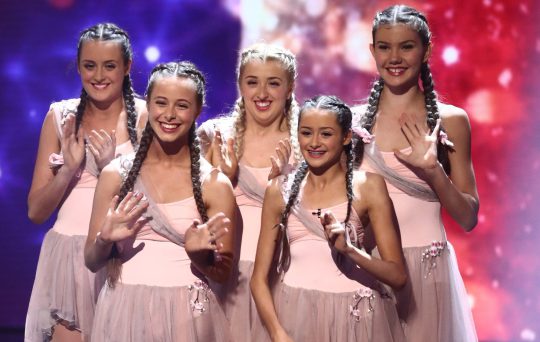
The Mersey Girls on Britain's Got Talent

As an osteopath, Richard’s scoliosis is another aspect of his life that fascinates me. It came to my attention that a contestant on Britain’s Got Talent, Julia Carlile, aged 16, had a scoliosis treated privately in the USA, which was paid for by Simon Cowell ($175,000)
The Mersey Girls on Britain's Got Talent
The Mersey Girls on Britain’s Got Talent – Julia is in the front, first from R-L

Click here to read more: Here.

This was interesting, but even more intriguing was the way it was treated. Scoliosis is usually treated by inserting metal rods each side of the spine. The operation is very invasive, involves large scars and leaves the patient with a spine which is very stiff, although straighter than it was. The old way would have meant Julia would never dance again, which is why Simon Cowell stepped in when he heard that the new technique would allow the spine to still be flexible enough to dance.

The operation is called vertebral body tethering, although the place in the USA that formulated the technique prefer to call it ‘Anterior Scoliosis Correction’. It involves screws being fixed along a cord inside the back. The recovery time is just six weeks and the operation is reversible if it doesn’t work. Here is a link to the place that pioneered the technique if you want to find out more: Here

Just imagine if Richard had had access to this kind of treatment!


Subscribe to my newsletter

  1. As my daughter was diagnosed with this condition at 11 years old, I found this article really interesting. It sounds far less invasive, and nowhere near as traumatic as the original operation of putting rods down the length of the spine. Recovery time is so much better too. The wonders of modern medicine, how fortunate are we? x

    Liked by 3 people

  2. My daughter was diagnosed with a 55 degree lateral curve of the spine this week. She has decided to blog her experience so that other children in her position have a better understanding of the road ahead and that this is not the end.

    Please see here for the link – https://faithsblog.news.blog

    Liked by 1 person

    1. Thank you for posting – your daughter is very brave and compassionate to do this to help others. Good on her!

      Liked by 1 person

  3. […] it is easy to treat this condition thanks to braces and, in the worst cases, with surgery but, unfortunately, these treatments were not available at the time of Richard III and medieval […]

    Like

  4. “It wouldn’t necessarily be possible to distinguish such signs,” Lund told LiveScience. “Richard had idiopathic adolescent onset scoliosis, which means that the cause for it is not apparent, and that it developed after the age of about 10. So he would probably have been treated as an adolescent as well as during his adult life.”

    Like

    1. I’m not sure what your point is!

      Like

  5. […] as “flaws”. Not so our lovely Princess Eugenie. We all know that Richard III suffered from scoliosis—a curvature of his spine—but in our modern period Princess Eugenie suffered from it too. The […]

    Like

  6. […] with collateral descendants in Canada and Australia, their height, age of death, era of death, scoliosis, battle injuries, region of origin and the location of his original burial at the choir of the […]

    Like

  7. […] seen evidence but obviously hadn’t, wrote subsequently that he suffered from kyphosis, not scoliosis, their statements are best described as lies, as shown by the evidence found in Leicester almost a […]

    Like

Leave a reply to EldonhEt Cancel reply