
Because I had considerable trouble finally reading all of this article, I have taken the liberty of copying it all, word for word. So I do not claim anything that follows . It is all Nottinghamshire live:-
“It was the site of one of the most important battles in English history, a blood-soaked clash that finally brought an end to the infamous War of the Roses.
“Yet the Battle of Stoke Field, fought near Newark in June 1487, is overshadowed by events two years earlier at Bosworth when the death of Yorkist Richard III gave the throne to Henry VII.
“Nowadays Stoke Field Battlefield, outside Newark, is just an empty field but the scene of this bloody conflict, which cost around 7,000 lives and which rewrote the history books, is being brought back to life in a joint project between Nottinghamshire County Council and the Battlefields Trust.
“A new history trail, featuring five oak panels which describe the background to the battle, the bloody events of the day and the aftermath, will bring the fascinating untold story of this bloody battle to a new audience.
“Visitors will also be able to travel back in time by downloading videos, starring re-enactors in full historical costume, who tell the harrowing, first-hand accounts of the people who were actually there as the battle unfolded.
“On that June morning, Henry VII was about to enter a conflict which would decide the future of the great Tudor dynasty.
“Across the open fields of this picturesque corner of Notts, waiting to face him, was the young pretender Lambert Simnel with his army of between 6,000 and 10,000 men — for the most part, a poorly-trained force of Irish and German mercenaries.
“Raised in Ireland, the rebel army had crossed the sea and then marched over the Pennines before fording the Trent at Fiskerton.

“The King, boosted by a contingent of Derbyshire soldiers he had collected in Nottingham, had a similar number at his call.
“But these were professional soldiers of the crown, more disciplined and better equipped.
“The King delivered a rousing speech, exhorting his troops to fight with every sinew for God was on their side, their cause was just and, he pledged, they would be triumphant.
“Across the fields between the villages of Stoke and Thorpe, rebel leader the Earl of Lincoln gave a similar battle cry before unleashing his rag-tag army in a bid to capture the English throne.
“Preliminaries over, the two men led their followers into the Battle of Stoke Field, an engagement that historians now record as the most bloody ever fought on English soil.
“For more than three hours, axes and swords, spears and spikes, bows and cudgels, were wielded with merciless force.

“As cries of “King Henry” rent the air, heads were cleaved and limbs severed as the two mighty armies fought a vicious hand-to-hand conflict across the open Notts ground, rapidly stained crimson by blood.
“The battle ebbed and flowed but slowly the King’s men gained the upper hand.
“The Irish, fighting with characteristic passion and bravery, were “stricken down and slayne like dull and brutal beasts,” according to one historical account.
“A last desperate thrust against the King’s main force was repelled and the rebels took to their heels, pursued by troops intent on killing every last man.
“Down a gully leading to the Trent near Fiskerton ferry, a large body of the pretender’s men were trapped.

“Without mercy, they were put to the sword, the carnage earning the little valley the name Red Gutter. And when it was all over only the cries of the wounded and the dying could be heard across the battlefield strewn with the bodies of more than 6,000 combatants.
“Most of the leading rebels, men like Lord Lovell, the Earl of Lincoln and German mercenary chief Schwarz, fell that day. But Lambert Simnel was spared and put to work in the royal kitchens, living to the grand old age — for the times — of 50.
“The battle, bloodier than Bosworth Field, signalled the end of the Wars of the Roses which had been raging since 1455 between descendants of the sons of Edward III, the Duke of York and the Duke of Lancaster.
“It confirmed Henry VII as the first Tudor king and a new dynasty took the crown.
“There are few reminders at Stoke Field today of the violence that occurred more than five centuries ago. One or two names suggest the deeds that went on there — Red Gutter is one, Deadman’s Field another.
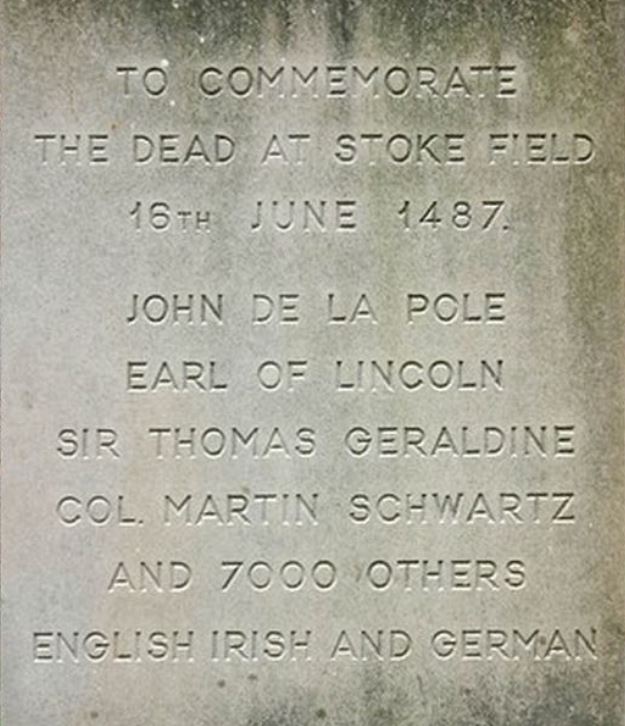
A stone monument which can be seen at the site of the Battle of Stoke Field
“A stone marker commemorating the battle can be found at Burrand Bush, where Henry is said to have placed his standard following his great victory. And Willow Rundle, at the side of Elston Lane, is said to mark the spot where Col Schwarz and the Earl of Lincoln fell, speared through the heart with willow stakes which then took root and sprouted.
“Councillor John Cottee, Chairman of Nottinghamshire County Council’s Communities and Place Committee, said: “We are delighted that this project will recognise our county’s only registered battlefield. Our heritage is important to us and our sense of place. The Battle of Stoke Field history trail project aligns perfectly with the county council’s aspirations to make more of Nottinghamshire’s heritage and tourism offer.
“Tourism is one of the fastest growing sectors and contributes £1.8 billion per year to our local economy. Visitors will be encouraged to visit our area, stay longer and enjoy our sites and scenery which all play a part in telling the story of who we are and the role Nottinghamshire has played in shaping the history of our nation.”
“Further information about the trail, including the videos, is available from www.nottinghamshire.gov.uk/BattleofStokeField”
My comments: Henry Tudor didn’t give a rousing speech – he didn’t arrive on the scene until the battle was over. Francis Lovell escaped, it is thought by swimming his horse across the Trent. Schwarz’s German mercenaries, the landsknechte, were very highly trained indeed! Oh, and yes, ‘Boo!’ to Derbyshire!


 The New Murrey and Blue blog
Leave a reply to A CASTLE SAVED AT CODNOR | murreyandblue Cancel reply