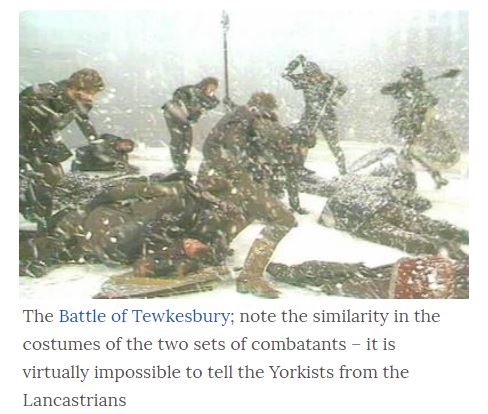
Believe it or not, the above is supposedly the Battle of Tewkesbury. At least, it is according to the BBC website. Tewkesbury was in May. Silly author. The picture is of Towton, which took place in the middle of a snowstorm. The article itself is referring to Henry VI, Part 3 – first transmitted in the UK: 16 January 1983
Nothing daunted, I read on, and came to The Tragedy of Richard III – First transmitted in the UK: 23 January 1983. Oh dear. I now have to say Silly Beeb! Here we have a pyramid of bodies, topped by a cackling Margaret of Anjou!

Delightful, yes? Is there such a pile in the Bard’s original? I quote from the article:-
. . .The production is unusual amongst filmed Richards insofar as no one is killed on camera except Richard himself. This was very much a conscious choice on the part of Howell; “you see nobody killed; just people going away, being taken away – so much like today; they’re just removed. There’s a knock on the door and people are almost willing to go. There’s no way out of it. . .
. . .Somewhat controversially, the episode ended with Margaret sitting atop a pyramid of corpses (played by all of the major actors who had appeared throughout the tetralogy) cradling Richard’s dead body and laughing manically, an image Edward Burns refers to as “a blasphemous pietà.” Howell herself referred to it as a “reverse pietà,” and defended it by arguing that the tetralogy is bigger than Richard III, so to end by simply showing Richard’s death and Richmond’s coronation is to diminish the roles that have gone before; the vast amount of death that has preceded the end of Richard III cannot be ignored. R. Chris Hassel Jr. remarks of this scene that “our last taste is not the restoration of order and good governance, but of chaos and arbitrary violence.” Hugh M. Richmond says the scene gives the production a “cynical conclusion,” as “it leaves our impressions of the new King Henry VII’s reign strongly coloured by Margaret’s malevolent glee at the destruction of her enemies that Henry has accomplished for her.”. . .
Good grief. Did you get all that? No, nor me. Nor do I want to. Serious stuff though, right? Er, no. It sounds like a load of silly and affected directorial posturing, and not worth bothering with. Someone should have kicked the Beeb’s pants for broadcasting it. Bah!


Leave a comment