Think of a cold week in this or your own country, with snow. On the last day, it thaws. You look out during the late afternoon and there remains a small patch of snow, in a seemingly random location.
 

In a way, the English Reformation was like this. It began, arguably, in 1534. By the end of the next decade, clerical celibacy was abolished and the Archbishop of Canterbury was among those priests who married , apart from a slight hiccup in the next reign.

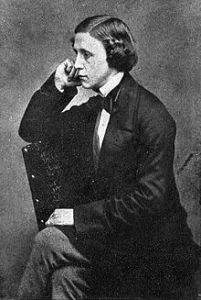
Some three hundred or more years after the Act of Supremacy was still passed, there was still a requirement at Oxford University for its Fellows to be celibate. One such was the legendary mathematician Charles Lutwidge Dodgson (left) also known, by his reversed, “translated” forenames, as Lewis Carroll.

The irony is that Dodgson had considered entering the priesthood during his youth but may have rejected it because he dreaded the thought of preaching regularly.


Subscribe to my newsletter

  1. […] this before. When Henry VIII made himself the head of the church in England, it became possible for hitherto celibate priests to marry. This situation continued under Henry’s son, Edward VI. But then, Catholic Queen Mary ascended […]

    Like

  2. […] hate and pullin a face–he is said to be the inspiration for the illustrations of Lewis Carroll’s Mad Hatter! Other figures include men with dogs who may be the churchwardens, a man with a fiddle, […]

    Like

  3. […] Pole, as a Cardinal, was bound by clerical celibacy but could this be reversed? Not if this later case is anything to go by, although Phillip II, […]

    Like

  4. […] had participated with gusto, they were part of the first generation of English clergy, not bound by clerical celibacy, to marry and have legitimate children. Bishop Ridley’s own notable descendants include these […]

    Like

  5. […] a life of so-called chastity really necessary? I say this of the Church in general, and any other religion/organisation that […]

    Like

  6. […] has returned with a further series. This time, the episodes earlier this year having been about the Reformation, the Armada and Queen Anne, she covers the eighteenth to twentieth centuries, reversing the […]

    Like

  7. […] the village of Wiveliscombe in Somerset. The 13th century palace had fallen into disuse after the Reformation and lay in ruins by the 1700’s…when the site was built over and subsequently lost, with […]

    Like

  8. […] Some people create just for fun, others to have fun AND to inform. Suffolk modelmaker Colin Patten plans to do both in a large-scale model of the entire town of Ipswich in late medieval times, before the abbeys and priories were swept away in the Reformation. […]

    Like

  9. […] Julian of Norwich, Margery Kempe, the East Window at York Minster and Death and the Gallant; The Reformation and rival queens, Foxe‘s Book of Martyrs, the Marian Hangings (embroideries not people), […]

    Like

  10. […] still do. Such reforms began at the Council of Trent.England (and Wales) had a gradual non-linear Reformation from the 1530s and Scotland a more sudden one in about 1560, although many Catholics still consider […]

    Like

Leave a reply to ST PETER’S CHURCH, WINCHCOMBE AND THE BOTELERS OF SUDELEY | murreyandblue Cancel reply