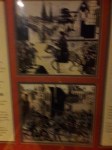
Here are some of the panels just inside the door of the Colchester Playhouse, now a theatre-themed public house. They illustrate John Ball, after whom a minor town centre road is also named, becoming a priest, a prisoner at Maidstone and then participating in the 1381
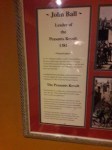
Peasants’ Revolt (from 30 May), fighting at Blackheath (on 12 June) and then being executed at St. Alban’s on 15 July that year.


Subscribe to my newsletter

  1. […] Ball Walk and Wat Tyler Walk, commemorating the Peasants’ Revolt leaders the former of whom had an Essex connection, lie at the lower end of West Stockwell Street. […]

    Like

  2. […] “….The first title, Charter for Murder, is now in bookshops, on Amazon and also available as an e-book. Set in taverns in the city, the cathedral and Hyde Abbey itself – still marked by a splendid gatehouse – it is a tale that pits the wits of churchman against politician at a time when monasteries were under threat and the teenage king Richard II faced the Peasants’ Revolt….” […]

    Like

  3. […] the first episode, Ian Hislop visits East Anglia, particularly Colchester, Ipswich and Sutton Hoo, viewing some coins with Philip Wise and hearing about the Wuffingas, […]

    Like

  4. […] the Peasants’ Revolt in 1381, when the Tower of London was breached by the rebels and some of those sheltering inside […]

    Like

  5. […] so full of bloopers that it really is a joke. For instance, OLD Richard II reigned during the Peasants’ Revolt. Um, Richard was 14 at the time. And then again Henry IV was Richard II’s son. But wait, […]

    Like

  6. […] the Bayeux Tapestry in style, is presently in Austria but the family hope it can be displayed in Colchester, near where Tirel hid during his flight, or […]

    Like

Leave a reply to This Union: The Ghost Kingdoms of England – murreyandblue Cancel reply