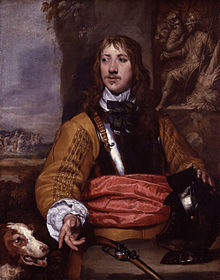
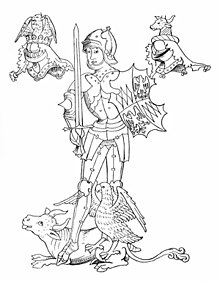
In the English Civil War, there was a Royalist commander named Richard Neville (left). Unlike his namesake and relative (right), this Colonel of Horse survived the campaign, fighting at the first Battle of Newbury and being with Charles I at Oxford at the conclusion of the first War. He became a High Sheriff, Lord Lieutenant, JP before he died, peacefully, at 61.

h/t Only Connect, who reminded us that there is also a publisher and a singer by this name.


Subscribe to my newsletter

  1. […] cited by the author’s correspondence with Exeter Cathedral. (2) Also an ancestor of Colonel Richard Neville (Royalist commander) and George Washington, inter […]

    Like

  2. […] the “English Civil War” is also known as the “War of the Three Kingdoms”, each of which had a different […]

    Like

  3. […] into Parliamentarians and Lancastrians becoming Royalists. One parliamentary commander was a Richard Neville and another bore the name of Ralph Assheton, as we shall show, descended from the Vice-Constable of […]

    Like

  4. […] Any further plans Richard had for Sandal came to nothing when he was killed at Bosworth in 1485, and the Tudors let the castle fall into decay after brief use as a prison. It was ruined further during the Civil War. […]

    Like

  5. […] for prisoners of war, before a housing estate was built over it. Then they follow the course of the Civil War to King’s Lynn, where Parliamentarians retook the town at a 1643 siege and fortified it with […]

    Like

  6. […] not to be confused with the branch of Compton Verney in Warwickshire, who were prominent in the Civil War and to the present day, still living in Claydon House […]

    Like

  7. […] the castle was badly damaged in the English Civil War, being the last to hold out against the Parliamentarians. Oliver Cromwell hated it for this reason […]

    Like

  8. […] tingling little tale of a ghostly event in a south tower room at Stokesay. Probably connected to the Civil War, not the medieval period, but intriguing all the same. And I have to agree that such things are […]

    Like

  9. […] I hoped the wall paintings would be medieval, but it seems not. They go back to the 1660s, the English Civil War, so are fairly old anyway. Of course, being in Micklegate, York, is a definite help when it comes […]

    Like

Leave a reply to NEW DISCOVERIES AT PONTEFRACT CASTLE – murreyandblue Cancel reply