treason among the roses

The scene above is fictitious, with roses being brandished nobly, but the strife known to posterity as The Wars of the Roses was full of treachery. Turncoats abounded, loyalty could be non-existent, and men’s names dragged down. Not always dragged down, of course, because if the traitor defected to the ultimately winning side, he did very nicely, thank you very much.

The Battle of Northampton, 10th July 1460, for instance, was won by the Yorkists because the Lancastrians were betrayed by the commander of their own vanguard, Edmund Grey, Lord Grey of Ruthin. It was a prearranged plan, with the Earl of Warwick’s Yorkists told not to attack anyone in Grey’s colours. Grey’s reward was to be made Earl of Kent.

200px-John_de_Grey,_1st_Baron_Grey_de_Rotherfield_Arms_svg
Edmund Grey, Lord Grey of Ruthin

But five months later, on 30th December that same year, was fought the Battle of Wakefield, at which the tables were turned and York lost to Lancaster, in the process forfeiting the lives of the Duke of York himself, his prominent supporter the Earl of Salisbury, and York’s 17-year-old second son, Edmund, Earl of Rutland.

sandal1300_2
Impression of Sandal Castle, near Wakefield

York was trapped at Sandal Castle near Wakefield, with (it is estimated) round 5,000 men compared with the (equally estimated) 20,000 of the Lancastrians. Richard Neville, Earl of Salisbury (not his namesake, the Earl of Warwick) was at York’s side throughout. The Nevilles were one of the great families in the north, but were divided because Salisbury’s cadet branch had risen above the senior branch, which was led by his great-nephew, the Earl of Westmorland. Westmorland was ill, and his younger brother, John Neville of Raby, had a great deal to gain by the destruction of both York and Salisbury.

Raby Castle
Raby Castle

The Percys were another great northern family, who, resentful of the jumped-up Nevilles, opposed York and Salisbury. John Neville of Raby was soon colluding with the Percys and other Lancastrians. A plot was hatched by the northern veteran Andrew Trollope to fool the Duke of York into coming out to join battle, when he should have stayed safely in Sandal Castle, waiting for the help that was on its way from his son and heir, Edward, Earl of March, the future Edward IV, and from the Earl of Warwick.

SIr_Andrew_Trollope's_coat_of_arms_svg
Sir Andrew Trollope

Trollope had been a Yorkist, but changed sides after feeding York with false information about the strength of the Lancastrians. Then, after concealing most of the Lancastrian army in the woods surrounding the intended battlefield in front of the castle, Trollope marched a much smaller contingent into the open to challenge York and deceive him into thinking the opposition was much smaller than it really was.

It would also seem that the scheming John Neville of Raby further fooled York with false colours, so that he thought some Yorkist reinforcements had arrived from Warwick. Another version is that Neville pretended he would raise men for York, but raised them for Lancaster instead. Either way he was a lying turncoat. And all this went on while a Christmas truce was in force! Not very honourable or chivalrous.

Oh, sneaky, sneaky Lancastrian traitors, yet York appears to have had faith in these men. Certainly it is thought he believed that if he gave battle, a large portion of the Lancastrian army would come over to his side. He was strongly advised to stay in the castle and just wait for his son Edward and real allies to arrive to save him, but something convinced him to march out and not only be confronted by the Lancastrians he could see, but surrounded too by the greater numbers hidden in the woods. Was he incredibly brave and sure of his cause? Or deluded and a complete fool? As we do not know what was in his mind, we will probably never know. All we do know is that he was betrayed by so-called friends.

The battle was short. York, Salisbury and young Edmund were all slain and beheaded, and their heads displayed ignominiously on Micklegate Bar in York. York’s head was ridiculed with a paper crown, and a notice: York overlooks the city of York.
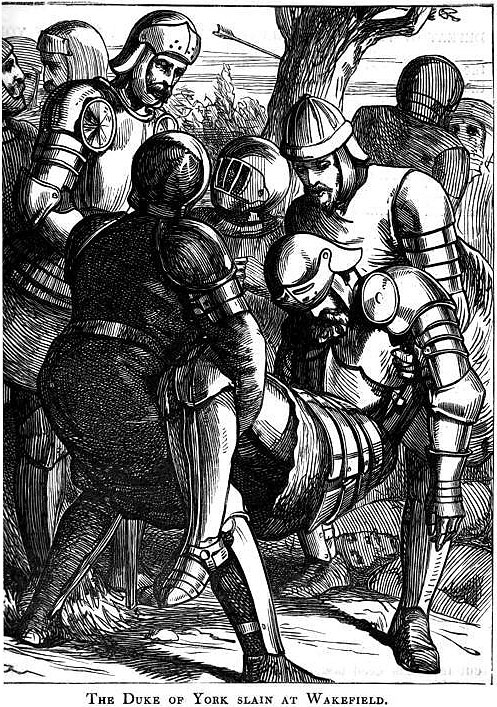
richardyorkdeath

It was a disaster for the Yorkist cause, but now Edward of March took over as head of the House. He triumphed, became Edward IV, and after one brief blip when he had to flee to his sister in Burgundy, he returned to vanquish Lancaster and reign for twelve peaceful years. He passed away at a relatively young age, but death came in his bed, not on a battlefield.

Of course, being a Ricardian, I have to think of Bosworth, where the greatest betrayal of them all brought about the brutal death of the Duke of York’s youngest son, Richard III. The name Stanley is all I need to say. Back-stabbing and fence-sitting was their game. The Stanleys benefited greatly from their shameful treachery. Who says crime doesn’t pay?

As I have commented here, if only York had stayed put in Sandal Castle, how different might things have been. Would he, not his youngest son, have become King Richard III? Edmund could have lived to marry and perhaps have progeny. George of Clarence might never have rebelled and been condemned for treason. And if York had been around, might his eldest son Edward have been prevented from making the disastrous Woodville “marriage” that was to eventually lead to the horror of Bosworth? Bosworth, where it might have been King Richard IV who was hacked to death.

Who knows? Without the Woodville marriage, there wouldn’t have been a King Richard to die at Bosworth. There wouldn’t have been a Bosworth, because Richard, Duke of Gloucester, would probably have happily lived out his days as Lord of the North, maintaining a peaceful balance between the Nevilles and the Percys.
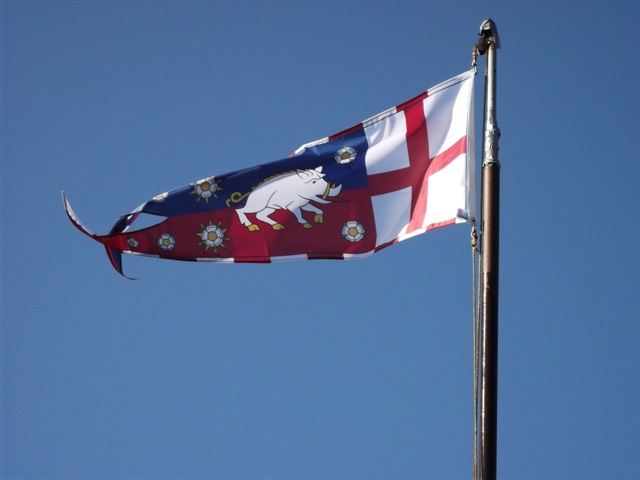
Richard's standard at Bosworth


Subscribe to my newsletter

28 responses to “Treason among the Roses….or….Who betrayed whom at Wakefield….?”

  1. michael tomlinson Avatar
    michael tomlinson

    Yes,,Lord Neville was certainly in the thick of the treachery, ,,,and got his come uppance three months later at Dintingdale before Towton!!!

    Liked by 1 person

  2. I visited Sandal castle a couple of years ago and it is a small site. 5000+ guests arriving with little notice in winter must have been difficult to provide for in even a minimal fashion. I don’t doubt the turncoats but I do think that notion of riding out to hunt at the least might have been necessary in the circumstances.

    Liked by 1 person

  3. […] don’t like to regard Richard, Duke of York, as a traitor. He was the rightful heir to the throne and had the dirty done on him. But then, I […]

    Like

  4. […] (the same fate as that suffered by the last of the sons, the brave Richard III) at the Battle of Wakefield. York and Edmund’s heads were displayed on the gate of York city. At least Richard III did not […]

    Like

  5. Hear, hear. Thanks for being a Ricardian too.

    Like

  6. […] Battle of Wakefield took place on 30th December, 1460. It ended when Richard, Duke of York, lost his life. As did his […]

    Like

  7. […] Duke of York, was killed at the Battle of Wakefield in 1460 but later, in 1476, exhumed by his son, Edward IV. The body was taken with great ceremony […]

    Like

  8. […] it comes to English medieval history, the closest I can come to New Year’s Eve is the Battle of Wakefield, which took place the day before in 1460. To learn more, go to Battlefields of Britain As the 3rd […]

    Like

  9. […] was also disappointed by the brief, conventional accounts of the battles of Wakefield and Towton, the great Lancastrian victory followed shortly by the catastrophic defeat which cost […]

    Like

  10. […] years ago there was an important battle of the Wars of the Roses, the Battle of Wakefield, which was fought before Sandal Castle. The Lancastrians won, and Duke of York and one of his sons, […]

    Like

  11. […] the original Hornby Castle. Sir Thomas Harrington and John, his elder son, were killed fighting at Wakefield in the Yorkist cause. John Harrington left two daughters – Anne was five and Elizabeth four […]

    Like

  12. […] and The Butcher after his murder of York’s young son, the Earl of Rutland, at the battle of Wakefield in […]

    Like

  13. […] Wakefield Museum there is a rather unusual artefact–a late medieval chamber pot that was discovered in […]

    Like

  14. […] the other battle scenes depicted are Wakefield, Towton, First Battle of St Albans, Tewkesbury and […]

    Like

  15. […] example, what if Richard III’s father, Richard Duke of York, had not been killed at Wakefield but had defeated Margaret of Anjou’s army and claimed the throne (HE would have then become […]

    Like

  16. […] moves on to Edward IV.   Edward took the throne, aged just 19,  after his father’s death at Wakefield when it ‘seemed the White Rose of York had withered past revival’ and is described as ‘a […]

    Like

  17. […] was taken from the rival Percy family. The second son, Thomas, lacked a title and was killed at the Battle of Wakefield in 1460. The oldest son, who was the couple’s third child, would reach the pinnacle of the […]

    Like

  18. […] throne. Oops. It’s his undoing, and eventually leads to the Lancastrian victory at Battle of Wakefield, where York and one of his sons, Edmund, are […]

    Like

  19. […] was common for these English lords to have at least some Welsh ancestry. Grey de Ruthin, for example, had a line of descent from Owain Gwynedd. The Charlton (or Cherelton) lords of Powys […]

    Like

  20. […] 1428 when he was killed at Orleans. He left as sole heir his daughter Alice, who was married to Richard Neville, eldest son of Ralph Neville and Joan Beaufort. Thus the Salisbury lands and titles fell into the […]

    Like

  21. […] the end of 1460 York was killed at Wakefield, but only a month later Wiltshire found himself facing the forces of York’s son Edward at […]

    Like

  22. […] and Cicely Neville was born on the 17th May 1443 at Rouen, France and  would die at the Battle of Wakefield,  just outside Sandal Castle,  with his father on the 30 December 1460.  A short […]

    Like

  23. […] with having slain (with some brutality) young Edmund of Rutland immediately after the Battle of Wakefield at the end of December 1460. It’s thought that this act earned him the nickname Butcher Clifford. […]

    Like

  24. […] then on the ills that befell Edward intensified into serious calamity, when at the Battle of Wakefield he lost his father and younger brother, Edmund, Earl of Rutland. Not only were they defeated but […]

    Like

  25. […] that his head was placed on Micklegate Bar, which would only be possible if:1) He had been at Wakefield aged eight and died with his father, which we know to be untrue. After all, Shakespeare places him […]

    Like

  26. […] yet another William,  Lord Harington jure uxoris –b.1420 d.31 December 1460 –  at the Battle of Wakefield, fought on the 31 December 1460 for Richard Duke of York (1). These deaths would result in a still […]

    Like

  27. […] was this Somerset who was in command of the victorious Lancastrian forces at Wakefield and St. Albans (second). He was fortunate to escape from the defeat at Towton, as he would almost […]

    Like

Leave a reply to When there’s snow at midsummer…. – murreyandblue Cancel reply