Robert Stillington is likely to have been born in about 1420 and was consecrated as Bishop of Bath and Wells on 30 October 1465. As we know, in spring 1483, he confessed his knowledge of Edward IV’s bigamy. Based on Stillington’s evidence, the Three Estates voted to cancel the coronation of Edward V, inviting Richard Duke of Gloucester to become king instead, as described by the (otherwise hostile) James Gairdner as “almost a constitutional election”.

Richard III succeeded as a result of this decision but Stillington’s status remained unchanged during this reign. Edward IV had raised Canon Stillington to the first available see after his own second secret marriage ceremony and Richard could have rewarded him similarly on two, three, four or even five occasions.

As the late David Baldwin’s Richard III (pp.172-3) reveals, two Bishops died during Richard’s reign – had he been of similar character to the first Lancastrian, the second or fourth “Tudor”, there may have been three:
1) William Dudley (Durham) died on 29 November 1483 and John Shirwood was appointed. The Prince-Bishopric of Durham was the next highest see in the province of York and Thomas Wolsey (right) was to be translated there from Bath and Wells in 1523, although he had already been Archbishop of York for nine years and was really only an administrator in the other dioceses.
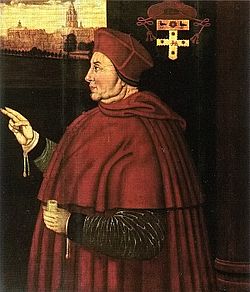
2) Lionel Wydeville (Salisbury), who had hitherto thought himself to be Edward IV’s brother-in-law, died some time in late 1484. Thomas Langton was translated from St. David’s and Hugh Pavy appointed there. Both of these diocesan livings were better than that of Bath and Wells. Earlier than this, he could have been deprived for treason. Langton was appointed as an administrator from March 1484.
3) John Morton (Ely) was arrested in June 1483 for treason and might have been deprived after his attainter, as Cranmer was summer 1553. Again, Ely was a more lucrative see.
4) Peter Courtenay (Exeter) joined the Buckingham rebellion in autumn 1483 and fled to Europe after attainder – another comfortable senior vacancy.

So there we have it. As we also showed here, Richard III had several good opportunities to promote Robert Stillington after his election by the Three Estates but took none of them, clearly implying that he regarded the cleric as having merely performed his conscientious duty, not a favour of any kind.


Subscribe to my newsletter

14 responses to “Significant opportunities missed?”

  1. Perhaps Richard was angry with Stillington for keeping quiet for so long and not speaking sooner, saving a lot of misery and heart ache?

    Liked by 1 person

    1. It is more likely that Stillington was just doing his job as early as it was safe and relevant to do so. A bigamist was not disqualified from being King but a bastard was – this is still the case.

      Like

  2. It was always a bit unlikely that stillington would have announced it while Edward was still alive,…..he would have been far too afraid

    Like

  3. He would have been absolutely insane to speak out while Edward IV was alive, as would anyone else with the relevant knowledge. Edward (particularly in his second reign) had a very short way with people who got across him. Ask George Clarence for details.

    Like

    1. As JA-H pointed out, Lady Eleanor died quite conveniently, just as Edward’s cohabitation with Elizabeth Wydeville was taking off properly and daughters were being born.

      Like

      1. Or alternatively, Stillington selected Eleanor specifically as the subject because of the fact that she had died.

        Like

      2. The evidence, which has increased since the first edition of her eponymous book, suggests that he “selected” Lady Eleanor because he remembers her being the bride and that he disclosed this as soon as it was safe and relevant to do so.

        Like

  4. I am a little doubtful about the idea that Eleanor was murdered as it seems stillington would also have to have been killed. Why kill one without the other

    Like

    1. Her sister’s servants were executed soon afterwards and Clarence was later. Each of these would be a reminder, whilst not actually harming a priest. See the new edition of “Eleanor”.

      Like

  5. […] not have been possible for a secret ceremony of which only Lady Eleanor, Edward and (possibly) Canon Stillington knew at the […]

    Like

  6. […] to students of the Wars of the Roses and especially to Ricardians: John Russell Bishop of Lincoln, Robert Stillington Bishop of Bath and Wells, Thomas Langton Bishop of St David’s and later of Salisbury and John […]

    Like

  7. […] Bishop Robert Stillington was imprisoned soon after Bosworth and died in captivity in 1491, definitely by 15 May. It is generally thought that this was a punishment for providing the copious evidence that convinced the Three Estates, in June 1483, of Edward IV’s bigamy. This rendered Elizabeth of York and all her siblings legally illegitimate, which was highly inconvenient for Henry “Tudor”, who sought to marry her. Stillington’s arrest and Catesby‘s summary execution fall into the first four days of Henry VII’s actual reign and the first five of the reign he claimed. […]

    Like

  8. […] prior to the 14th/15th century addition of the two West Front towers we know today and that Stillington would have seen. I really is quite […]

    Like

  9. […] there for the night. It is far more grand and spacious…and the resident bishop at the time, Lionel Woodville, had recently fled owing to his involvement with Buckingham’s Rebellion, leaving it handily […]

    Like

Leave a reply to sighthound6 Cancel reply