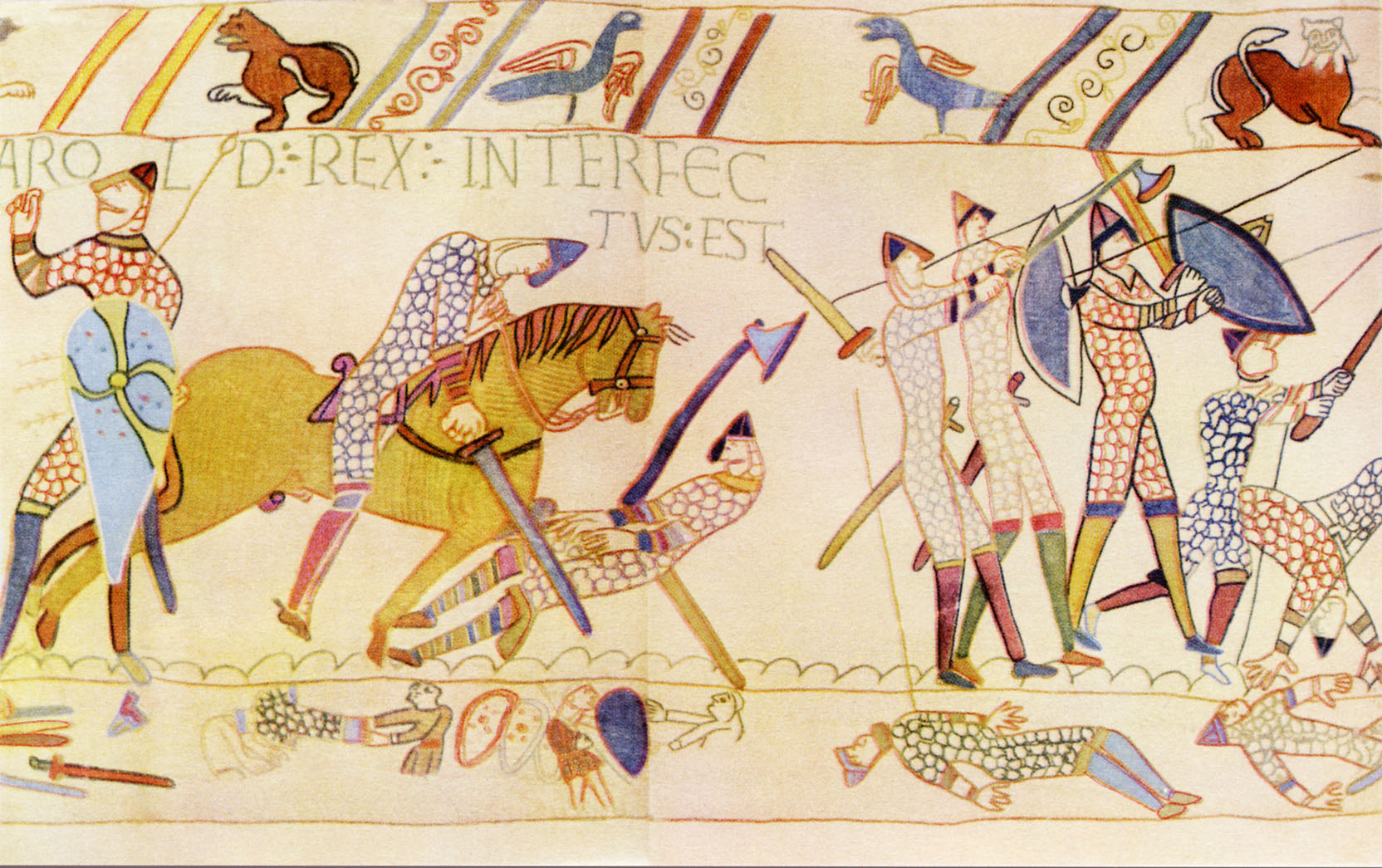
This piece, by Marc Morris in History Extra, describes the events that followed the previous usurpation from France. A lot more violent, indeed, than the early reign of the first “Tudor”, although his son and grandchildren changed that ..The Death of Harold at the Battle of Hastings, 1066.

Subscribe to my newsletter

27 responses to “William the B … er, Conqueror”

  1. […] Viking dynast, to learn sparring with a sword and shield. Then he went to the Tower to talk about William I and Dover Castle for Henry II, discussing his rebellious sons and his mixed relationship with […]

    Like

  2. […] city, Ethelred II reconquered it and destroyed London Bridge as well. The programme finished with William I’s coronation on Christmas Day 1066, followed by his rebuilding of the Tower with Norman stone, not to be […]

    Like

  3. […] 2019. Deep in the soil of the valley  lay a hidden hoard of silver coins  buried just after the Battle of Hastings, probably by a wealthy […]

    Like

  4. […] Among the kings and emperors portrayed are Alexander the Great, Charlemagne, King Arthur, and William the Conqueror. Secondary decorations include initials decorated with gold filigree, and others rubricated in red […]

    Like

  5. […] all know that Richard is directly descended from William the Conqueror, who is his eleven times great grandfather. Here is Richard’s pedigree to William in three […]

    Like

  6. […] had turned up to interrupt the proceedings. The Battle of Hastings would definitely not gone in William the Bastard‘s favour, and we’d have kept our King Harold Godwinson. No brutal interference from […]

    Like

  7. […] Tapestry didn’t credit the Confessor with albinism either, and I can’t imagine that William the Conqueror would have given a damn one way or the other. The Confessor could have been blue with yellow spots […]

    Like

  8. […] Bean. They proceeded to Lenton in Nottinghamshire, to seek the remains of a priory pertaining to William I, with several householders’ permission, of course, then to South Shields for a World War Two […]

    Like

  9. […] with the familiar narrative, from Harold‘s shipwreck and forced oath to Edward‘s death, William‘s invasion plans and their execution, the battle and the subsequent construction of the […]

    Like

  10. […] of Bayeux was William of Normandy’s half-brother and right-hand man, and was a fearsome prospect when in armour and on the warpath. […]

    Like

  11. […] it. Earl Spencer pulls no punches in his description of the king’s character, the last of the Conqueror‘s legitimate male line, whilst quite possibly describing the rediscovery of the White Ship […]

    Like

  12. […] husband, the up and coming Roger de Montgomery, who was friend to the young, new Duke of Normandy, William (who would of course eventually become ‘the Conqueror). Roger did not fight at Hastings but […]

    Like

  13. […] episodes, to which Marc Morris is a regular contributor, as are Janina Ramirez and Gareth Williams, the numismatist of the British […]

    Like

  14. […] seems that William the Conqueror’s corpse “exploded” at his funeral. The thought of an exploding corpse is bad enough without […]

    Like

  15. […] Owain Glyndŵr. He adopted the surname ‘Herbert’ because of alleged descent from one of William the Conquerer‘s companions of that name, a descent that was quite bogus but useful when aspiring to […]

    Like

  16. […] by David Threlfall (Men of the World), feature:The Roman and pre-Roman periods, Beowulf, the Norman conquest and the Bayeux […]

    Like

  17. […] King of England in 1077 was William I. Henry IV of England reigned from 1399-1413. So who, exactly, negotiated those sheets of ice in […]

    Like

  18. […] King of England in 1077 was William I. Henry IV of England reigned from 1399-1413. So who, exactly, negotiated those sheets of ice in […]

    Like

  19. […] images depict him in a Christ-like context, stops very soon after the battle without going on to William the B … er … Conqueror‘s coronation, implying that there is a missing end part to the 1066 […]

    Like

  20. […] warriors, but according to this article it seems the Fearsome Five are (in chronological order) William I, Edward I, Robert the Bruce, Henry V and … Richard III. Now, I’m not saying Richard […]

    Like

  21. […] exactly how old they are, so it’s often a surprise to learn that some date back to the time of the Conqueror, or before. They seem so  naturally there that they’re almost as if nature conjured them. But […]

    Like

  22. […] Edward are by no means the only English/British monarchs honoured in this way. The series runs from William the Conqueror to William IV, with Oliver Cromwell thrown in for good […]

    Like

  23. […] a long time it was believed the grave of Henry I, the son of William The Conqueror, was under a nursery school building, but from my research it looks like he is under the car park […]

    Like

  24. […] Castle is in glorious Northumberland, see here, and dates back to the time of William the Bastard….er, Conqueror. All you need is £3 […]

    Like

  25. […] in East Sussex dates back to the Romans in the 3rd Century, and so was about 775 years old when the Conqueror marched into it. What a pity it didn’t collapse over the Bastard! Ha! Oh, but wait, that would […]

    Like

  26. […] did indeed have large castle, of which only the mound remains today. It was first built in 1068, so the Conqueror deemed Cambridge important enough to take care of very quickly after his […]

    Like

  27. […] called this son born on the wrong side of the blanket William, and in a few years this bastard son would change English history […]

    Like

Leave a reply to Was Edward the Confessor an albino….? | murreyandblue Cancel reply