This article investigates why, as the Mediaeval Warm Period drew to a close, Britain (and particularly England) developed differently to many nations of Southern Europe.
Sandbrook mentions two major cultural factors: the tradition of salting bacon because ham could not be dry-cured and the evolution of the wool trade through the systematic elimination of the flock’s only natural predator – the wolf – through a hunting campaign led by Peter Corbet, from a Shropshire family, under Edward I. Corbet, who fought at Falkirk, may even have given his name to this.
Sheep could n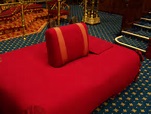 ow safely be domesticated and their numbers greatly expanded. In Florence, the Medici saw the banking system develop as a result. In England, the best evidence is all around us. Whilst the Woolsack (left) has been a dominant feature of the House of Lords for centuries, the wealth generated
by the wool and cloth trade is reflected in properties throughout the country, but particularly in East Anglia, the region generally closest to the European mainland and the other territories of the Hanseatic League. In particular, Lavenham (below), Hadleigh and  Woodbridge still have many such distinctive timber-framed houses, the former having been regarded as a town in the late mediaeval and Early Modern eras.
As Sandbrook goes on to explain, in his review of Robert Winder’s “The last Wolf”, writers from Chaucer (who married into the de la Pole family of wool barons) to Eliot and Orwell wrote of the traditions of the wool trade. It continued long after Corbet’s 1281-90 campaign and was to benefit from the technological developments of later centuries.


 The New Murrey and Blue blog
Leave a reply to There was a crooked man who lived in a crooked house…. – murreyandblue Cancel reply