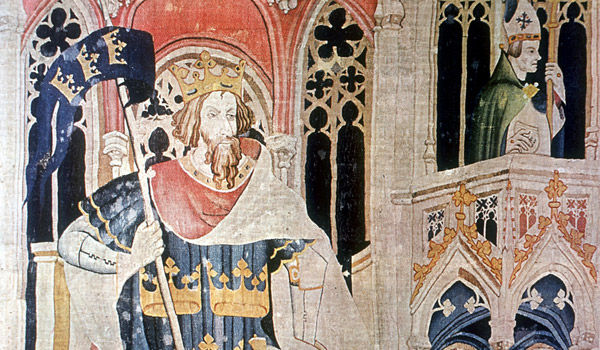


The following article is based on books by Chris Barber and David Pykitt, so I do not claim anything as my own work. The books are The Legacy of King Arthur and Journey to Avalon. It is also based on a third book by Chris Barber called King Arthur: The Mystery Unravelled, which contains more about Henry VII and King Arthur. The illustration of St Armel’s tomb is also from one of the books, the rest I found by Googling. I recommend all three works as fascinating reads about the eternally fascinating King Arthur.
According to the above authors, Henry VII knew that he was not only descended from King Arthur, but also the identity that the king assumed, and exactly where he was buried.
These are astonishing claims, because to this day no one else really knows, so how come Henry VII was au fait with these astonishing details back in the 15th century? I mean, we all know how cunning and secretive Henry was, so he was quite capable of inventing it all, but the inference in the above books is that there was nothing invented at all. Henry was on the level. According to his lights.

The thing about Arthur, has always been that when he was “mortally” wounded at his last battle, now thought to be Camlann (the whereabouts of which is not known), he just disappears. We have the story of Sir Bedivere having to be told three times to throw Excalibur into the water to the Lady of the Lake, and that’s…well, the end of it, really. He was last seen being taken away across water to be healed by magic of some sort. Of course, I’m referring to the later romances, not the real Arthur, who was a Dark Age war leader, but even so, the outcome is the same. No one knows what happened to him. Except for Henry Tudor, who, somehow, had all the facts.
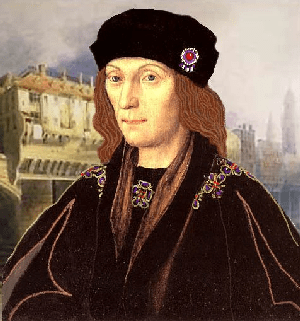
Henry was proud of his Welsh roots. At least, he was when he needed his countrymen’s help to usurp the throne of Richard III. After that, he didn’t do much for Wales or the Welsh…except decide to claim King Arthur for himself. Arthur being Welsh too, you understand. Well, that’s my opinion, but I know there are a lot of other theories about the who, where, what and why of the real Arthur.
According to Barber and Pykitt, as far back as the eighteenth century, Arthur was known to be the hereditary leader of the Silures in South Wales, yet the vast majority of modern historians choose to ignore this, placing him anywhere and everywhere except South Wales. Oh, with a passing mention of Caerleon. Hmm, it must be a general failing of modern historians, to ignore obvious truths in order to feed a traditional obsession.
An examination of early Welsh genealogies revealed to Barber and Pykitt that a misinterpretation by academics had mixed up two Arthurs. Gildas, the monk, mentions a charioteer belonging to someone known as “The Bear”. The Celtic word for bear is “arth”, and so it is possible that the name Arthur is a nickname derived from the title Arthwyr. Whatever, the result was that the Welsh Arthrwys, whose title was Arthwyr, to a later century, and thus detaching him from the Arthur of legend and history. Once this mistake was discovered and corrected, the authors were able to locate not only Arthur’s court, the sites of his most of his principal battles and the Isle of Avalon, but even his final resting place in Brittany.

In Nennius’s Historia Brittonem Arthur is described as not only a military leader, but a religious one too, which brings me to another important point in the story. Now, apart from the Arthur we all know, there was also a soldier-saint named Arthmael (Bear Prince), or Armel. He is portrayed wearing armour—in his guise as “Miles Fortissimus” (Mighty Warrior).
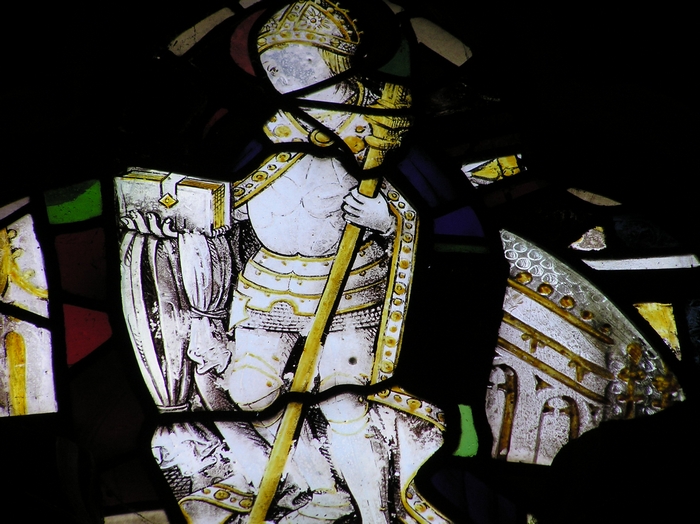
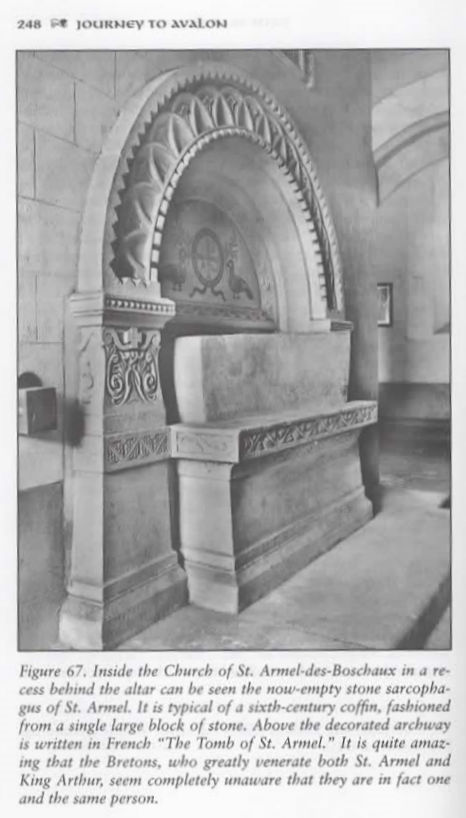
He liberated Brittany from the 6th-century tyranny of Marcus Conomorus. This soldier-saint is known to us now as St Armel (Feast Day tomorrow, 16th August), and his tomb can be seen to this day in Armel’s church at Ploërmel. The stone sarcophagus is empty now, but the identification of the saint’s resting place is definite. There is a gilded casket which is said to contain the saint’s jawbone. The church itself has been rebuilt on the site of the original church, and the tomb incorporated.


Barber and Pykitt have concluded that after Arthur was deposed and apparently fatally wounded in England, he actually went into exile in Brittany—“Little Britain”, where so many of his countrymen were to be found. Thus arose the story of the Once and Future King, because Arthur didn’t die as such, he simply disappeared, leaving his fate unknown to his countrymen. They, of course, hoped he would return. Then, in Brittany, Arthur became St Armel, the Bear Prince, using all his warrior skills to lead the Bretons to freedom. Crucially, St Armel was also an exiled Welshman, and so Henry would certainly feel an affinity with him, if nothing else. Is this connection rather a great leap? Who can say? After all, the authors’ reasoning concerning so many names that contain “bear” in one form or another, seems perfectly logical.
St Armel, a dragon-slayer like St George, was most certainly one of Henry VII’s favourite saints, appearing among the many saints in Henry’s amazing chapel in Westminster Abbey. And Henry, in his determination to establish his links to Arthur, made sure that his firstborn son was not only born in Winchester, but also christened with the name Arthur. Winchester was the ancient capital of the Kings of Britain, and believed (by Malory) to be the site of Camelot. Whether Henry VII agreed with the latter is debatable. After all, surely he’d have preferred Camelot to be somewhere in Wales. But what the heck, in the 15th century Winchester was where it was at, as the saying goes. It had even possessed the famous Round Table since the time of Edward I. The table that hangs in Winchester was painted as we know it now by Henry VIII, and so after Henry VII would have known it in its green-and-white guise.


It all went awry, of course, because young Arthur, heir to the throne of England, died before his father. So there wasn’t a second King Arthur, just another Henry. And what a Henry. Say no more. Please.
There is a lot of extra detail and explanation in the books, both of which are well worth reading. When Henry and his uncle, Jasper Tudor, fled from Britain in 1471, he believed that he was saved from shipwreck off the coast of Brittany by none other than St Armel. The dragon-slaying Welsh saint always featured prominently throughout Henry’s life, and is represented in his chapel (more a cathedral) at Westminster Abbey.

Of course, Henry spent a long time as a captive in Brittany, hunted unsuccessfully by two kings of England, Edward IV and Richard III. In Brittany it was known there was a King Arthur and a St Armel, but the connection between the two had apparently not been made. Ploërmel, where St Armel was buried, is not far from some of the places where Henry was held. (See the example of Chateau de Largoët below – and see more of Henry’s early life in Brittany here)

If nothing else, Henry was a sharp cookie, and quite capable of putting two and two together to make a total that might be true and that definitely suited him. He would have heard the local tales and memories, so maybe—just maybe—he drew the same conclusions that Barber and Pykitt would all these centuries later, to wit, that the saint and King Arthur were one and the same.
We’ll never know the truth, of course. But one thing we can be sure of with Henry, he went out of his way to claim descent from Arthur, and brandished this claim at every opportunity. His purpose was to imprint the belief that his occupation of the throne was justified. Which it certainly wasn’t, except by conquest. His lineage was, if anything, a hindrance. He had no right to the crown of England, and only won at Bosworth through a fluke (by the name of Sir William Stanley).
Were it not for “Judas” Stanley, Henry and his grand Arthurian claims would have been consigned to history. Hardly remembered at all, in fact. A mere footnote – as the loser on 22nd August 1485.


 The New Murrey and Blue blog
Leave a reply to Royal Armouries Cancel reply