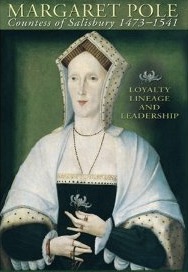
Those looking for an in-depth assessment of the life of Margaret Pole need look no further. Hazel Pierce has more than adequately supplied it in her biography of Margaret – Margaret Pole Countess of Salisbury 1473-1541 Loyalty Lineage and Leadership. Covering Margaret’s life from early childhood – orphaned at five years old, Margaret’s earlier needs were catered for by her uncle Edward who supplied her with the necessities – well – it was the very least he could do under the circumstances – her marriage to Sir Richard Pole – Pierce opines this was a happy one – her widowhood – the restoration to her of her brother Edward’s Earldom of Salisbury by Henry Vlll and finally, her violent death at the hands of an inept axeman aged 67.

George Duke of Clarence – Margaret’s father ‘a myghty prince semley of person and ryght witty and wel visaged’. At her birth in 1473 he stood third in line of succession to the crown of England.
I must confess that on reaching the end of the book my view of Margaret had changed slightly and not perhaps for the better. I was left slightly confused – was she merely obstinate, stubborn and hardheaded, foolishly pressing Henry’s buttons to the limits – unwisely as it transpired – or was she driven by the rememberance of her noble lineage, indeed more noble than Henry’s, the present occupier of the throne? Did she feel honour bound , even duty bound, after the judicial murder of her brother, Edward the Earl of Warwick, to fight Henry tooth and nail over property matters, a fight that raged for 10 years? Did this lead to Henry nurturing a dislike for her which would later influence the decision to execute her? Undoubtedly she infuriated Henry when she encouraged his daughter, the rebellious Mary, aiding and abbeting her in her refusal to return her jewels when her father needed them for his new wife, Anne Boleyn. Margaret seems to have suffered from a nervous breakdown when she and Mary were forcibly parted but later regained her strength and resolve when standing up to the most strenuous of interrogations , her courage shining through in the comments made by one of these interrogators, Sir William Fitzwilliam, Earl of Southampton, who according to Pierce was sympathetic to Margaret’s younger son Geoffrey, but disliked Margaret. He later wrote ‘we have dealid with such a one as men have not dealid with to fore us, Wee may call hyr rather a strong and custaunt man than a woman

William Fitzwilliam, Earl of Southampton by Hans Holbein. The face of the man who interrogated Margaret over 2 days.

Warblington Castle, Hampshire, Margaret’s principal residence where she was interrogated by Sir William Fitzwilliam and Thomas Goodrich Bishop of Ely.
Fortunately for Pierce – and for us – plentiful records have survived that cover Margaret and her sons’ lives ( had the human shredders from the reign of Henry Vll long since departed this mortal coil?) that have enabled Pierce to write a cracking good book and her meticulous attention to detail must be applauded. I found it difficult at times to put this well researched and balanced book down.
Margaret’s eldest son, Henry Montague seems the most sensible of the lot although prone to letting his mouth run dangerously away with him from time to time.
Geoffrey, the youngest, is perhaps the one that took after his maternal grandfather, the mercurial George Duke of Clarence, a loose cannon, but at the same time likeable and charming , with friends that tried to save him, but perhaps lacking the courage of George. He tried to suffocate himself with a cushion, which, not surprisingly failed, and his wife was terrified that he might reveal too much if interrogated – indeed he feared this very thing himself.
Reginald – ah Reginald! – he was the fly in the ointment, safely on the Continent, he managed to survive assassination attempts on his life and was complicit, via his writings, in the downfall of the Pole family. Reginald survived to become a Cardinal and later Archbishop of Canterbury under Mary Tudor. For me a further question arises over Reginald’s rather cavalier attitude to his family back in England. Opposed to Henry’s religious changes in 1537 he sent a message warning that if his mother supported these opinions ‘mother as she is myne, i wolde treade appon her with my feete” Reginald seems not to have give a flying fig over the survival and fates of his family. If so why? Perhaps a grudge of some sort, an axe to grind? Pierce added that Reginald’s actions are so well known that they do not need including in her book. So that is another story.
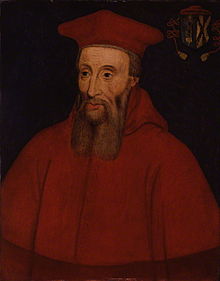
Margaret’s son, Reginald Pole, consecrated as Archbishop of Canterbury in 1556.
And so around spun the fickle wheel of fortune, until they, with the exception of Reggie, were totally undone, disaster and tragedy overtaking them all , with even Montgue’s young son, Henry Pole the Younger, disappearing from sight forever once he entered the Tower of London with his father and grandmother. Poor little blighter.
Although this book does answer many question about Margaret and her family it does leave me with one – did the Poles contribute to their own demise, all in some way stretching Henry’s patience to the limit OR was it always inevitable that Henry would in the end, annihilate the last of those who had the royal and noble Plantagenent blood coursing through their veins?
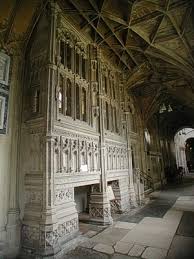
The Salisbury Chantry, Christchurch Priory, Dorset. Margaret’s intended resting place. Margaret was in eventuality buried in the chapel of St Peter ad Vincula, at the Tower of London alongside Henry’s other victims.
‘

 The New Murrey and Blue blog
Leave a reply to super blue Cancel reply