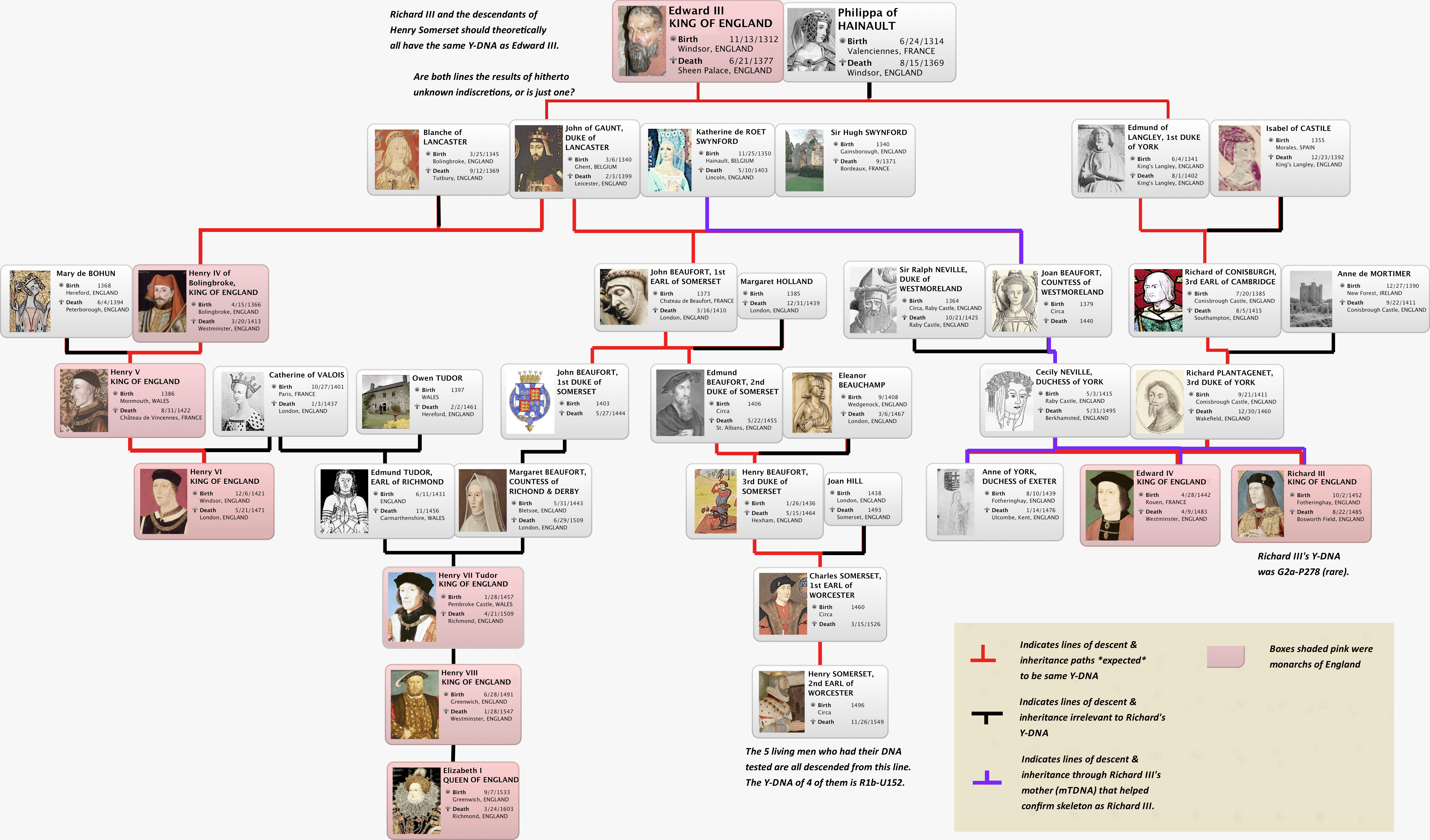
DNA - family tree

The following link arrived in my box this morning.https://figshare.com/…/Richard_III_The_Livingstons_…/4764886 I quote:

“18.03.2017, 07:26 by John Smith

“A skeleton excavated at the presumed site of the Grey Friars friary in Leicester in 2012 is almost certainly that of the English king, Richard III (1452 -1485), and mtDNA (which is passed from mother to child) extracted from the skeleton matches mtDNA taken from descendants of Richard’s sister Anne of York. However Y-DNA (which is passed from father to son) extracted from the skeleton apparently doesn’t match Y-DNA taken from descendants of Henry Somerset the 5th Duke Of Beaufort, who according to history descended from Richard’s 2nd great grandfather Edward III (1312 – 1377).

“The implication according to geneticists, and the media, is that there is a ‘false paternity event’ somewhere between Edward and the Somersets. Also, the false paternity events don’t end there, for only 4 of these 5 Somerset descendants match each other. And it may be worse even than this: the patrilineal line of a Frenchman named Patrice de Warren apparently traces back to Richard III through the illegitimate son of Edward III’s 4th great grandfather, Geoffrey Plantagenet, Count of Anjou (1113 – 1151).

“But de Warren’s Y-DNA doesn’t match that of either Richard III or any of the Somersets. In this note, a formula for calculating the time of the most recent common ancestor is introduced, and some of its consequences outlined. This formula arises from a mathematical framework within which it is possible that the traditional genealogy is correct, and that Geoffrey Plantagenet was the father of a male line incorporating Richard III, all 5 Somersets, and Patrice de Warren.”

References:

http://www.nature.com/articles/ncomms6631

http://users.skynet.be/lancaster/Discussion Maclea.htm

https://figshare.com/articles/On_a_Question_Concerning_the_Littlewood_Violations_pdf/4240424

Me again: The above prompted me to look back at some of the articles that abounded in 2015, when discussion about Richard’s DNA was rife. I selected the following, if only because of the eye-catching family tree:-

http://globalfamilyreunion.com/…/01/03/king-richard-iii-dna/

As the saying goes, the thot plickens. Just who is the father of who…? Our posts here and here may well have answered this.


Subscribe to my newsletter

  1. I must admit I still wonder about the margin of error on Richard’s y-dna haplogroup anyway. While Mtdna survives pretty well most times in ancient remains, the Y-chromosome is much less stable. It DID have to be reconstructed in Richard’s case and as you might remember, this took quite a long time. I am sure somewhere someone (of note) said there is a 20% chance the Y-Dna is not G2.

    Liked by 2 people

  2. blancsanglier Avatar
    blancsanglier

    Nothing would surprise me anymore……..

    Liked by 1 person

  3. John of Gaunt had a Lancastrian wife with descendants…Blanche. Perhaps this could be ironed out with a test. I am her descendant with John Of Gaunt, but not directly down through the female line. Can researchers use a skip-around descendant to reveal the truth?

    Liked by 1 person

    1. Yes, if there is an unbroken female line from Blanche’s mother, grandmother, great-grandmother etc to you, you would share her mtDNA. Michael Ibsen is descended from Richard’s mother, as probably is Wendy Duhlig.

      Liked by 1 person

  4. […] the analysis will reveal more specific information on Richard’s Y chromosome type. This is DNA that is passed down through the male line, from father to son through generations. Earlier analysis […]

    Like

  5. […] his two half sisters and half brother on his father’s side had any children. However recently it was possible to to track DNA from Richard III who also had no direct descendants, and find a correllation in a distant relative. […]

    Like

  6. patricia feeney Avatar
    patricia feeney

    hi william the concorer was born out of wedlock his son henry

    had 25 children out of wedlock. edward the 3rd had 3 children out

    of wedlock. perhaps this could be it trish

    Liked by 1 person

    1. All of Edward IV’s children were illegitimate, of course. The Y-chromosome comes from Henry II’s father so Henry I and William I are not part of the relevant line.

      Liked by 1 person

      1. patricia feeney Avatar
        patricia feeney

        to super blue what does that mean then could you explian this to

        me thanks tish

        Liked by 1 person

      2. Quite simply, the Y-chromosome can only pass through the male line. Geoffrey Plantagenet was Henry II’s father and is part of this line, whilst Matilda, female and descended from both William I and Henry I, isn’t.

        Liked by 1 person

      3. patricia feeney Avatar
        patricia feeney

        hi also i dont know if this is true but i did read that john of guant

        was the son of a flemish butcher. john of gaunts mother

        had given birth to a still born daughter though edward the 3rd

        so john was quickly brought in as a subdidute . i dont know

        if this is true or not if this is the case then john of gaunr

        is not of royally blood and the rest of the royally family

        any body thought on this thanks tish

        Liked by 1 person

  7. Accusing someone of illegitimacy was a favourite ploy of enemies in the medieval period. And other periods, come to that. I don’t believe this one, which is quite widespread, but I DO believe in the illegitimacy of Edward IV’s children because I DO believe Edward was contracted to Eleanor Talbot/Butler first.

    Like

    1. patricia feeney Avatar
      patricia feeney

      to superblue

      also richard the 3rd the duke of somerset and patrice de warren

      and another duke of somerset do not share the same dna. and yet they

      are all decendents of edward the 3rd so what went wrong there. i know

      edward the 3rd had 3 children out of wedlock. but the timeing does not make

      sense. if patrice de warren is from the french anjor this is from the 1100

      where as the duke of beufort are from edward the 3rd richard the 3rd

      is from edward the 3rd and so is patrice de warren and not the same dna

      did edward the 3rd have more children than we think

      thank tish and yet michel and wendy share the same dna as richard tish

      Like

      1. Michael Ibsen and Wendy Duhlig share Richard III’s mtDNA. This passes through the female line only and Richard’s mother is their ancestor.
        There is clearly a discrepancy in the Y-chromosome with at least one false paternity event, but this is far more likely to be in the longer chain.
        I hadn’t heard your theory on John of Gaunt but, if true, it would explain most of the discrepancy.

        Like

      2. patricia feeney Avatar
        patricia feeney

        hi super blue the discrepancy in the Y-chromosome with at least one false paternity event, but this is far more likely to be in the longer chain.

        what does this mean would it mean that edward the 3rd had a few more

        kids out of wedlock that we know for if it is on the male side or is it john of gaunt

        thank tish

        Like

      3. The longer chain is the one from Edward III down to the present Duke of Beaufort, the shorter is the one from Edward III to Richard III, comprising many fewer father-son links. Please try our “Snooker and probability” post.

        Like

  8. patricia feeney Avatar
    patricia feeney

    i will try and find the information on john of gaunt. william the conquers

    son henry beluce. this is in 1100. henry actually had 25 children out of wedlock

    i dont know who the woman were they could have been his mistress.

    there is no shame in this how could someone have 25 children out of wedlock

    there is no love there at all terrible. tish

    Like

    1. As we have said, William I and Henry I are irrelevent as their Y-chromosome couldn’t pass through Matilda, who was female and wouldn’rt have one.

      Like

  9. patricia feeney Avatar
    patricia feeney

    Was Bard’s patriot Prince really a butcher’s boy? Author examines John of Gaunt’s life in fascinating new biography
    Helen Carr has penned an absorbing new biography about John of Gaunt
    Son of king Edward III and the father of Henry IV, owned Savoy palace in London
    Centuries after his death, Shakespeare included the ageing Gaunt in Richard II

    by Helen Carr (Oneworld £20, 304 pp)

    During the Peasants’ Revolt in 1381, a mob attacked a palace in London which was where the Savoy Hotel now stands. The attackers burned much of what they found. Delighted by the wine cellars, many of them proceeded to get outrageously drunk.

    At one point, two boxes of what were thought to be further spoils were thrown on to the flames. They actually contained gunpowder and the ensuing explosion blew the Savoy Palace to bits, burying many of the drunken rioters.

    Luckily for him, the palace’s owner was away. His name was John of Gaunt and he was one of the most important figures in medieval Europe.

    Helen Carr has penned an absorbing new biography about John of Gaunt (pictured) who was the son of king Edward III and the father of Henry IV

    Helen Carr has penned an absorbing new biography about John of Gaunt (pictured) who was the son of king Edward III and the father of Henry IV

    He was the son of one king (Edward III) and the father of another (Henry IV). His elder brother was a war hero — Edward, the Black Prince, teenage victor at Crecy, a major battle of the Hundred Years’ War. Two centuries after his death, Shakespeare included the ageing Gaunt in Richard II and gave him a patriotic speech — the famous one that describes England as ‘this scepter’d isle’. (Shakespeare, who reputedly took ‘old man’ parts as an actor, may well have played Gaunt himself.)

    John of Gaunt continued to be a familiar name in English history books until the 20th century.

    His fame has faded in recent years but Helen Carr’s absorbing new biography returns him to his rightful place. He was born in 1340 in Ghent (hence the ‘Gaunt’ bit of his name), the third son of Edward III. His father was away, engaged in the medieval English monarch’s favourite pastime — fighting the French.

    TRENDING

    Gaunt was to see his own share of war in his lifetime. He witnessed his first battle aged ten and, by his 20s, he was campaigning with his brother, the Black Prince. Contemporary chroniclers describe him as ‘full of valour’ and fighting ‘so nobly that everyone marvelled, looking at his great prowess’.

    At home, he was not so popular. As the destruction of his Savoy Palace indicates, Londoners hated him. There were rumours that he was not the true son of the king but the offspring of a Flemish butcher, smuggled into the birthing room to replace a stillborn girl.

    Reports that he had been in league with a Genoese envoy named Janus Imperial, to divert trade from London to Southampton, did nothing to improve his standing with the capital’s merchants.

    Imperial was murdered outside his lodgings in Cheapside, stabbed twice in the head, and Gaunt gained no new friends by pushing for the severest of punishments for his killer.

    After the death of his father and older brother, Gaunt enjoyed his greatest power during the reign of his nephew, Richard II, who came to the throne as a boy of ten.

    Gaunt became Richard’s wisest adviser, although he had to endure accusations of treason. In 1384, a friar named Latimer claimed Gaunt was plotting against the king. Richard, now 17 and increasingly volatile in temper, ordered his uncle’s execution. Cooler heads eventually persuaded him that this was not a good idea.

    The unfortunate Latimer was hauled off to prison, where he was tortured to death after his tormentors ‘lit a fire beneath him . . . and hung a heavy stone from his genitals.’

    Away from the dangerous turmoil of medieval politics, Gaunt emerges from Carr’s biography as a rather attractive individual. He was loyal to his long-standing mistress, Katherine Swynford, and, after the death of his second wife, he married her, despite the huge gulf in social status. He was interested in the arts and proved a generous patron. The poet Chaucer was a beneficiary.

    Gaunt died in February 1399, just short of his 59th birthday. He was never crowned a king himself, although he pursued for many years a claim, through his second wife, to the throne of Castile in Spain.

    But his son overthrew the increasingly tyrannical Richard II only a few months after his father’s death to become Henry IV. And another son by Katherine Swynford was the ancestor on his mother’s side of Henry VII, founder of the Tudor dynasty. As Carr points out at the end of this excellent biography, John of Gaunt ‘became the father of a long line of famous monarchs’

    Like

  10. patricia feeney Avatar
    patricia feeney

    hi could some one help me with a dna like richards the 3rd and micheal

    i did try family tree dna in america but the payment would not go though.

    is there anyway that there is a dna in england thnask tish the mt dna

    Like

    1. patricia feeney Avatar
      patricia feeney

      to super blue this is what i found on line about johnof gaunt tish

      Like

  11. patricia feeney Avatar
    patricia feeney

    if john of gaunt is the son of a butcher then i think this explains the reason

    why richard the 3rd the duke of beufort and his ancester patrica de warren

    dna does not match. if it was just one person then this would be possible

    but the fact there is 4 people decendents of edward 3rd whose dna does not

    match. so this could be a possibilty . the only thing is to take more dna test

    of other decendents. and see what happens there. also the princes in the tower.

    any comments on this tish

    Like

  12. i think edward the 3rd or john of gaunt had more children out of wedlock

    more than we know for. there something not right. patrice de warren and the

    present duke of beufort are the same age. richard the 3rd is 5oo years ago

    and the 5th duke was 200 years ago. this is why i think there is

    some of the kings have had a few children out of wedlock

    and it has been covered up tish

    Like

    1. I don’t think this follows and it would have no impact on the Y-chromosome chains down to Richard III and the 5th Duke of Beaufort.

      Like

      1. patricia feeney Avatar
        patricia feeney

        hi would it be edward the 3rds grandchilden.

        would it be margeret beufort born 1493 could it have come form

        there. she was the great great geandaughter of edward the 3rd

        tish it might be that margert beufirts farther was not her real

        farther tish

        Like

  13. […] the founder of his line, Count Fulke the Black, ruler of Anjou [Fulke III, 970–1040, ancestor of Geoffrey Plantagenet, Count of Anjou, see here Fulk III, Count of Anjou – Wikipedia), travelled to a distant land […]

    Like

Leave a reply to Will the sequencing of Richard’s genome prove he was good or bad….? | murreyandblue Cancel reply