UPDATED POST AT sparkypus.com A Medieval Potpourri https://sparkypus.com/2020/06/26/sir-william-stanley-turncoat-or-loyalist/
3e7bec6ec74358833e324e5360bd92dc-1

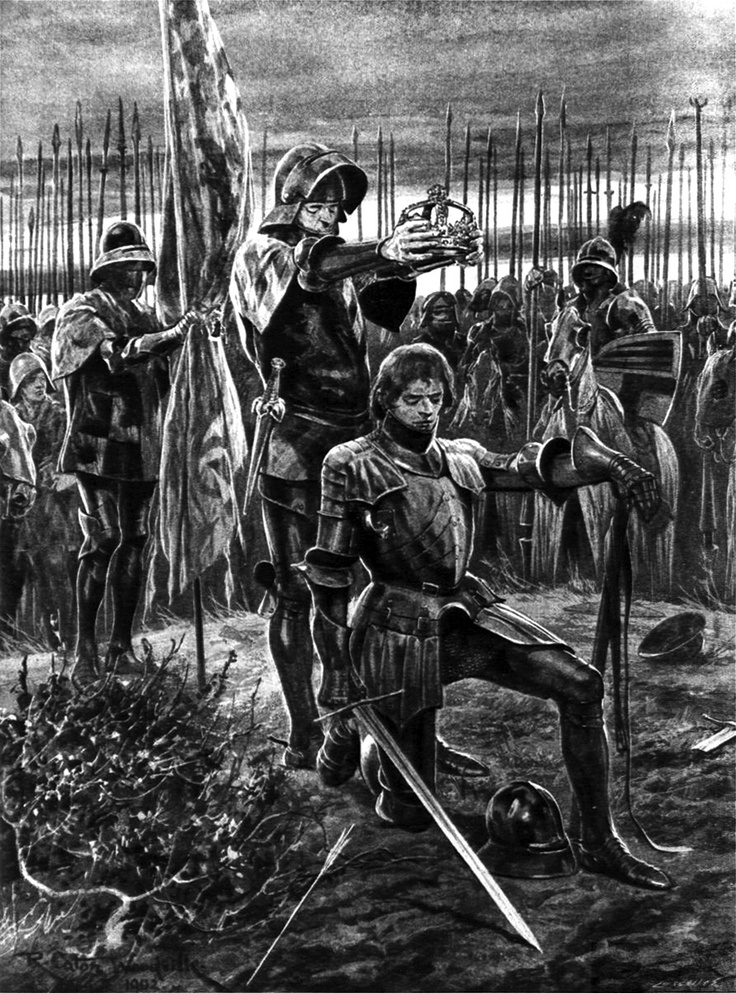
It is well documented how, through the treasonable and treacherous actions of Sir William Stanley at Bosworth, Richard lost his crown and his life. He was hacked to death after Stanley, who brought 3000 men with him, intervened at the crucial point when Richard, with his household cavalry in a heroic charge, came within a hair’s breadth of reaching Tudor and despatching him.  There is a story that after Richard’s crown was found under a hawthorn bush, it was Stanley who crowned him.

Sir William seems to have been one of those people who can run with the hounds and play with the foxes, doing well under Edward IV, who made him Chamberlain of Chester and, interestingly, Steward of the Prince of Wales’ Household(1).  Later Richard made Stanley Chief Justice of North Wales and finally Tudor made him Lord Chamberlain and Knight of the Garter.  It is said that Stanley – step-uncle to Tudor and brother-in-law to Margaret Beaufort – was one of the richest men in England.  Bacon estimated his income at 3000 pounds a year.  Stanley was also step-father to Francis Lovell, having married Lovell’s mother, Joan Beaumont,  widow of John Lovell, 8th Baron Lovell, but I digress!

Fast forward 10 years and it all ended ignominiously at Tower Hill, where Stanley was beheaded on 16 February 1495 for the treasonable act of communicating with Perkin Warbeck.  Stanley was accused of telling Robert Clifford, who informed on him, that if he was sure Perkin was indeed Edward’s son ‘he would never take up arms against him’.

The question I am raising here is not so much about Stanley’s interminable fence-sitting, which is common knowledge  – and a penchant he shared with his brother Thomas – but rather, did Sir William, an apparent dyed-in-the-wool turncoat, capable of the greatest untrustworthiness, actually possess a latent streak of honour, perhaps dating from the time when he was Steward to the Princes of Wales’ Household?  Did his time there give birth to a fierce loyalty to Edward’s sons, that later emerged with such a passion that he risked all, absolutely all,  when he joined the Perkin Warbeck plot?  Did he grow fond of young Edward, later focusing this affection on Edward’s brother, Richard of Shrewsbury, whom Warbeck purported to be?  OR, was he, as the historian Gairdner (2) suggested, merely attempting to secure his position in the event of an invasion?

(1)  Ramsay, Lancaster and York, ii 482

(2) W A J Archbold ‘Sir William Stanley and Perkin Warbeck’ English Historical Review 14( 1899) pp 529-534. ‘On 14 March (year unknown) Gairdner suggested in a note to Archbold that Stanley may ‘simply have wanted to secure his position with both sides in case of an invasion’.  I am grateful for this information which I have gleaned from Helen Maurer’s ‘Whodunit – The Suspects in the Case’.


Subscribe to my newsletter

  1. This is a common confusion with his brother, who certainly was duplicitous. Sir William was a loyal Yorkist all his life and the historical facts support this. The idea that he came in on the side of Tudor at Bosworth is popular and convenient history, but I believe it was the opposite, a blunder where he was actually coming to the king’s aid. The problem was the king and his men had no way of pausing the battle while they had a conference. His support for the man known as Perkin Warbeck, who he believed to be Richard of York, is consistent with his abiding loyalties to York. He died in the Yorkist cause.

    Liked by 1 person

  2. Good post that presents a poser. Did Sir William really believe in Edward IV’s Woodville marriage and therefore that Richard III was a vile usurper? Usurper? Richard was the rightful king, full stop. So I’m afraid I cannot forget or forgive Stanley actions at Bosworth. I’m just too biased against both brothers to credit them with any nobility of purpose. Sir William was a chancer and seized that chance, knowing that his brother would be the new king’s father-in-law. Plump rewards might come his way. I’ll bet he thought so. Later, when he sneaked on Henry, I think you’re right, he was hedging his bets. I simply cannot credit Sir William Stanley with any honour whatsoever. I guess the plump rewards weren’t plump enough for him…

    Liked by 2 people

  3. If it was indeed a ‘blunder’ on Sir William’s side as Richard Unwin suggests and that he was ‘actually coming to the king’s aid’ then he must have recovered his composure pretty quick in the immediate aftermath of the battle… Mr Unwin is saying that Sir William was not a serial turncoat and that it was his brother who was duplicitous! I would say that for someone who rides into battle to someone’s aid, fails, then does a rapid turnabout to look as if he was doing the exact opposite is in fact the epitome of duplicity.

    Liked by 3 people

    1. Thank you David. This was my intention. If I may reiterate my second note on my article, the eminent historian James Gairdner himself suggested to W A J Archbold ‘Sir William Stanley and Perkin Warbeck’ that Sir William may ‘simply have wanted to secure his position with both sides in case of an invasion’. I think there are grounds for debate regarding Williams intentions and I think to dismiss them out of hand is rather presumptuous.

      Liked by 1 person

  4. Emyr Wyn Jones, in ‘A Kinsman King,’ suggests that Stanley may never have intended to come to Henry’s aid (nor Richard’s either). He was simply unable to control his Welsh troops. It’s a viable theory, anyway, and would explain why Henry, if he suspected this, never quite trusted him.

    Liked by 3 people

  5. you mean just sitting on the fence..awaiting the outcome and then whosoever won..William is your man?

    Liked by 1 person

  6. This version of Stanley makes him sound like some accounts of Elizabeth Woodville that I’ve read. After Richard becomes king, Elizabeth W consistently backs Henry — betrothing her eldest daughter to him and leaving sanctuary only after Richard swears an unprecedented public oath — and then years later she (according to Bacon) assists the “feigned boy” in the Simnel matter. Sounds to me that both Elizabeth Woodville and Stanley might have originally believed that Richard killed the princes and then found out later that the boys were killed in the interests of someone else.

    Liked by 3 people

  7. Good point Esther. Thank you.

    Liked by 2 people

  8. I still like the idea that slimy Thomas had a foot in both camps , and decided to send younger brother William into the Warbeck camp to ensure the Stanley family would come out on top. Only “shock”” horror” it all went so very wrong , leaving Thomas to cover his own rear and leave poor William (he was so sure at the worst Henry would only give him 6 months in the tower )to the axe .

    Liked by 2 people

  9. McArthur, Richard P. Avatar
    McArthur, Richard P.

    I did some research on William Stanley some years ago. Contrary to what I had expected, I found that unlike his brother Thomas, William seems to have always turned out for the Yorkists.
    Also-he did not join the Warbeck plot. The words quoted in the article were used to condemn him; it seems to have required some legal sophistry to make the charge stick. The attitude he expressed was the Yorkist attitude. Had Warbeck convinced most Yorkists of his identity, they almost certainly would have backed him.

    Liked by 2 people

    1. I think your theory is certainly plausible but like many others in this debate probably unprovable. It is likely we will never know what was in their minds during those moments of panic. It is probably true that the tudor myth of mass betrayal on the battle field will be shown to be inaccurate as there may be alternative explanations for Stanley and northumberlands behaviour. So much of any countries future depends on a few minutes………

      Liked by 2 people

  10. A while ago, a member of a Bosworth FB page reported that Thomas Stanley had signed a great many legal documents at Lathom shortly before the battle. This was used to question whether he could even have been at the Battle. However, assuming these to be enfeoffments, it tends to indicate that he really did have urgent business.

    Liked by 1 person

  11. Wasn’t there a sort-of-similar problem at the Battle of Barnet where Lancastrians blundered by attacking Oxford’s forces (even though Oxford was on their side and coming to help) because they mistook his battle standard for that of Edward IV?

    https://en.wikipedia.org/wiki/Battle_of_Barnet#Fighting_in_the_mist

    Like

  12. It’s not that difficult to reason out. If Richard had been severely malformed, he wouldn’t have been able to wear a suit of armour, let alone fight in one. If he’d been a child-killer, he’d have executed more people tha he did. His actions, although in acordance with the late fifteenth century, were quite coordinated and controlled, I think.

    Like

  13. I like this theory, Richard, but wasn’t William under attainder by Richard? Was this just Strange’s story-telling, or had he really colluded with Tudor?

    Like

  14. Francis Lovell’s mother was Joan Beaumont NOT Joan Beaufort.

    Like

    1. thank you Pamela. I will correct..

      Like

  15. […] in knowing what made slippery Lord Stanley tick, here is an excellent evaluation, save that Sir William was executed for refusing to oppose “Perkin”, not for supporting him. The man was a […]

    Like

  16. […] by first supporting Richard III and then betraying him at Bosworth, Stanley fell from grace and Henry VII had him beheaded in […]

    Like

  17. […] Bosworth, oddly, it was Northumberland alone who was accused of betraying Richard. Sir William Stanley was later mentioned as falling foul of Henry by conspiring with Perkin Warbeck. Warbeck was […]

    Like

  18. […] and ancestor of the Gunpowder Plot letter recipient) and John Stanley of Melling (Thomas and Sir William‘s nephew, who was later knighted). However, Sir Thomas Harrington’s younger sons, Sir […]

    Like

  19. […] as the turncoat who tipped the balance. And here’s me thinking it was his reptilian brother, Sir William. Oh, but his lordship was sneaky as well. All the Stanleys were sneaky and untrustworthy. I’m […]

    Like

  20. […] Their treachery killed Richard and we ended up with Henry VII. Thank you, Stanleys. I’m glad that at least one of you paid the ultimate price for your Judas […]

    Like

  21. […] LORD CHAMBERLAIN, Sir William Stanley, reined in close to the torchlit entrance of Westminster Hall where a throng of lords and ladies […]

    Like

  22. […] III are concerned, the mere name Stanley is anathema. The family was traitorous to Richard, and Sir William Stanley betrayed him so abominably at Bosworth that Richard was killed most brutally. It was no mere death […]

    Like

  23. […] was, of course, Thomas’s father-in-law. Even more importantly, Thomas’s brother, William, was also in the Yorkist camp. Needless to say, Thomas held off and was not involved in the Battle […]

    Like

  24. […] one who fell out with unloveable Henry Tudor. I hope he was thankful not to have gone the way of Sir William Stanley, another one who saw the light too […]

    Like

  25. […] “As Sir William Stanley discovered when you had him executed,” she responded. “So much for having won Bosworth for you.” […]

    Like

Leave a reply to da45ve Cancel reply