Once again, while rooting around for information that might be of use in a book I intend to write about figures in the court of Richard II, I have found an interesting snippet. This time my thoughts are jolted with regard to the name of Richard III’s horse, White Surrey.
I have never particularly liked the name, and know that there is some doubt about its veracity, but even so, it is what we all call the great white courser he rode at Bosworth.
Anyway, my interest in Richard II centres on his Holland half-brothers . . . and so I have been going through “The Hollands, Dukes of Exeter, Earls of Kent and Huntingdon, 1352-1475” by Michael M.N. Stansfield, which is the most detailed work about this family that I have found so far.
In 1399, Richard II made a very ill-judged expedition to Ireland, and while his foolish back was turned, the exiled Henry of Bolingbroke, Duke of Lancaster, soon to be Henry IV, invaded England and took over. Among the lords who were with Richard in Ireland was his half-nephew, Thomas Holland III (viscountessw note: his father and grandfather were also called Thomas), Earl of Kent, who had taken his wife and a lot of property with him. When news of Bolingbroke’s invasion reached Ireland, a very hasty return to England was soon underway. This return was bungled, and Richard’s party was soon in Henry’s hands. The unfortunate king would be deposed and executed, the Epiphany Rising of his remaining supporters would be betrayed, and they too would met unpleasant ends.
Meanwhile, the Countess of Kent had been left behind in Ireland, in charge of her husband’s property. When she too returned to England, bringing his goods and belongings with her, she was apprehended and the property seized.
What has this to do with White Surrey, I hear you ask? Well, simply that in a passage about the nature of these goods, I came upon the following:-
“Some idea of a lord’s travelling accoutrements can be gleaned from the inventory of possessions seized with Thomas III’s widow Joan when she landed at Liverpool, back from Ireland, on 13 January 1400. She brought very little in gold, but a fair amount of silver tableware, 205 lbs 12oz in weight. This went to the royal exchequer and was used to pay some of Thomas III’s debts to Henry Beaufort, Bishop of Lincoln. Equipment for a travelling chapel was also seized, valued in total, books, frontals and all, at £43 8s 4d. Also taken were six horses, three of them coursers and three trotters, with names of aristocratic association such as Bayard March, Lyard Exeter and Bayard Perrers. Their harness and gear, for war and the hastilude, stabling equipment, tents for living in the field, armour for the earl, or perhaps his brother, a chest of arrows and the necessary impedimenta to carry it all completed the possessions brought back from Ireland by the countess.”
Bayard March, Lyard Exeter and Bayard Perrers were (I imagine, but cannot be certain) the three coursers, and in the notes to this passage, Stansfield clarifies that Bayard meant bay-coloured, and Lyard referred to being dappled with white or silver-grey. March, Exeter and Perrers are clearly references to noble titles or families. Exeter, for example, refers to Thomas III’s uncle, John Holland, Earl of Huntingdon and Duke of Exeter.
As for White Surrey, in 1483 the title of Earl of Surrey was held by John Howard’s (Duke of Norfolk) son and heir, Thomas. I almost wonder if the horse could have been a gift to Richard from one or other of the Howards.
It seems possible that by naming their horses in such a fashion, aristocrats were following an accepted norm, and suddenly I feel I understand Richard III’s choice of White Surrey for his great courser.
Perhaps someone knows much more on this subject. If so, I will be delighted to learn.
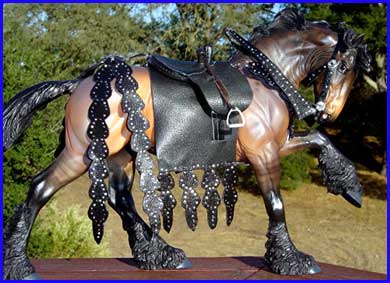
(The above illustration is from Black Rose Studios)


 The New Murrey and Blue blog
Leave a comment