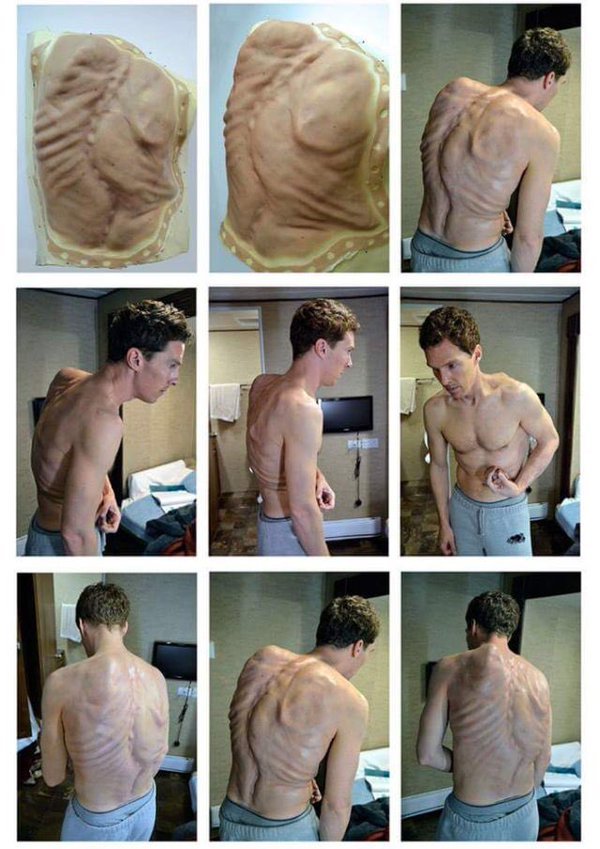
I have been watching the BBC’s ‘The Hollow Crown’ with interest, as I have never actually seen the whole of Shakespeare’s Richard III and none of Henry VI (Parts I and II). At first I was appalled at Benedict Cumberbatch’s grotesquely exaggerated portrayal of Richard, but consoled myself by thinking that at least, because people will see that it bears no factual resemblance to his actual spinal condition, it might serve to distance the Bard’s Richard from the real man.
I was to be sadly disillusioned, however, on reading an article published by The Mail On Sunday. It basically states that the production team researched people with “curvature of the spine” and how they would have looked if unable to have it corrected “In order to make the depiction of Richard more accurate.” They also state that:
“Until recently it was assumed Shakespeare had exaggerated Richard’s disability to make him appear more monstrous. That theory was undermined by the discovery of the King’s body in Leicester in 2012”

“I have seen a report in the Mail on Sunday concerning Benedict Cumberbatch and his portrayal of Richard III in The Hollow Crown. (‘Benedict’s really got the hump’). Towards the end it states: ‘In order to make the depiction of Richard more accurate, Mallett and Cumberbatch studied the medical histories of those who had curvature of the spine and had not been able to have the condition corrected. Until recently, it was assumed that Shakespeare had exaggerated Richard’s disability to make him appear more monstrous. That theory was undermined by the discovery of the King’s body in Leicester in 2012, and tests showed that he suffered from scoliosis’.
While you may be reporting what the BBC have told you, and while it is correct that Richard suffered from scoliosis, this categorically does not equate to him having a hunchback. If your reporter had done any independent research at all into the condition, they would see that a scoliosis is a sideways curvature, which would not have manifested as a hump in a normal standing position. The only outward sign of the condition would have been one shoulder appearing higher than the other (which is how he was indeed described by contemporaries). As a Registered Osteopath, I am in a position to give an expert opinion on such matters. As a Ricardian, I am appalled that all the hard work we are doing to try to rehabilitate Richard’s reputation can be undermined in this way. Shakespeare’s Richard did have a hunchback, true, but to say that this is an accurate physical depiction of Richard is false and misleading. The public will think that if Richard’s spine was as Shakespeare described (which it isn’t), his character must be too. This prosthetic was obviously used for shock value. Fair enough, but it should be distanced from the real Richard III. There was a ‘body double’ found who had an almost identical curvature of the spine to Richard’s and a documentary made on Channel 4 showed how he could fight, ride and move perfectly normally and, clothed, you wouldn’t know he had the condition. (I have personally met the young man in question and can vouch for that being true). Incidentally, Shakespeare’s (and Cumberbatch’s) depiction of Richard having a withered arm and a limp is also false: Richard had neither. Please publish a correction as soon as possible; it might seem a trivial thing to you but many people really care that Richard was unjustly maligned and it means a lot to us. I would be happy to comment further if you would like to contact me and get an expert opinion instead of sensationalist nonsense.”



 The New Murrey and Blue blog
Leave a reply to jrlarner Cancel reply