
I have just completed my new novel, Richard Liveth Yet (Book II): A Foreign Country, an alternative history story in which Richard, having won at Bosworth, continues as King of England and pays a visit to Florence at the invitation of Lorenzo de’ Medici.
On researching Lorenzo, I became intrigued by the number of parallels and similarities between the two leaders.
Lorenzo was about four years older than Richard and, in common with him, was given great responsibility at a young age. He was sent on diplomatic missions, which included meeting the Pope. Like Richard, he had a brother who was considered very beautiful, where he was seen as plainer, shorter and less attractive and both of them lost their brothers too soon (three of them in Richard’s case).
The Medicis’ main rivals for power in Florence were the Pazzis, who murdered Lorenzo’s brother, Giuliano, in the famous Pazzi conspiracy. Of course, Richard’s York family’s rivals were the Lancastrians and the rivalry took the form of battles rather than covert assassinations.
They both enjoyed hunting and hawking and both were patrons of the arts: in Richard’s case this was mainly through music and architecture, whereas Lorenzo patronised the Renaissance artists such as Botticelli, da Vinci and Michelangelo, and encouraged art and culture, even writing poetry himself, written in his native Tuscan. As we know Richard was the first English monarch to swear allegiance in English, had his laws written in English and even owned a bible translated into English.
They were both seen as intelligent – Lorenzo was thought to be the most intelligent of his siblings – and they both encouraged education and enjoyed books and learning.
They diverge in their family life in that Lorenzo and his wife, Clarice, had ten children (though not all survived) whereas Richard and Anne had only one, who died young. However, they both knew the grief of losing children and both their wives pre-deceased them.
Both were courageous – Richard in battle, and in particular during Bosworth’s final moments, and Lorenzo when he went himself to Naples, which was enemy territory after the Pazzi conspiracy, to settle the resulting war with the Holy See through diplomacy.
Both took their deceased brother’s child(ren) into their household after their death (in Richard’s case, I am now referring to George’s death).
Both of them were praised by their respective favoured cities after their death. As we know, York’ said: ‘King Richard, late mercifully reigning over us, was through great treason . . . piteously slain and murdered, to the great heaviness of this city.’ They also referred to him as the ‘most famous prince of blessed memory.’
As regards Lorenzo, on his death (also at a young age of 43) the Signoria and councils of Florence issued this decree:
‘Whereas the foremost man of all this city, the lately deceased Lorenzo de’ Medici, did, during his whole life, neglect no opportunity of protecting, increasing, adorning and raising this city, but was always ready with counsel, authority and painstaking, in thought and deed; shrank from neither trouble nor danger for the good of the state and its freedom….. it has seemed good to the Senate and people of Florence…. to establish a public testimonial of gratitude to the memory of such a man, in order that virtue might not be unhonoured among Florentines, and that, in days to come, other citizens may be incited to serve the commonwealth with might and wisdom.’
Finally, I think there were some similarities in their appearance also.
What do you think?

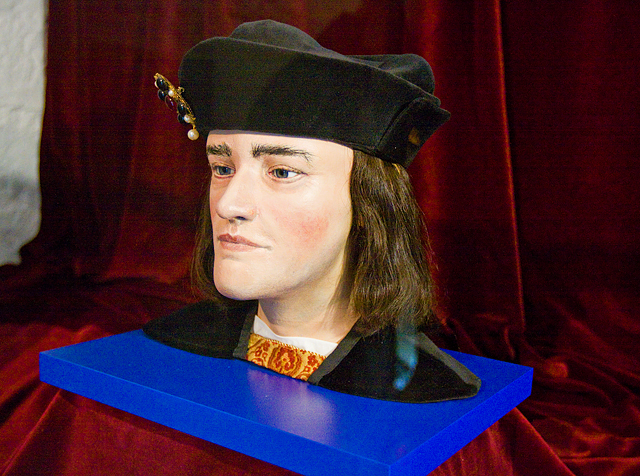
Photo of Lorenzo: Public Domain / Photo of RIII reconstruction © Copyright Mike Searle and licensed for reuse under this Creative Commons Licence


 The New Murrey and Blue blog
Leave a reply to Phoenix Woman Cancel reply