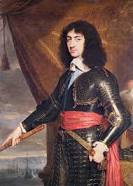
charlesiiGuest author Richard Unwin explains the context behind the discovery of those convenient bones:

Charles II came to the throne in 1660 after the period of Commonwealth when England, and particularly its entertainments, had been suppressed by Puritan authority. The security of the new reign was precarious and there were many in the country opposed to a return of the monarchy. The king needed good PR and he began by restoring those entertainments the English had enjoyed before the Civil War, which had been suppressed by the Puritans. The Restored theatres were immediately used to promote Court propaganda and would do so for most of the reign. Theatre had been banned under Cromwell and anyone performing as a player would be thrown into prison. Similar penalties were applied to those who might be in the audience at a performance.
The first playhouse to be constructed in the new reign was The Theatre Royal, at Drury Lane, which opened in 1663. This theatre, though unaffected by the Great Fire of London in 1666, burned down in 1672 as the result of an internal combustion. Because of the demand for entertainment, a new theatre was financed and built on the site of the old one. Thought by some to have been designed by Sir Christopher Wren, the second theatre opened to the public on March 26th 1674; the alleged bones of the Princes in the Tower were discovered just four months later, in July.
Upon the restoration of Charles II, old plays were, at first, resurrected for performance at the new venue. Many of these were rewritten and used as pure propaganda to promote the court of the restored monarch. Shakespeare’s language was out-of-date and soon his plays were being rewritten to suit the tastes of the modern audience. Charles was a devotee of the theatre and we find one of his most famous courtesans, Nell Gwynne as an actress at Drury Lane.
The playhouse at Drury lane was not the only one in Restoration London. There was another: Dorset Garden, also known as the Duke’s Theatre. The duke in question was the duke of York, Charles’ brother and destined to become James II. It was home to the Duke’s Company of players and renowned for its technical innovations, moving scenery and lavish productions. Later, in 1782, the Duke’s Company would merge with the King’s Company and move to Drury Lane, but in 1674 it was vibrant and in open competition for audiences with the Theatre Royal.
Villainy was not long becoming, in the popular public mind, synonymous with Shakespeare’s Richard III due mainly to the supposed murder of his nephews, popularly known as The Princes in the Tower. Sometime in 1661 there was a performance of Shakespeare’s play, the details of which are now lost. The prologue survives and it shows us King Richard presented as a dictator, (metaphorically Oliver Cromwell) set against one Henry Richmond who defeats him to become a benign monarch (King Charles II). It seems that this was propaganda used to promote the new reign. In the year 1667 the Duke’s Company performed a similar play, written by John Caryll. Its title was “The English Princess: or the Death of Richard the Third.” The author was a diplomatist and later became secretary to Mary of Modena, the second wife of James II. This particular play was printed in 1667, 1673 and pertinently, in 1674. Clearly the story of Richard III and the murder of the two Princes in the Tower had much currency throughout the period of the “discovery” of the Westminster bones and was current in the year they were found.
Throughout the reign of Charles II we find the villainous character of Richard III in a variety of plays, none of them Shakespeare’s and with a deliberate political bias. Of course, the character could also be used against the monarchy. In 1680, John Crowne adapted Shakespeare’s Henry the Sixth, Part Two converting it into an anti-catholic rant. It was sub-titled: the Misery of Civil War, performed at the Duke’s Theatre (Dorset Garden) and printed in the same year. In this version of Shakespeare’s play the malign character of the duke of Gloucester (Richard III) is enhanced, his crookback is emphasised and his brothers’ philandering in the play becomes a comment on the current Court. John Crowne, although said to be a favourite of Charles II, was known to have a moral repugnance for his Court. This was politically sensitive as the Exclusion Crisis, an attempt by parliament to prevent the accession of a Catholic monarch, was in full cry in this year.
Almost as if he was deliberately flouting the concerns of his people, his mistress, Louise de Kerouaille was a Catholic and a French spy to boot. She had replaced Barbara Villiers, (Lady Castlemaine) as Charles’ principal mistress. He ran her more or less currently with the actress Nell Gwynne. Bad luck had also brought about the Great Plague of 1665, which only came to an end due to the Great Fire of 1666 when much of the old City of London was consumed in the flames. Charles had also provoked war with the Dutch. The first war had been something of a success, but the second war had gone badly. In the year following the Great Fire, a Dutch fleet had sailed up the Medway and destroyed the British fleet supposed to be safe at anchor at Chatham docks. Ignominiously for the English navy, the Dutch boarded and captured the fleet flagship, the Royal Charles. This was the very vessel that had brought Charles to England from exile. They towed it back to the Netherlands as a trophy where the ship’s coat-of-arms can be seen on display to this day at the Rijksmuseum in Amsterdam. It was England’s greatest naval defeat. The Dutch destroyed fifteen ships while the English scuttled others to block the river. The biggest ships, the Royal Oak, the Loyal London, a new ship, and the Royal James were burned. Afterwards, this misfortune, on top of the Catholic question and the scandals of his personal life meant King Charles and his government feared a backlash from the people of England who were becoming increasingly critical of his rule.
By the year 1674 then, we can see that Charles and his government had become highly unpopular and desperately needed to turn the mood of the people towards that which he had enjoyed at the beginning of his reign. We must remember that the Court establishment feared a resurgence of republicanism. At the same time there was the real threat, that Charles’ brother James would succeed him, provoking a Catholic revival and religious conflict. (This did indeed occur and James II’s persecution of Protestants led to his eventual removal and exile – the Glorious Revolution of 1688).
Charles’ strategy at the beginning of his reign had been to use the printed word and public performance in the restored theatres as propaganda to promote his monarchy. Perhaps what had worked in the heady days of the early 1660’s could work in 1674 too? The “chance” discovery of royal bones in the Tower of London, accompanied by a series of plays where the villain was understood metaphorically to be the dictatorial Oliver Cromwell and the possibilities for promoting the monarchy would be obvious to Charles II. Unfortunately what worked in 1660 seems to have failed in 1674. Charles II managed to cling on to his throne until his death in 1685. His brother would be the one to lose it.


Subscribe to my newsletter

  1. I grew up with a father who was a dedicated admirer of Oliver Cromwell, and so heard no good of the Stuarts. But Cromwell had no glamour as far as I was concerned, which is another matter entirely. Besides, the Stuarts period couldn’t hold a candle to that of the Plantagenets, especially the ‘last’ one.

    The great Business of the Bones will rankle forever more, until that pesky urn is opened and its contents examined with today’s scientific knowledge and capability. It occurs to me that someone should knock the thing over ‘accidentally’!

    A great post, Richard, beautiful written and explained. I’d forgotten what a busy boy Charles II was when it came to extramarital goings-on. Perhaps some of Edward IV’s DNA was to blame? I can imagine Edward resorting to an ‘urn’ scheme to divert attention.

    Thank you for posting.

    Liked by 1 person

  2. The Plantagenets had charisma, the Tudors had brains, but the Stuarts were an all-around disaster. The Hanoverians were sort of comic relief, but at least they didn’t wear funny clothes.
    There, I summed up all pre-20th century British history for you in two sentences! No, really, you don’t have to thank me. 😉

    Liked by 1 person

  3. I love coming here, not only for my daily dose of Richard (I’ve been lurking through many of the older posts I’d missed, and followed them to their source), but for the wonderful on-going history lesson. Thank all of you so very much!

    Liked by 1 person

  4. So…. If this play was so popular during Charles’s reign…… How do we know it wasn’t altered to the one we know today? Is there a possibility it could have been re-written from the original?

    Like

    1. I presume you are referring to The English Princess. The copy I have is a facimile of the original held in the British Library. It represents an authentic reproduction of the text as printed by the original publisher. To be clear – it is not Shakespeare’s play. It is Caryl’s version of the story intended specifically to promote Charles’ rule.

      Like

  5. 17th Century politicians were not at all above using medieval precedent for their own purposes. For example, the party opposed to Charles I just ahead of the CW (very much led by a minority of radical peers) were apt to draw parallels between Charles and Richard II. In part at least this was out of a desire to show that they were not ‘radical’ but merely following on established uses. This demonstrates that they were well aware of medieval history, and willing to take ‘lessons’ from it, insofar as it suited their particular book.

    Like

  6. […] IV are irrelevant, that several different discoveries were made during the seventeenth century, that Charles II benefited from the find in 1674 and that the “Princes” mtDNA could well be available […]

    Like

  7. […] to forget about Richard, Henry and the late 15th century for the moment and concentrate upon Charles II and the political pressures and perceived necessities of the 1670s.  Any takers?’ Maurer […]

    Like

  8. […] explains the various claimants, including the House of Braganza, which supplied Charles II‘s […]

    Like

  9. […] tendency book browsers often engage when skimming though potential purchases. Its caption reads: “The remains found in 1674: ‘They were small bones of lads in their teens, fully recognised to be the bones of those two […]

    Like

  10. […] tendency book browsers often engage when skimming though potential purchases. Its caption reads: “The remains found in 1674: ‘They were small bones of lads in their teens, fully recognised to be the bones of those two […]

    Like

  11. […] tendency book browsers often engage when skimming though potential purchases. Its caption reads: “The remains found in 1674: ‘They were small bones of lads in their teens, fully recognised to be the bones of those two […]

    Like

  12. […] crowns were made for Charles II‘s  coronation in 1661 by Robert Vyner including a new Coronation Crown.  This crown […]

    Like

  13. […] Charles II (1630-85) fathered about fourteen children, of whom only James, Duke of Monmouth could possibly have been legitimate. The Duke’s mother, Lucy Walter died before Charles’ marriage to Catherine Braganza, sister of Pedro II, King of Portugal – thus James VII/II was his legitimate heir. […]

    Like

  14. […] no verification as to exactly where/how they were found since they were discovered in the reign of Charles II, are Edward V and Richard of […]

    Like

  15. […] crowns were made for Charles II‘s  coronation in 1661 by Robert Vyner including a new Coronation Crown.  This crown […]

    Like

  16. […] to forget about Richard, Henry and the late 15th century for the moment and concentrate upon Charles II and the political pressures and perceived necessities of the 1670s.  Any takers?’ Maurer […]

    Like

  17. […] the Jacobites. Apparently, he wrote that  the maternal grandparents of Lord Derwentwater were Charles II and Moll Flanders. MOLL FLANDERS? She is a character in a novel by Daniel […]

    Like

  18. […] work to survive from that century. The small pearls were added to its decoration by King Charles II.It is unclear from the 1349 inventory whether the spoon at this date was part of the chapel plate. […]

    Like

  19. […] Suppose More departed from the truth earlier than that. Successful deceit starts with some facts that the reader will know and continues with some that he or she can verify, before misleading them. In particular, when he accuses Sir Robert Brackenbury, Sir James Tyrrell, Miles Forrest and “Will Slaughter” (Slater?) of carrying out the killing of Edward IV’s illegitimate sons, is it not more likely that they transported them, probably separately, to safe locations? This would be far easier than digging a large hole, burying the “Princes”, filling it in and sending all the attendants away, even if we aren’t supposed to believe that a priest disinterred and reburied them – it doesn’t correspond with Charles II’s antics. […]

    Like

  20. […] the Princes’ burial with the discovery of the 1674 remains, the problems merely multiply. The 1674 remains were not found ‘meetly’ deep at the foot of an internal staircase, but 10 ft down under […]

    Like

  21. […] Earl Spencer is actually a direct descendant of Henry I, via Charles II […]

    Like

  22. […] Episode Three covered Westminster Bridge. By 1700, the population of London was growing rapidly to about half a million people but only one bridge served them and their economy. The guilds of London, particularly the Company of Watermen, had opposed building any more to the west, to the extent of bribing Charles II. […]

    Like

  23. […] is interesting that the late Princess of Wales is a descendant of Charles II but this is through the illegitimate Duke of Monmouth (RMS, ch.13) who has many descendents senior […]

    Like

  24. […] Wilkinson explains that he was simply Eustache, arrested near Dunkirk and possibly connected to Charles II, who was secretly negotiating with the Sun King, their siblings being married to each […]

    Like

  25. […] have That Urn, of course. Charles II believed they were the boys, so it must be true. We have a close-up of Lucy’s delicate fingertips […]

    Like

  26. […] brother to late Princess Diana” I’m impressed by his complete dedication to his subject, Charles II! Talk about entering into the spirit of things! […]

    Like

  27. […] daughter married one of their kings, Richard III tried to marry the sister of another (whilst Charles II did) and a cardinal succeeded to their throne as the last legitimate domestic heir but wasn’t […]

    Like

  28. […] Stuarts, van Dyck and Rubens, the Civil War Cromwell “warts and all”, the Restoration, Milton, science, Aphra Benn, Wren and St. […]

    Like

  29. […] found in 2007 but kept quiet—the Gloucester, which was bringing to England the brother of Charles II, James, Duke of York (later James II). Hundreds of people died when the Gloucester went down, but […]

    Like

  30. […] stuck. It’s not the adult moth that causes the damage, but the larvae. There’s an inspection of King Charles II’s funeral cope – a beautiful creation of midnight blue velvet with golden embroidery. We are […]

    Like

  31. […] reviewer goes on to ask– ‘Were the two skeletons found at the tower in 1674 those of the princes? What is the evidence and what do historians – as opposed to the Richard III […]

    Like

  32. […] was an interesting character.4) I can understand the writer’s favourite monarch being Charles II.5) Only 10% of hereditary peers, 92 in number, can now attend the House of […]

    Like

  33. […] those of other tradesmen’ (4).  Could the burying of the Hoard have occurred in 1665 when the Great Plague cut its deadly swathe across London and Londoners left in droves if able to do so?   But this […]

    Like

  34. […] was found at auction in 2010 in Chester. But no, this is a different bed, and only dates back to Charles II. Nor is it a marriage bed, but rather the state bed from Westminster Palace, used by the monarch on […]

    Like

  35. […] in Westminster Abbey, purporting to contain the remains of the “Princes” as found in 1672, although we don’t know whether they were discovered a few decades earlier and reburied soon […]

    Like

  36. […] Charles IIeems to have specialised in “supposed” records. We all know he’s responsible for That Urn, the contents of which are “supposedly” those of Richard III’s nephews. The fact that there are animal bones in there as well as human is always passed very quickly. So quickly the point has become a blur! As a result we still have to see that darned marble vessel venerated as the final resting place of the two tragic cherubs murdered by their wicked uncle. Bah! No one knows if they were murdered, let alone by Richard. […]

    Like

  37. […] to the monarchy website, the current Ampulla was supplied for the coronation of King Charles II in 1661 and is based on an earlier, smaller vessel, which in turn was based on a 14th-century […]

    Like

  38. […] can see here that the 11th Duke, Charles, married Frances Fitzroy-Scudamore, a descendant of Charles II, but they had no sons. There is also Lavinia Strutt, who married the 16th Duke, but they too had no […]

    Like

  39. […] those of you who like to see anything to do with Charles II, or just historical drama or docudrama of most sensible kinds, there’s a new miniseries […]

    Like

Leave a comment