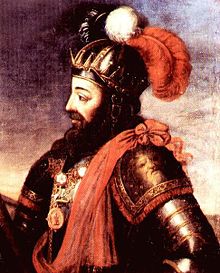
Afonso_V 220px-Portrait_of_John_II_of_PortugalAfter Henry VI’s death in 1471, Henry IV’s legitimate line was extinct but his sister’s senior descendant was her grandson, Afonso V, King of Portugal (1432 r.1438-81). He was, therefore, the principal Lancastrian claimant to the English throne, although Edward IV had become Duke of Lancaster by then as a result of Henry IV merging that title with the Crown.

After his death, the senior claimant was Afonso’s son Joao II (1455 r.1481-95). In 1485, following Joao in line, were:

2)  His son Afonso.
3)  His sister Joanna.
4)  His cousin Manoel (later I), Duke of Beja.

5)  Phillip (“the Handsome”, later I) of Castile.
6)  Margaret of Savoy, his sister.

7)  Ralph, 3rd Earl of Westmorland.

8)  Edmund, 1st Earl of Kent.
9)  His son George Grey.
10) His grandson Richard Grey.

11) Isabella, Queen of Castile.
12) Her son Juan.
13) Her daughter Isabella.
14) Her daughter Juana (“La Loca”).

These people all precede any Beaufort, even when the “excepta dignitate regalis” clause of their legitimisation were ignored. So, if you were a diehard legitimist Lancastrian, let us introduce you to your missing “Kings of England”.


Subscribe to my newsletter

  1. Reblogged this on Jo's Historic Collection and commented:

    Very interesting

    Like

  2. I think it was a very clever intention of Richard’s to attempt to ally himself with Joana and Elizabeth of York with Manoel. If only he hadn’t lost the battle of Bosworth he would be remembered as the one who united York and Lancaster and ended the Wars of the Roses. Plus I didn’t know that the title of Duke of Lancaster was merged with the title to the Crown. Strange how the ‘Tudorites’ never mention that – York and Lancaster were already united!

    Like

    1. Precisely – the real Yorkist heir and the (third, but first female) real Lancastrian heir.

      Liked by 1 person

    2. Yes to the former, but to the latter – if Richard had won at Bosworth, nobody probably would be thinking that there was ever something called the Wars of the Roses, and it’s possible that the Tudor invasion would be seen as a fairly minor episode in a series of conflicts, maybe not important enough to consider the entire period 1471-1485 as a part of a continues struggle. Who knows how the historians would have considered all of it?

      In any case, two things that strike me about the traditional narrative of “Henry Tudor ending the Wars of the Roses by uniting the Houses of York and Lancaster” are 1) the fact that he only ended it after restarting it in the first place (otherwise they would have ended in 1471 with Edward IV’s victory), and 2) that this “unification of the two houses” looks a lot more like the classic violent takeover – kill off all males from the other family (kill in battle, execute, imprison then execute, imprison and keep in prison till death, try to get your hands on them so they flee into exile…), marry all the females (to yourself and your family/supporters).

      Liked by 2 people

      1. Ah yes. Imprisonment to prevent reproduction, eg Warwick, can be termed “social castration”.

        Like

  3. Wouldn’t Isabella of Castile’s youngest child, Katherine of Aragon, also precede any Beaufort claimant? I’ve often thought that Henry’s mis-treatment of her was due (in part) to her having a better claim to the throne than Henry VII (I doubt that Henry VIII thought that the pre-contract was valid, but assuming that it was … Katherine would also have a better claim to the throne than Henry VIII)

    Liked by 1 person

    1. She would, but she seems not to have been born until nearly four months after Bosworth. An unborn child can only be heir apparent if male with no brothers. The hypothetical unborn child of Alexander III and Yolande in 1286 is a case in point – a real posthumous son would have supplanted the Maid of Norway, “his” niece.

      Liked by 1 person

      1. Thank you. I understand that Katherine would not precede any of her elder sisters , but I just wanted to know where she would stand as compared to the Beaufort line.

        Like

  4. Some of these claimants were ruled out by being female, and all of them were ruled out by being foreign, from a practical standpoint. Henry Tudor was at least half English, French enough to bring a contingent of French soldiers to Bosworth, and Welsh enough to have popular support there. Can’t see a Portugese or Spanish prince meeting these qualifications.

    Like

    1. The Earl of Westmorland wasn’t foreign and wasn’t excluded by legitimisation “excepta dignitate regalis”. Foreign-born and based claimants have succeeded on other occasions.

      Liked by 2 people

    2. Being female does not necessarily preclude you from the English throne and never has. No Salic Law in England.

      Liked by 2 people

      1. From a legal standpoint, yes. I’m looking at it from a practical viewpoint. Maybe Westmorland just didn’t want the throne, or he had no partisans to back him up. That mattered. .

        Like

      2. … or the three Greys?

        Like

      3. IIRC, that there was no Salic law in England meant only that someone could take the throne through a female claimant … for example, the house of York claimed through Phillippa and Anne (daughter and granddaughter of Edward III’s second son). That is different from people accepting a female as ruler. If they would accept a woman, I wonder why Lady Margaret Beaufort didn’t declare herself queen after Bosworth.

        Liked by 1 person

  5. I thought I would point out that the Duchy of Lancaster was quite quickly unmerged from the crown, so that it still provides the Queen with a considerable income, even though the crown holdings were given up. I live in an area where much of the land is owned by the Duchy, which still operates along feudal lines.

    Like

    1. Administratively unmerged, yes. Have a look at the Dukes of Lancaster from 1399 onwards – an identical list to that of the monarchs.

      Like

      1. In any case, doesn’t a claimant actually have to, you know, make a claim?

        Like

  6. No, the separation of the Duchy is more than administrative.

    The first act of Henry IV was to declare the Lancastrian inheritance be held separately from the other possessions of the Crown, and should descend to male heirs. This separation of identities was confirmed in 1461 by Edward IV when he incorporated the inheritance and the palatinate responsibilities under the title of the Duchy of Lancaster, and stipulated that it be held separate from other inheritances by him and his heirs. The Duchy thereafter passed to the reigning monarch and in 1760 its separate identity preserved it from being surrendered with the Crown Estates in exchange for the civil list. It is primarily a landed inheritance belonging to the reigning sovereign.

    The limitation to heirs male may account for the fact that Elizabeth II is regarded as the Duke and toasted as such in Lancaster.

    Like

    1. Every monarch since 1399 has been Duke of Lancaster. Today, we have separate Royal Dukes of Edinburgh, Cornwall, Rothesay, Cambridge, York, Gloucester and Kent, there have been Royal Dukes of Clarence and Sussex in the past 200 years but that of Lancaster is never “re-assigned”.

      Like

  7. […] he wasn’t a true lineal Lancastrian. Carson has listed thirty individuals, some mentioned here, who were alive on 22 August 1485 and were descended from Blanche, therefore having better claims […]

    Like

  8. […] decades and resulted in the crown going from Lancaster to York, and then back to Lancaster….if Henry Tudor can be described as a Lancastrian. He was descended through the Beauforts, who, according to Henry IV, could not succeed to the […]

    Like

  9. […] line, i.e. from Blanche Lancaster, were to have been continued, it would have been through the Portuguese offspring of Philippa of Lancaster, Gaunt’s elder daughter by […]

    Like

  10. […] Starz is at it again. After The White Princess and The White Queen, now we’re to have a dose of Catherine of Aragon, The Spanish Princess. See […]

    Like

  11. […] we come to Henry Tudor, Richard’s contemporary who had been raised a supporter of the Lancastrian dynasty, and had thus been on the losing side in England’s civil strife commonly known as the Wars of the […]

    Like

  12. […] the famous Ralph 1st Earl of Westmorland by his first wife Margaret Stafford.  It was the children Ralph 1st Earl had with Margaret that he would later go on to largely disinherit in favour of the children from […]

    Like

  13. […] of September had made land at the Portuguese port of Porto, where he arranged an audience with King Afonso V and […]

    Like

  14. […] of the Howards, for which there seems not to be evidence. There is a good explanation of what makes a true Lancastrian (ie not a Beaufort) and the status of royal bastards, together with a note on the Statute of Merton […]

    Like

  15. […] any event, Charlton seems to have passed as a loyal Lancastrian, and the ebbing of Owain’s revolt may have turned him that way. Once Owain was beaten, it […]

    Like

  16. […] marshal, and anyway was a banished man. So he had no lawful authority whatever. But he was merely carrying on the honourable tradition of the Appellants. By the way, I have yet to see a learned article […]

    Like

  17. […] historians as a ‘tyrant‘. He had, after all, a key qualification, as he was neither a Lancastrian nor a […]

    Like

Leave a reply to Henry the “Lancastrian”? Another own goal | murreyandblue Cancel reply