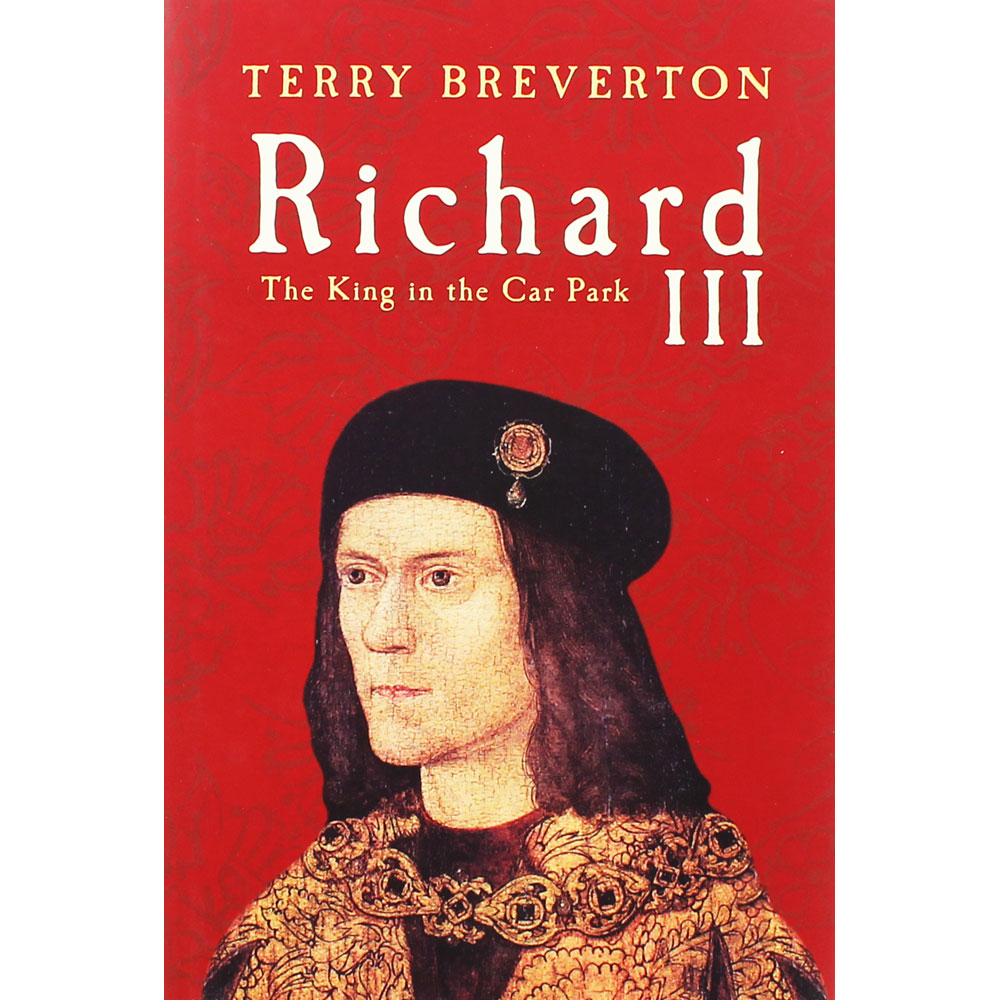
Part 2 of a review by Myrna Smith, Ricardian Reading Editor, of Richard III: The King in the Car Park.
EVISCERATING TERRY BREVERTON
Being an elaboration, with examples, of some of the points made in Part I. Let’s get the more trivial criticisms out of the way first.
Grammar: Pg. 82 –“Her son was only 14 years younger than her.” It should be “than she (was).” I can’t help it. I paid attention in English Composition.
Here’s one of my favorite gripes: “Devout believers in the Roman Church could literally get away with anything and still go to heaven if they confessed and paid enough to the Church. In Richard’s case his gifts to the Church, in exchange for forgiveness for his sins, came from illegal confiscations of properties and fees.” Literally? Literally?? You mean Richard is actually, literally, in Heaven right now, at the right hand of God? And more particularly, right next to Henry Tudor, who certainly made lavish gifts to the Church – which were a waste of good money, according to Mr. Breverton. More about that later. For right now, let’s just say that people who confuse ‘literally’ and ‘figuratively’ are quite annoying.
More a matter of syntax than grammar is the way the author , 99 times out of 100, uses ‘upon’ for ‘on’, as in ‘upon 20 January 1487.’ Another annoyance.
Further, he doesn’t seem to be able to count. Pg. 115: “Arthur was probably conceived two months before the couple wed. [My decimal digital computer says one month.] , and recent Ricardian novelists are attributing this to forcible rape.” [That’s one ‘Ricardian’ novelist, Philippa Gregory – who writes mostly about the Tudors.]
Did I mention that there are no footnotes or endnotes, and only a “Partial List of Sources?” And no index! Grr-rrr!
To go on to more factual criticisms: Terry Breverton hates Richard, to be sure, but not half as much as he hates Ricardians, it would seem: “Ricardians claim that [the Beaufort line] had been bastardised by Parliament” (not just Ricardians claim this) “so Henry, the son of Margaret Beaufort, had no claim to the throne. The same could be claimed against Richard – no recent books seem to mention that. Anti-Henry writers decry the fact that Henry’s real claim came via his mother, whereas in fact Richard’s real right also came via his mother. Both inherited through the female line.” No recent book mentions this, because it is simply not true. Richard’s mother, Cecily Neville, had Beauforts in her family tree, but Richard’s, and his brother Edward’s, claim did not come through her. Breverton had just spent the better part of a paragraph telling us about Philippa, the daughter of Lionel of Clarence, and Anne Mortimer, without mentioning that they were from senior lines. Richard’s father, from whom he derived his right to the throne, was the Duke of York, and he was descended from Edmund, Duke of York, the third son of Edward III. John of Gaunt, Duke of Lancaster, Henry’s great etc. grandfather, was the fourth son. Even if the Beauforts were unquestionably legitimate, Richard had primogeniture on his side.
“(T)he Richard III Society had always disputed that Richard had a crookbacked appearance, as usual blaming ‘Tudor propaganda,”, but the skeleton is the same as the body depicted by Richard’s contemporaries and later writers.” Most Ricardians accepted that Richard may well have had uneven shoulders, though not knowing the cause until his skeleton was discovered. Breverton is careful to use the words ‘crookbacked appearance’ in the text, but the blurb on the back cover clearly calls Richard a hunchback. The author thus confuses scoliosis (curvature of the spine) with kyphosis (commonly called ‘hunchback”) and hopes we won’t notice. Or maybe he doesn’t notice himself.
“A blog was recently set up called ‘The Henry VII Appreciation Society. Unlike the Richard III Society, with its royal patronage, it is a one-man-band…..This is one person facing the members of two national groups of the Richard III Society, plus their American, Continental, Australian, Canadian and New Zealand branches.” He thus argues, on the one hand, that Richard was certainly guilty – “What we can say is that nearly every important death in his time was connected with Richard contemporaneously” – and the majority is always right – and also argues from poverty and minority status. Poor little brave David, against the Goliath of the Richard III Society. You’re not going to root for Goliath, are you? (I have checked out that blog, which seems to be mainly a recording of significant dates in early Tudor history.)
That’s not enough for Terry Breverton, who decries ‘hagiographies’ of Richard, but proceeds to author one of Henry. “…Henry in his long reign was never involved in any estate-grabbing scandals, Richard was immured in them.” The reader picks his/her jaw up off the floor, and reads on: “Henry redistributed estates illegally confiscated by Yorkists, but had no truck with upsetting the balance of the great houses and creating potential resentment and conflict. “ He contrasts Richard’s shabby treatment of his mother-in-law, Anne Beauchamp, with Henry’s: “In November 1487 [when Henry had been king for over two years – he was in no hurry to do right by our Nell] an Act of Parliament…restored to her the family estates. One month later, the countess conveyed most of her lands back to the Crown…This led to the effective disinheritance of her grandson, Edward, Earl of Warwick.” And Breverton doesn’t find that just a little peculiar? Doesn’t necessarily mean that Henry bullied her, as TB accuses Richard of doing. He may simply have been a king of flim-flam artists (a viewpoint I rather favor, since I thought of it myself!).
On those occasions when Richard III and Henry VII did pretty much the same thing, such as post-battlefield executions, Breverton finds excuses for the latter, or points out that they are not the same thing at all, or Henry only did it a little bit. Henry’s inactions are held up as virtues: He did not display Richard’s head on a pole, “as Plantagenets were wont to do.” Yes, and many of those Plantagenets were Lancastrians, Henry’s ancestors and partisans. He deserves some credit for not being Margaret of Anjou, I suppose.
There is also the ‘man of his times’ argument, sometimes used in defense of Richard III. Breverton turns that argument on its head: “Plantagenet history is drenched in bloodshed and intrigue, whereby power was more important that legitimacy. This is Richard III’s background….Several of Richard’s predecessors had murdered their way to the crown or been usurpers, so his so–called royal bloodline was tangential at best…” Henry Tudor’s background? “Over 200 years of fighters for independence.” Welsh independence, he means. Honesty compels him to admit that Henry was twice as English (Boo! Hiss!) as he was Welsh, but he elides the fact that Henry actually did very little for the independence of Wales, though he did remove some of the anti-Welsh laws.
Breverton quotes copiously from Welsh poetry, hardly an unbiased source when dealing with an English king. One bard refers to King Richard (“the boar”) as a ‘Jew,’ a “Saracen,” and an “ape,” none of which he was, and as “little,” which was no doubt accurate. Breverton would not use such racial epithets himself, but the fact that someone in his own, less enlightened, time did, proves how much Richard was justifiably hated, and deservedly so!
Finally, Terry Breverton gives an annotated list of Richard’s crimes. Some so-called crimes might more accurately be described as civil torts (such as the Countess of Oxford affair). Some were undone almost as soon as they were done (the arrest of Stanley, et al). Some are just plain reaching. George Neville, Richard’s ward, ‘died in mysterious circumstances,’ so he was murdered? The circumstances are a ‘mystery’ only because no record survives of his cause of death. If Richard did kill him, he did so at the worst possible time for his long-term benefit, so it can be put to simple bloodthirstiness. Same with the death of sister-in-law Isabel Neville, for which he had no motive whatever. (He does name Richard’s guilt in her death as “unknown,” which, translated, means “ridiculous.”) He forgets to list Isabel’s infant son, who died at the same time she did.
Terry Breverton does bring up some points that pro-Ricardian, or neutral, historians should probably give more attention to, such as the executions of Rivers, Grey, Vaughan, et al, But when one has said that, one has said just about everything. Not quite everything – the above is just a ‘partial list.’
Just to show how ecumenical and even-handed I am, I am now preparing to eviscerate John Ashdown-Hill – well, mildly anyway. If there is such a thing as a mild evisceration.


 The New Murrey and Blue blog
Leave a reply to Kalina Cancel reply