


Top: Looking through from Dean’s Close to Deanery.
Second row: College Hall showing the screen.
Third row: The Deanery, with the College Hall on the left.
Fourth row: From Jerusalem Chamber south, showing the west wall of College Hall.
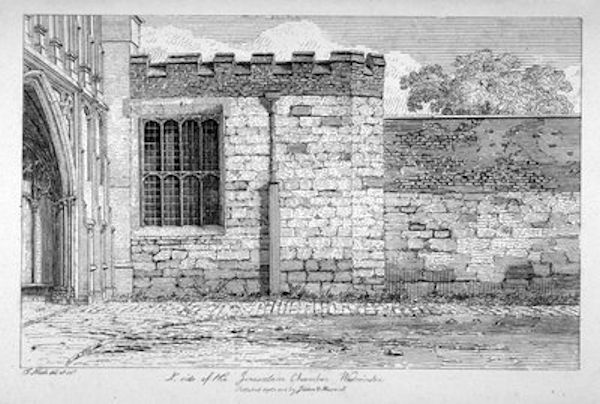
Bottom: Jerusalem Chamber before addition of abbey shop.
Before I begin, I must tell you that this article is all due to the efforts of my friend, Eileen Bates, and so to her must go the kudos of perceiving such interesting facts, finding information and illustrations, and putting it all together. I merely record what she has found.
We all know that when Edward IV died suddenly in April 1483, his queen, Elizabeth Woodville, attempted to take control of her eldest son, the new king, Edward V, in order to maintain her hold on power, and be sure her family had all the top jobs. She endeavoured, unsuccessfully, to outmanoeuvre Richard, Duke of Gloucester, her husband’s only remaining brother, who had been named as Lord Protector. The Woodvilles would not fare well under Richard, so I imagine her aim was to be rid of him entirely. But he confounded her, took Edward V under his wing, and Elizabeth panicked. She dashed off to sanctuary at Westminster Abbey, taking her remaining children with her. In her scramble to take as much with her as she could, she had to have a hole knocked in the abbey wall to accommodate all the treasure and other loot she’d grabbed. Not very dignified, but then dignity was not uppermost in her mind at that point
There she remained, refusing all Richard’s attempts to persuade her that she and her children would come to no harm at his hands. She was still there when history unfolded further, and Richard—rightfully—became king in the stead of her (illegitimate, as it turned out) son. But, she eventually accepted Richard’s reassurances, and her daughters at least came to their uncle’s glittering court. Elizabeth herself may have done as well, but it is not so certain.
So, where, exactly, was she ensconced in Westminster Abbey, and where might the infamous hole in the wall have been made? Well, this was not the first time Elizabeth had taken refuge there, because it happened before, when her Yorkist husband had been temporarily ousted by the Lancastrians.
I quote from
http://www.westminster-abbey.org/our-history/people/elizabeth-woodville
“Edward IV was forced to flee the country and left Elizabeth and their three daughters at the Tower of London. She left there secretly by night with her family and her mother and claimed Sanctuary on 1 October 1470 at the Abbey. The Abbey was a chartered sanctuary which gave immunity from justice to traitors, felons and debtors and important policital figures within its walls and in designated houses nearby, under certain strict conditions. The Abbot of Westminster, Thomas Millyng, took care of the royal family and Edward V was born and baptised while in Sanctuary. It is thought that she occupied rooms in Cheyneygates, within the Abbot’s house complex, on this occasion. She left on 11 April 1471 when her husband once again gained the throne.”
This part of the abbey is now known as the Deanery. So Cheyneygates, the Abbot’s House and the Deanery all appear to be names for the same place, which is today part of Westminster School. Where did the name Cheyneygates come from? And how is it pronounced?
In 1483, to quote the same source: “. . .she came from the Palace of Westminster on 31 April 1483 with her family and her brother Lionel, bishop of Salisbury. Her servants broke down the Abbey walls in order to get her furniture, chests and other items through. John Esteney was then Abbot and it is thought that she used College Hall, the abbot’s dining hall, when she stayed this time.” The College Hall is so called because it is now the dining room of Westminster School. The hall providently escaped the Blitz of World War II, while much of Cheyneygates seems to have perished. The hall isn’t open to the public, but it is among the illustrations above. Many other pictures of it may be found online.
The incumbent abbot appears to have still been in residence on both occasions, so any belief that Elizabeth swanned regally around the entire place can be discarded. One can only imagine how she felt on the day of Richard and Anne’s coronation, for she must have heard the bells and celebrations. The phrase ‘spitting feathers’ springs to mind.
Now to the matter of where That Hole might have been made in the abbey wall. If the part of Cheyneygates occupied by Elizabeth was the College Hall, then the western outer wall is adjacent to the Jerusalem Chamber, abbey shop and so on. There does not seem to have been any building there in the 15th century, so it has to be wondered if the deed was done somewhere along that wall, which is now greatly covered by the shop? Maybe it has been rebuilt/altered in that area since 1483. If it has, the information is not to hand. But if no alterations have been made, dare we wonder if a proper examination might locate the very spot? A change in the construction—a subtly newer cement, different stonemasons, and so on—might well be detectable. But that is conjecture, of course.
If you go to
http://archive.org/stream/abbotshouseatwes00robiuoft/abbotshouseatwes00robiuoft_djvu.txt
and search ‘Elizabeth’ or go to ‘III. Subsequent Developments’ you will find out much more about Cheyneygates/The Abbot’s House/the Deanery and Elizabeth’s sojourns there.
Still with the same archive.org source, when Henry VII came to the throne, Elizabeth obtained a lease (10th July 1486) on Cheyneygates from the Abbot. Apparently for the entire property, which is described in the lease as ‘the mansion of Cheyneygates’. Why did she want to be there, one wonders? It was a luxurious property, there’s no mistake of that, but how could it possibly have happy memories? On the other hand, the one thing it did offer was…sanctuary. Would she have felt safe there, this time from her cold new son-in-law? Probably. However, “. . . whether she entered into possession may be questioned, as she was soon afterwards sent to the abbey of Bermondsey, where she died in 1492″. It would seem that Henry didn’t give her time to sneak back into sanctuary to elude him. To Bermondsey she went, and in Bermondsey she stayed, except for being trotted out now and then. Sic transit gloria mundi.
A further search of the archive.org source, for ‘The Lease to the Widowed Queen’, will take you to a copy of the actual indenture (see below) – complete with the information that Elizabeth was responsible for the kitchen gutter! Oh, the picture that must form in minds—proud Elizabeth having to poke around in a gutter to be sure it was in full working order . . . (OK, we know she didn’t, but it’s quite a thought.)
The Lease:-
“This eindenture made bitwene John by the sufferaunce of god Abbot
of the Monastery of seint Peter of Westm’ the Priour and covent of the
same of the one partie And the most high and excellent Princesse
Elizabeth by the grace of god Quene of England late wyf to the moost
mighty Prince of famous memore Edward the iiij th late Kyng of Englond
and of Fraunce and lord of Irelond on the other partie Witnesseth
that the forsaid Abbot Priour and Covent consideryng and wele re-
membryng that the forsaid excellent and noble pryncesse in the tyme
of her said late husbond our alder liege lord was unto the said Monastery
verry especiall good lord aswele in protectyng and defendyng the libertes
& ffrauncheses of the same as in bountevous and largely departyng of
her goods to the edifying and reparacions of the ffabrice of the said
monastery by the hole assent concent & will of all the Captre have
graunted dimised and to ferme letyn unto the forsaid Quene a mansion
with in the said Abbey called Cheynegatis Apperteynyng unto the
Abbot of the said place for the tyme beyng with all the Howses
Chambers Aisiaments and other Appertenaunces therunto belongyng
To have and hold the forsaid mansion with Thappertenaunces and
other premisses to the said Quene from the fest of Ester last passed
before the date herof unto thende of the terme of xl yeres then next
folowyng and fully to be complete Yeldyng therfor yerely to the same
Abbot or his successor or theire Assignes x w of lawfull money of Englond
duryng the said terme to be paid atte festis of Mighelmas and Ester by
even porcions And the forsaid Quene at her propre costis and Charge
shall sufficiently repaire uphold and mayntene the said mansion and
voide dense repaire and make the gutter goyng from the kechen of the
same as often as shall be necessary and behovefull And atte ende of
her terme the said mansion with Thappertenaunces sufficiently repaired
mayntened and upholden yeld up unto the forsaid Abbot Priour and
Covent and theire Successours Also it is covenanted and agreed bitwne
the parties abovesaid that the said Quene shall in no wise sell lete
to ferme nor aliene her said yeres nor eny parte therof in the said
mansion with Thappertenaunces to any other person or persones duryng
the said terme And the Abbot Priour and Covent and their successours
forsaid the said mansion with thappertenaunces to the said Quene in
the manner and fourme aboverehersed shall warant ayenst all people by
these presents Provided alwayes that yf it shall happen the same
Quene to dye within the said terme of xl yeres as god defend that then
this present graunt and lees immediately after her decesse be voide and
of no strengthe And over this it is covenanted and agreed that yf it
happen the said Rent to be behynd unpaid after any terme of the termes
abovelymytted in party or in all that is to say the Rent of Mighelmasse
terme at seint Martyns day in wynter then next folowyng and the Rent
of Ester at Whitsontyde then next ensuyng that then it shalbe leefull
to the said Abbot and his Successours in the forsaid mansion with the
Appertenaunces to reentre And the said Quene therfrom to expelle
and put out this lees and dimyssyon notwithstanding In Witnesse &c
Yeven the x day of Juyll the yere of our lord god mcccclxxxvi And the
first yere of the reigne ofkyng Henry the vii th . (Register I. f. 4.)”


 The New Murrey and Blue blog
Leave a reply to Barbara Cancel reply