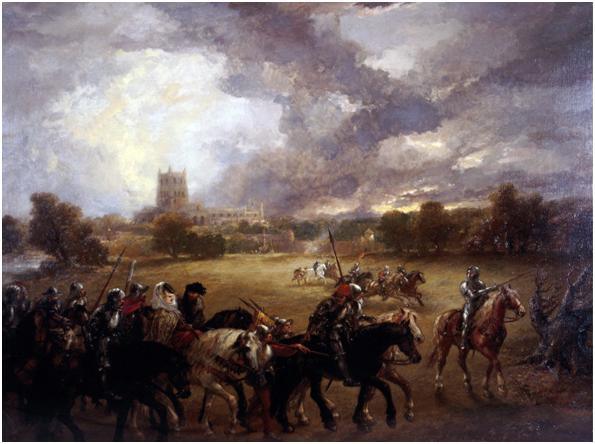
The above rather dark and dingy painting shows the unfortunate Margaret of Anjou, queen of the Lancastrian monarch, King Henry VI, being led from the battlefield at Tewkesbury after being captured. She had not only lost the battle, but also her son, the heir to the throne, seventeen-year-old Edward of Westminster, Prince of Wales. The painting is by Gilbert John, ‘Margaret of Anjou taken prisoner after the Battle of Tewkesbury’, 1875, Oil on Canvas, Guildhall Art Gallery, London, United Kingdom
The Battle of Tewkesbury took place on 4th May, 1471, as every good Ricardian knows. The conflict was not only notable for the decisiveness of the Yorkist victory, but also Prince Edward’s death. As always, it seems that apart from being killed in battle, there are various other versions of how he met his end.
The following is from Wikipedia, which I know is not always viewed with approval, but in this instance it tells all that’s necessary:-
“According to some accounts, shortly after the rout of the Lancastrians at Tewkesbury, a small contingent of men under the Duke of Clarence found the grieving prince near a grove, and immediately beheaded him on a makeshift block, despite his pleas. Paul Murray Kendall, a biographer of Richard III, accepts this version of events.
“Another account of Edward’s death is given by three Tudor sources: The Grand Chronicle of London, Polydore Vergil, and Edward Hall. It was later dramatised by William Shakespeare in Henry VI, Part 3, Act V, scene v. Their story is that Edward was captured and brought before the victorious Edward IV and his brothers and followers. The king received the prince graciously, and asked him why he had taken up arms against him. The prince replied defiantly, “I came to recover my father’s heritage.” The king then struck the prince across his face with his gauntlet hand, and his brothers killed the prince with their swords.”
Hmm, well I certainly discount the latter tall tale. IMHO, Richard of Gloucester, in particular, would not have killed Prince Edward in this way. In the heat of battle, yes, but not cold-bloodedly afterwards. The same goes for the yarn that Richard personally killed Henry VI. Nor do I think George of Clarence would have summarily beheaded a Prince of Wales. No, he’d have brought his captive before the king, Edward IV, who might indeed have beheaded the prince on the spot. But there is no proof of anything. The prince was buried in Tewkesbury Abbey, although his exact whereabouts aren’t known now.
However, I digress, because there is yet another version of Edward of Westminster’s demise. The Lancastrian Prince of Wales is also said to have been killed in a house close to the abbey church in Tewkesbury, and his mother’s ghost roams nearby Bloody Meadow, weeping for him. Folklore? Maybe, but such things often had a root in fact, so maybe Edward escaped the battlefield, and was cornered in a house near the abbey. Sounds plausible enough to me.
There is a further ghostly footnote to Edward of Westminster’s story. A creepy little tale, that annually, on 7th May, the prince’s spectral funeral cortege passes out of the abbey, the bells of which toll the occasion.
I’m now guilty of a tiresomely practical thought that rather spoils the supernatural aspect, but why, if the prince was entombed inside, would the procession be leaving the abbey? Surely the inference of this lingering, almost unnoticed echo from 1471, is that Edward wasn’t interred in Tewkesbury Abbey after all, but somewhere else?
If so, where?


Leave a comment