Despite clear explanations by a spinal expert, the exact nature of Richard III’s spinal curvature is still being misconstrued and misunderstood. As an osteopath, I feel I am in a position to shed some definitive light on it.
Richard was portrayed by Shakespeare as a hunchback (“Bunch-backed toad”), with a withered arm and a limp.
The detailed examination of his spine by the experts has proved that he did not have a withered arm, and there was no evidence of a limp, either. If you think the bones are unlikely to show whether or not he had a withered arm you would be wrong, because the pull of muscles on the skeleton actually causes changes in the bone. That is why new born babies have no mastoid process (the bony part of the skull behind the ear) – it only develops after the baby is able to hold up its own head, as the force of the muscles causes the mastoid to form. Muscles are stronger than bone. Therefore, if Richard had had a withered arm (i.e. one that was paralysed or weakened in some way) it would have shown in his bones.
Finally, Richard’s spinal curvature is clearly seen to be a sideways S-shaped curve, known as a scoliosis. A so-called ‘hunchbacked’ appearance is caused by a forward bending of the spine, as often occurs in the elderly who have osteoporosis, and is known as a kyphosis. You can see the difference in the picture below.
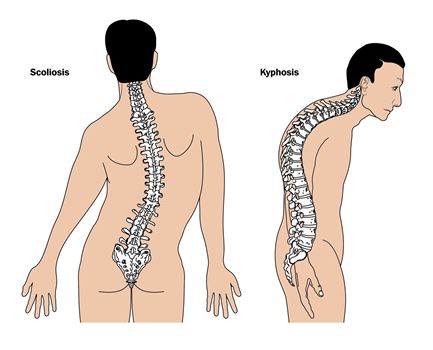
But what would that mean as regards his appearance and gait? A scoliosis is quite a common spinal deformity, although the severity varies considerably. In fact, I myself have a mild scoliosis, caused by the spine’s natural compensation for a leg length discrepancy. It is so mild that it is barely noticeable, even without clothes (unless you’re an osteopath!)
Scoliosis can also be present at birth (congenital). Many people who have this degree of scoliosis are probably oblivious to it and it wouldn’t affect their gait or appearance much at all.
However, some types of scoliosis can be much more severe, impinging on the symmetry of the ribcage and even interfering with breathing. This type occurs more commonly in females and often begins in puberty when the body is going through a rapid growth spurt, but the complete cause is unknown. Richard appears to have had this type of scoliosis.
What would he have looked like? Because the curve in the spine was quite severe, it is likely that Richard would have held one shoulder higher than the other and one shoulder blade would be more prominent. One hip may also have been slightly higher than the other. His ribcage would also have been more prominent on one side than the other, but when clothed this would not have been obvious. This would show more on forward bending, when the more prominent side would be exaggerated.
Contemporary or near-contemporary accounts of his appearance do not mention a spinal deformity, although some say he held one shoulder higher than the other. So, if his condition was scarcely noticeable whilst wearing clothes, how did it become known to the ‘Tudors’, who exaggerated and added to it for their own ends? I am of the opinion that it was one of two events which revealed his condition. The most obvious would be the circumstances after his death at the Battle of Bosworth when it is reported that his naked body was taken from the field, slung over a horse, in other words bent forwards which, as mentioned above, exaggerates the deformity. The other event which could have revealed his scoliosis was his coronation. In mediaeval times, the king was anointed on his back, chest and head for which his body had to be bared to a certain extent. Although not visible to public gaze because a canopy was used to shield this part of the coronation from view, he would have been seen by the important participants in the ceremony, who might possibly have passed the information on to others.
So, no, Richard was most definitely NOT a ‘hunchback’!
NB:Drawing of spine with scoliosis and kyphosis
Image credit: hfsimaging / 123RF Stock Photo


 The New Murrey and Blue blog
Leave a reply to Joanne Larner Cancel reply