I am posting this courtesy of Leigh Griffiths of the Mortimer History Society.
A papal bull is an official paper document issued by the pope or his office. The term derived from this fascinating device which was used to seal the formal bull.. The Bulla. (Latin, Bullire, to boil. A reference to the bubble like shape of the bulla.)
Such items were attached to official documents of the Catholic Church to show their legitimacy and religious loyalties.
Lead was used to solve the problem of ineffective wax seals, warping in many hot countries, where the communications were sent.
The bulla was connected to the papal bull with either a Silk or Hemp cord. Silk was traditionally used for bulls issued on happy occasions, like sanctification. Hemp cords were used on an order of excommunication. So I am guessing this one once had hemp running through the center of it considering the era in which this was made.
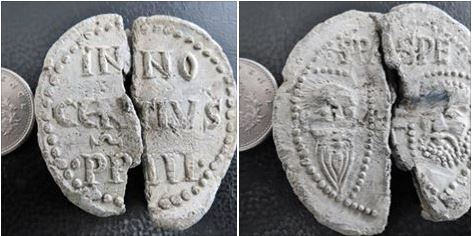
This Bulla is from Pope Innocent 3rd. One of the most influential popes of all times.. His power claimed supremacy over all the kings of Europe. He ordered a Christian Crusade against Muslims in Spain and the Holy Land. He became pope in 1198 until his death in 1216.
The Reverse features the legend SPASPE… ( SPA = St. Paul and SPE = St Peter) over the characteristic heads of Paul and Peter.
Although this bulla has been torn into two halves, both sections were found some distance apart.. The 1st section to be found is the half showing St. Paul. This section was under the earth about half a foot into the ground… I carefully searched the surrounding area for a good hour or so, hoping to locate the 2nd half. The 2nd section of the bulla lay on the surface of the ground; with a big recent scuff mark across St Peters face…St Peter had recently been brought to the surface by the plough….
This bulla was the 7th example to be found and recorded from the Diocese of Norwich.
 The New Murrey and Blue blog
Leave a reply to The Augustinian Priory of St Mary Merton and its Destruction. – murreyandblue Cancel reply