Richard II
-
It is not widely know that Richard II had a half-brother on his father’s side. This was Sir Roger of Clarendon, son of Edward of Woodstock ‘the Black Prince’ by one Edith de Willesford. Roger was almost certainly older than Richard II. In 1372 he received an annuity from Edward III of £100. He was…
-
TREASON 3 – The Long Parliament 1649
Algernon Sidney, anarchy, Bishops, Carisbroke castle, Catholicism, Charles I, Charles II, Church of England, Commonwealth, constitutional monarchy, Cornet George Joyce, dethronement, Edward II, Elizabeth I, executions, Henry VI, Holmby House, House of Commons, House of Lords, Interregnum, James VI/I, James VII/II, John, John Bradshaw, John Cooke, Juxton, Laud, lex talionis, Lockyer, London, Long Parliament, Lords Appellant, Magna Carta, Mary II, Mass, Merciless Parliament, Naseby, Netherlands, New Model Army, Newcastle, Oliver Cromwell, Oxford, Parliament of Devils, Preston, Pride’s Purge, Puritans, Restoration, Richard Duke of York, Richard II, Robertson, Royal Assent, Rupert, Samuel Gardiner, Scotland, Short Parliament, siege of Colchester, Sir Charles Lucas, Sir George Lisle, Sir Orlando Bridgeman, Sir thomas Fairfax, Southwell, Spain, Strafford, treason, Treaty of Newport, Triennial Act, tyranny, Veronica Wedgwood, Whitehall, William III, WindsorIntroduction “ The scaffold was hung round with black, and the floor covered with black, and the axe and block (were) laid in the middle of the scaffold. There were divers companies of Foot and Horse on every side of the scaffold, and the multitude of people that came to be spectators were very great.”[1]…
-
Once again, while rooting around for information that might be of use in a book I intend to write about figures in the court of Richard II, I have found an interesting snippet. This time my thoughts are jolted with regard to the name of Richard III’s horse, White Surrey. I have never particularly liked…
-
Here is a writer’s dilemma, concerning an incident from the reign of Richard II. So, not our Richard, but the one before him. At Christmas 1389, which the court celebrated at Woodstock, there was a tournament. Or at least, jousting. One of those taking part was 17-year-old John Hastings, 3rd Earl of Pembroke. He was…
-
I came across a conversation recently where people were regretting the early death of the Black Prince, because apparently everything would have been much better had he lived. Unfortunately, even people interested in English history tend not to appreciate that at the end of Edward III’s reign England was 1. losing the war with France…
-
TREASON 1 – The Merciless Parliament 1388
Alexander Neville Archbishop of York, Bellamy, Bishop of Chichester, Black Death, Chrimes, Chris Givern-Wilson, Dafydd ap Gryffudd, Edward II, Edward III, executions, Frederic Maitland, Glorious Revolution, Henry de Bracton, Henry IV, Hugh le Despenser, John Blake, John Carey, John Holt, Lords Appellant, Magna Carta, Mark Ormrod, Merciless Parliament, Michael de la Pole, Nicholas Brembre, Nigel Saul, Peasants’ Revolt, Richard II, Richard of arundel, Robert de Vere Duke of Ireland, Robert Tresilian, Roger Mortimer, Sir James Berners, Sir John Beauchamp, Sir John Salisbury, Sir Simon Burley, Sir William wallace, Thomas Arundel, Thomas Mowbray Earl of Norfolk, Thomas of Warwick, Thomas of woodstock, Thomas Usk, treason, Treason Acts, William Burgh, William de la Pole, Wonderful ParliamentIntroduction Treason is a terrible crime. It denotes a betrayal so wicked as to be unforgivable. In medieval England a traitor was executed with the maximum of corporeal pain and all his goods and chattels were forfeited to the crown, thus disinheriting his heirs and successors forever. Henry de Bracton a thirteenth century English jurist,…
-
Henry IV added these words to Richard II’s legitimisation of his half-siblings in 1407, when he had four healthy sons and two daughters. So what was the Beaufort family situation in the year that their claim to the throne was disregarded? JOHN, MARQUIS OF DORSET AND SOMERSET was about 36, a married father of five.…
-
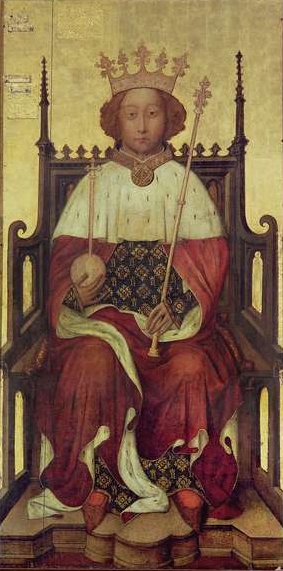
This portrait of Richard II in Westminster Abbey is familiar. What is less well-known is that it is heavily ‘restored’ over the years, most recently in 1866. In Richard II, Manhood, Youth and Politics, 1377-99, Christopher Fletcher reveals that when examined under infra-red reflectography the king’s beard was much more developed, covering much of his…
 The New Murrey and Blue blog