rebellions
-
The Inspirational Borders and Lothians
A History of Scotland, Alexander III, borders, Borders Railway, Borders towns, David Hume, Donald Bain, Douglas Haig, Dukes of Roxburghe, Earls of Lauderdale, Edinburgh, Edinburgh Castle, Edith of Scotland, Floors Castle, guns, Henry I, Holyrood Palace, Honours of Scotland, Hume statue, James II holly, James V, James VII/II, Jedburgh, Jedburgh Abbey, Kelso, Leith, Malcolm III, Mary Queen of Scots, Mary Queen of Scots’ House, Melrose, Melrose Abbey, Melrose RFC, Neil Oliver, North Bridge, Ocean Terminal, Princes Street, rebellions, Richard III, River Tweed, Ronnie Corbett, Roxburgh Castle, Royal Mile, Royal Yacht Britannia, rugby clubs, Scotland, Scott Memorial, Scott’s View, Scottish campaign 1482, siege of Roxburgh, Sir Walter Scott, Skirmish Hill, St. Giles’ Cathedral, St. Margaret of Wessex, St. Margaret’s Chapel, Thirlstane, Tweedbank Station, Waverley Station, whiskyvia The Inspirational Borders and Lothians
-
Here’s something to ponder. “….He [John of Gaunt] built the large mansion called The Savoy by the bank of the Thames in London, lost in during one of the countless rebellions against Richard [II], who, with John I and Henry III, could be termed one of the unusually stupid Plantagenets, though all three had terrible…
-
London: 2000 years of history (channel 5)
Admiralty Arch, Aldwych, Alfred the Great, ampitheatres, Anderson shelters, Anglo-Saxons, Black Death, Blitz, Boudicca, bridges, Brunel, Channel Five, Charles Booth, Charles I, cholera, City of London, Commonwealth immigration, coronations, Covent Garden, Crossrail, Dan Jones, Docklands, Edward VII, Elizabeth I, Ethelred II, Euston, expansion, glass, Golden Hind, Great Fire of London, Great War, Green Belt, Guido Fawkes, GWR, Hampstead, Harold II, Henry III, Henry IV, Henry VIII, hills, industrialisation, Jack the Ripper, Joseph Bazalgette, Kent, Lamb Street Teenager, land reclaimed, Londinium, London, Londonburgh, Londonwich, Metroland, Metropolitan Line, MI5 building, Norman stone, Normans, Northern Line, Old London Bridge, Paddington, pottery, railways, rebellions, Richard II, Richard Whittington, Rob Bell, Roman walls, Romans, Royal Ordnance factories, Samuel Pepys, Savoy, Selfridges, sewage system, shipping containers, Shoreditch, Sir Christopher Wren, Sir Francis Drake, Spanish ‘flu, Spitalfields, St. Paul’s, stone, Suffragettes, Suzannah Lipscomb, Thames, Thomas Wolsey, Tower of London, trials, Underground, Viking raids, War Office, Westminster, Westminster Abbey, Westminster Hall, White Tower, Whitechapel, Whitehall Palace, William I, William Wallace, ZeppelinsWho let Dan Jones out? At least, as in his last outing, he is accompanied both by a historian (Suzannah Lipscomb) and an engineer (Rob Bell), narrating and illustrating almost two millennia of the city’s past. In the first episode, we were taken through the walled city of “Londinium” being built and rebuilt after Boudicca’s…
-
And here we have…Harry Hotspur. The picture is from here, an interesting site about the Percy family. This is said to be a very good likeness of Hotspur, although how anyone can really know that I’m not sure. Clearly he conforms to a Percy “type”. The section dealing with the Percys under Richard III is under construction,…
-
The mystery of the Cade key….
burials, Cade Key, family vault, Greenwich Church, Hampstead, Henry Kelsey, Henry VI, Henry VIII, Jack Cade, James Wolfe, John Stow, Kent, Lavinia Fenton, mortimer claim, mysteries, National Churches Trust, Nicholas Hawksmoor, rebellions, Shakespeare, St. Alfege, The London Stone, Thomas Tallis, Victoria County History, Wars of the Roses, YorkshireThere is an interesting article by Sally Self in the Victoria County History, Gloucestershire, Newsletter 8, January 2018. I will repeat it in full, before making any comments of my own. Not to disprove anything, I hasten to say, but to show my own efforts to find out more about this key. I wish to thank…
-
Here are some of the panels just inside the door of the Colchester Playhouse, now a theatre-themed public house. They illustrate John Ball, after whom a minor town centre road is also named, becoming a priest, a prisoner at Maidstone and then participating in the 1381 Peasants’ Revolt (from 30 May), fighting at Blackheath (on 12…
-
These days, the London Stone (also called the Brutus Stone) is set into the wall of the Bank of China on the south side of Cannon Street, EC4. Well, part of it is. Just the tip. The entire Stone stood originally in Candlewick Street (Cannon Street) on the south side near the gutter, facing the door of…
-
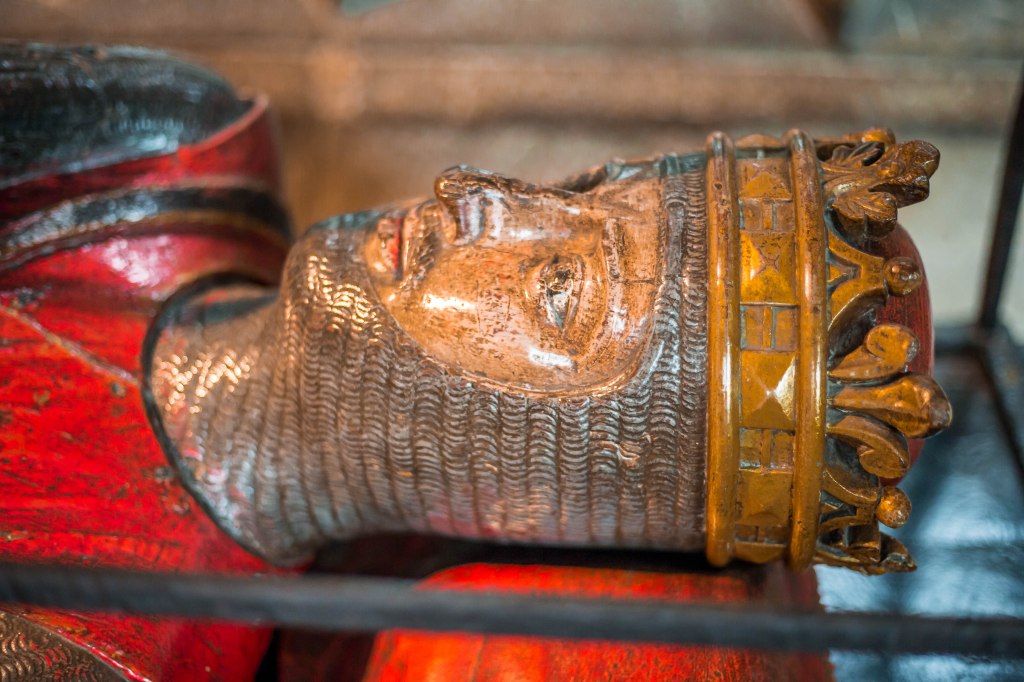
It is perhaps not a well-known fact that during World War II, many priceless historical treasures were crated up and shipped out of London for safe storage. At least, I wasn’t particularly aware of something that now makes perfect sense. I found out about this whilst visiting Gloucester Cathedral and touring the amazing crypt beneath…
 The New Murrey and Blue blog