“Perkin”
-
They are sharp and good for purposes both fair and foul, and might even be handy for some back-stabbing (should one be of that disposition!) What am I talking about? The Stanley Knife. Jokes abound on certain medieval groups about these multi purpose knives being something that should have been invented by the two side-shifting,…
-
SIR MATTHEW CRADDOCK 1468 – 1531
“Perkin”, Anne Neville, Battle of Bosworth, Berkshire, Bridgend, Caerphilly Castle, Calendar of Patent Rolls, Candelston Castle, Candleston Castle, castles, Coity Castle, Dictionary of Welsh Biography, Elizabeth of York, Fitzalan, George Duke of Clarence, Glamorgan, Gower Peninsula, Henry Cardinal Beaufort, Henry VII, Henry VIII, Herberts, Inventory of Ancient Monuments of Glamorgan, Jane Mansell, Jane Stradling, Jasper “Tudor”, Katherine Plantagenet, Kenfig Castle, Lady Catherine Gordon, Llynfi Valley, Lordship of Glamorgan, Mansels, Mary I, Matthew Craddock, Newcastle Castle, Newtons, Norman conquest, Ogmore Castle, Ogmore Triangle, Oxwich Castle, Perkins family, Reynoldston, Rhys ap Thomas, Richard III, Richard of Warwick, Robert Stillington, Sir Richard Herbert, Sir Roger Berkerolles, Somerset, St. Donat’s Castle, Stradlings, Strattigan, Swansea, Switzerland, Talbots, Turbevilles, Wales, William de Londres, William Herbert Earl of HuntingdonMatthew Craddock was the son of Richard ap Gwilliam ap Evan ap Craddock Vreichfras and Jennet Horton of Candleston Castle in Glamorgan. His great grandfather, William Horton of Tregwynt in Pembrokeshire, married Joan de Canteloupe the heiress of Candleston. Jennet Horton was their granddaughter. I first came across Matthew Craddock while looking at anything that…
-
I have often wondered about Richard’s plans for the Yorkist “heirs” he sent for safety to Sheriff Hutton. We know Elizabeth of York was there, because Henry Tudor sent a very swift party to secure her person. She was then escorted regally to London, to be greeted at Lambeth by her husband-to-be. After he’d established…
-
Elizabeth of York and the cult of Edward of Lancaster….
“Perkin”, “Princes”, “Tudor” propaganda, Anne Neville, Battle of Bosworth, Edward IV, Edward of Buckingham, Edward of Lancaster, Edward of Middleham, Edward V, Elizabeth of York, George Duke of Clarence, Henry VI, Henry VII, Henry VIII, Isabel Neville, Margaret of Anjou, Richard III, Richard of Shrewsbury, Tewkesbury, Westminster AbbeyEdward, Prince of Wales, the eighteen-year-old son of Henry VI and Margaret of Anjou, was killed in the Battle of Tewkesbury, 4th May 1471. He became the subject of an exclusive posthumous cult. The chronicle of Tewkesbury Abbey tells of the Prince’s death in battle and of his burial ‘in the mydste of the covent…
-
A SWORD OF EDWARD IV IN IRELAND
“Lambert Simnel”, “Perkin”, Bishop of Annaghtown, Calais, Dublin Castle, Earl of Desmond, Edmund of Rutland, Edward IV, George Duke of Clarence, House of York, Ireland, Ludford Bridge, rebels, Reginald’s Tower, Richard Duke of York, Richard III, Richard of Warwick, Stoke Field, Trim castle, Waterford Mint, Waterford MuseumThe House of York always had a strong connection with Ireland. Richard Duke of York and his family lived there from a while, sometimes at the imposing Trim Castle (beloved of movie makers from Excalibur to Braveheart) and sometimes at Dublin Castle where George of Clarence was born. Later, after the battle of Ludford Bridge,…
-
Squaring the Circle
“Perkin”, Arthur “Tudor”, Arthur Plantagenet, books, Catherine of Aragon, David Baldwin, Dr. John Clement, Edward IV, Edward of Warwick, Edward V, Elizabeth Wydeville, Ferdinand of Aragon, Henry VII, Henry VIII, Isabel of Castile, Jack Leslau, James “VIII/III”, James VII/II, Lady Catherine Gordon, Margaret of Salisbury, Matthew Lewis, Reginald Cardinal Pole, Richard III, Richard of Eastwell, Richard of Shrewsbury, sanctuary, The Survival of the Princes in the Tower, Thomas More, Westminster AbbeyWriting The Survival of the Princes in the Tower was an enormously enjoyable project. The book, due out in Autumn 2017, considers the evidence that one, or both, of the sons of Edward IV survived well beyond 1483, when they are traditionally considered to have been murdered by their uncle Richard III. My problem with…
-
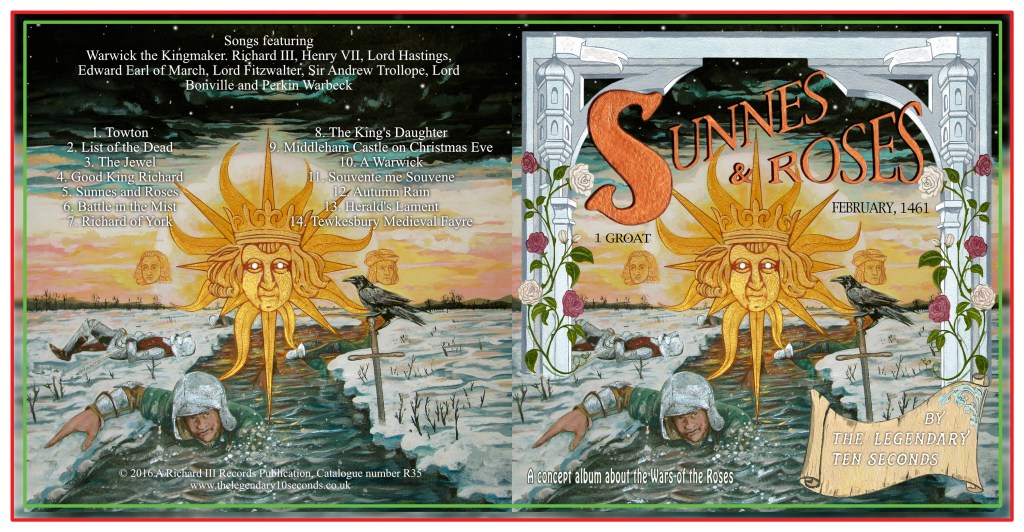
Review by Elke Paxson Sunnes And Roses – it’s finally here, the new album by The Legendary Ten Seconds. This new one focuses on the history and some of the events and people during the War of The Roses. Like the music of the 3 CDs about Richard III, this is a unique and quite…
-
SIR WILLIAM STANLEY – TURNCOAT OR LOYALIST
“Perkin”, Archbold, Battle of Bosworth, betrayal, Cheshire, crown, Edward IV, executions, Francis Viscount Lovell, Gairdner, hawthorn bush, Helen Maurer, Henry VII, Joan “Beaufort”, Lady Margaret Beaufort, Lord Chamberlain, loyalty, North Wales, Ramsay, Richard III, Richard of Shrewsbury, Robert Clifford, Sir William Stanley, Thomas Lord Stanley, Tower Hill, treasonUPDATED POST AT sparkypus.com A Medieval Potpourri https://sparkypus.com/2020/06/26/sir-william-stanley-turncoat-or-loyalist/ It is well documented how, through the treasonable and treacherous actions of Sir William Stanley at Bosworth, Richard lost his crown and his life. He was hacked to death after Stanley, who brought 3000 men with him, intervened at the crucial point when Richard, with his household…
-
… or the probable anniversary of the battle of Mortimer’s Cross: Sunnes and Roses, a new album by The Legendary Ten Seconds Released on R ichard The Third Records on 31st December 2016. Songs featuring Warwick the Kingmaker. Richard III, Henry VII, Lord Hastings, Edward Earl of March, Lord Fitzwalter, Sir Andrew Trollope,…
-
Edgar the Aetheling: Failure or Survivor?
“Perkin”, anniversaries, Battle of Hastings, Denmark, Edgar the Atheling, Edward the Exile, Edward V, exiles, Harold II, House of Wessex, Hungary, Malcolm III, Margaret of Wessex, Normandy, Normans, Norway, Richard of Shrewsbury, Scotland, St. Edward the Confessor, Stigand, Wallingford, Westminster Abbey, William I, Witangemot, youth
Originally posted on Giaconda's Blog: You could argue that Edgar was set up to fail from the start. As the last male heir of the ancient royal House of Cerdic of Wessex; Edgar had the bloodline but little else to support his claim to the English throne when his great uncle, Edward the Confessor, died…
 The New Murrey and Blue blog