Nigel Saul
-
Having just acquired Nigel Saul’s For Honour and Fame, about chivalry in England from 1066 to 1500, one of my first actions was (as always!) to go to the pages that refer to Richard III. Well, it’s second nature to any Ricardian, I think. So, on page 279, I read: “. . .A generation later…
-
We do not suffer a great many earthquakes in the United Kingdom, but there have been some, occasionally quite considerable. Our main sphere of interest on this site is the time of Richard III, and while I was investigating another earthquake, from the previous century, I happened up information about an earthquake of 1480:- “.…
-
Here is the opening paragraph of an intriguing article by the excellent Professor Nigel Saul:- “As increasing numbers of early copies of Magna Carta are identified in fourteenth- and early fifteenth century registers and cartularies, so we are becoming more aware of the close interest taken in the document by lawyers and political actors in…
-
As so often happens, acquiring a book for a specific reason leads to something else that is quite thought-provoking. In this case, the book is The Medieval Python: The Purposive and Provocative Work of Terry Jones, in which the subject of one of the eighteen contributions is Catherine of Aragon and her two marriages. Do not…
-
This post harks back to a previous one of 5th November 2014. Both concern the similarities between the lives and deaths of Richard II and Richard III, but I have now come upon a passage in a book that is actually about Richard II, but much of which could be applied to Richard III. The book…
-
The Epiphany Plot of 1400
Abbot of Westminster, anniversaries, Bristol, Charles VI, Chris Givern-Wilson, Earl of Wiltshire, Edmund Duke of York, Edward Duke of York, Epiphany Rising, Henry IV, Ian Mortimer, John Duke of Exeter, John Earl of Salisbury, Lancastrians, Lollards, Maidenhead, Marie Louise Bruce, Mortimers, Nigel Saul, Old St. Paul’s, Owain Glyn Dwr, Pleshey Castle, Richard II, Richard Maudelyn, Sir Bernard Brocas, Sir Thomas Blount, summary executions, Thomas Earl of Gloucester, Traison et Mort, Walsingham, William Feriby, Windsor CastleFollowing the deposition of Richard II, his leading supporters among the nobility were put on trial before Henry IV’s first parliament. Well, all apart from the Earl of Wiltshire who had – in plain terms – been murdered at Bristol on Henry’s orders before Henry became king. (As a Lancastrian, Henry was of course allowed…
-
TREASON 1 – The Merciless Parliament 1388
Alexander Neville Archbishop of York, Bellamy, Bishop of Chichester, Black Death, Chrimes, Chris Givern-Wilson, Dafydd ap Gryffudd, Edward II, Edward III, executions, Frederic Maitland, Glorious Revolution, Henry de Bracton, Henry IV, Hugh le Despenser, John Blake, John Carey, John Holt, Lords Appellant, Magna Carta, Mark Ormrod, Merciless Parliament, Michael de la Pole, Nicholas Brembre, Nigel Saul, Peasants’ Revolt, Richard II, Richard of arundel, Robert de Vere Duke of Ireland, Robert Tresilian, Roger Mortimer, Sir James Berners, Sir John Beauchamp, Sir John Salisbury, Sir Simon Burley, Sir William wallace, Thomas Arundel, Thomas Mowbray Earl of Norfolk, Thomas of Warwick, Thomas of woodstock, Thomas Usk, treason, Treason Acts, William Burgh, William de la Pole, Wonderful ParliamentIntroduction Treason is a terrible crime. It denotes a betrayal so wicked as to be unforgivable. In medieval England a traitor was executed with the maximum of corporeal pain and all his goods and chattels were forfeited to the crown, thus disinheriting his heirs and successors forever. Henry de Bracton a thirteenth century English jurist,…
-
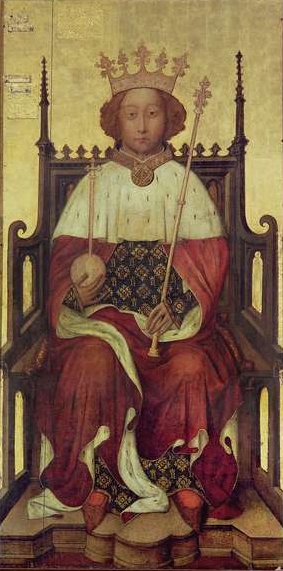
This portrait of Richard II in Westminster Abbey is familiar. What is less well-known is that it is heavily ‘restored’ over the years, most recently in 1866. In Richard II, Manhood, Youth and Politics, 1377-99, Christopher Fletcher reveals that when examined under infra-red reflectography the king’s beard was much more developed, covering much of his…
 The New Murrey and Blue blog